
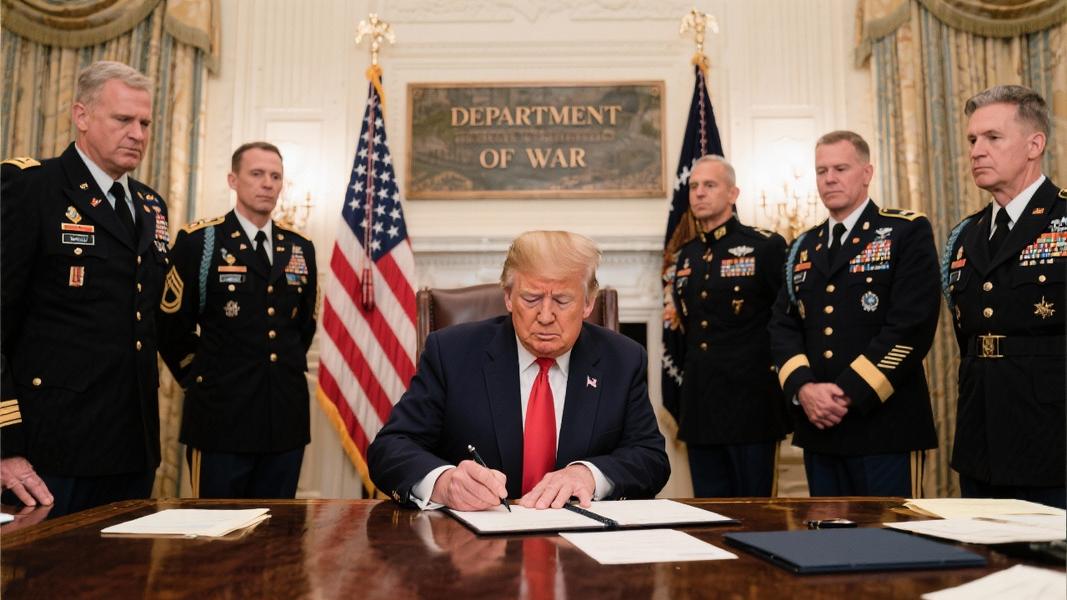
President Donald Trump signed his 200th executive order on Thursday, officially restoring the historic name “Department of War” as a secondary title for the Department of Defense — a move that signals a more aggressive military posture in his second term.
The executive order, which doesn’t fully rename the 75-year-old Department of Defense, authorizes using “Secretary of War” and other war-related titles in official documents, communications and ceremonies throughout the executive branch. It also directs the Pentagon chief to explore making the change permanent, which would require congressional approval.
Reclaiming a Name from History
“Defense is too defensive,” Trump explained when discussing the reasoning behind the change. “We want to be defensive but we want to be offensive too if we have to be.”
The Department of War was established in 1789 and led America through major conflicts including the War of 1812, World War I, and World War II before being reorganized and renamed as the Department of Defense in 1949. The White House cited George Washington’s 1790 address to Congress in justifying the move: “To be prepared for war is one of the most effective means of preserving peace.”
Secretary of Defense Pete Hegseth has already embraced the rebranding. Just hours after the order was signed, he greeted reporters with “Thank you for traveling with the War Department!” before boarding a flight to NATO headquarters — a moment that raised eyebrows among some European allies.
Power Projection and Perception
The administration’s stated goal is to project American military strength more forcefully. “Restoring the name ‘Department of War’ will sharpen the focus of this Department on our national interest and signal to adversaries America’s readiness to wage war to secure its interests,” Trump declared upon signing the order.
But what’s in a name? Quite a lot, according to defense analysts who worry the rebranding could reinforce perceptions of America as overly militaristic. The shift comes just months after a massive military parade in Washington commemorating the Army’s 250th birthday, and weeks after U.S. strikes against Iran’s nuclear facilities — both events the White House highlighted as examples of renewed American military confidence.
The timing is no coincidence. As America approaches its 250th birthday, the administration has made “restoring national pride in America’s military heritage” a cornerstone of its domestic messaging strategy.
Practical Challenges Ahead
Should Congress eventually approve a permanent name change, the costs could be staggering. Every uniform patch, building sign, letterhead, website, and official document would need updating — not to mention the diplomatic and foreign policy implications.
The executive branch can’t unilaterally rename a cabinet department established by law. That’s why Trump’s order creates a dual-naming system while directing Secretary Hegseth to “recommend actions to permanently rename the Department of Defense to the Department of War.”
Military recruitment numbers are reportedly at their highest in decades under Trump’s second term, a fact the administration connects to its more assertive military posture. Critics, however, question whether rebranding an institution tasked with national defense to emphasize war sends the right message to service members and the world.
As one Pentagon official put it, speaking on condition of anonymity because they weren’t authorized to comment publicly: “We’re still figuring out if my email signature needs to change by Monday morning.”
