
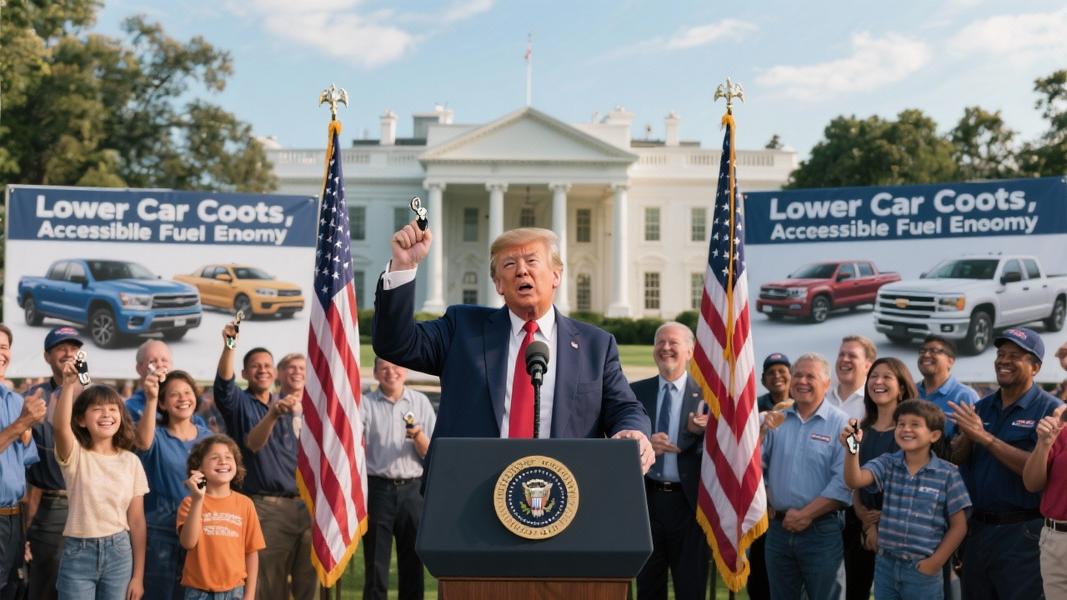
President Trump delivered on a key economic promise Tuesday, unveiling a sweeping rollback of Biden-era fuel economy standards that his administration claims will save American families billions while putting the brakes on what critics called a de facto electric vehicle mandate.
“My administration is taking historic action to lower costs for American consumers, protect American auto jobs and make buying a car much more affordable for countless American families,” Trump declared at a White House ceremony flanked by automotive industry leaders, including the CEOs of Ford and Stellantis, along with a General Motors plant manager — a show of industry support that signaled significant buy-in from America’s largest automakers.
The reset targets the Corporate Average Fuel Economy (CAFE) standards that the Biden administration had dramatically tightened, requiring automakers to produce increasingly fuel-efficient vehicles. Under Biden’s plan, efficiency requirements jumped by 8% for model years 2024-2025 and a substantial 10% for 2026 — far above the 1.5% increase Trump had implemented during his first term.
What’s at stake for consumers?
The White House claims Biden’s standards would have added nearly $1,000 to the sticker price of new vehicles. “President Trump is returning CAFE standards to levels that can actually be met with conventional gasoline and diesel vehicles,” the administration stated in its announcement. “The Biden Administration standards imposed unrealistic fuel economy targets that effectively resulted in an electric vehicle (EV) mandate.”
By resetting these requirements, the Trump administration projects savings of $109 billion for American families over the next five years. But the move represents more than just economic relief. It’s the latest in a series of actions dismantling Biden’s climate agenda, which heavily emphasized transitioning the nation’s automobile fleet toward electric vehicles.
Critics have long argued that the Biden standards overreached. “The Biden standards broke the law by going far beyond the requirements that were mandated by Congress when it created the CAFE program,” the White House stated, suggesting the previous administration had used fuel economy rules as a backdoor method to force electric vehicle adoption.
Industry alignment
The presence of automotive executives at Tuesday’s announcement underscored a surprising level of industry support. General Motors issued a statement backing the move: “GM supports the goals of NHTSA’s proposed CAFE rule and its intention to better align fuel economy standards with market realities… We have long advocated for one national standard that upholds customer choice and provides the auto industry long-term stability,” the company explained.
Automakers have struggled to navigate competing regulatory frameworks and shifting consumer preferences. While some manufacturers have invested heavily in electric vehicle technology, others have found themselves caught between ambitious government mandates and a market where many consumers remain hesitant about making the switch to electric.
Safety is another dimension the administration emphasized. The White House projects the reset will save more than 1,500 lives and prevent nearly 250,000 serious injuries through 2050 by making newer, safer vehicles more affordable. “By helping more Americans buy newer, safer vehicles, this reset is projected to save more than 1,500 lives and prevent nearly a quarter-million serious injuries through 2050,” the administration noted.
Broader regulatory rollback
Today’s announcement fits within a broader pattern of regulatory changes aimed at unwinding Biden’s climate agenda. In June, Trump signed a joint resolution ending California’s ability to set its own EV mandates. Just weeks later in July, the Working Families Tax Cuts Act effectively neutralized penalties for CAFE violations by setting them to zero dollars.
Perhaps most significantly, the Environmental Protection Agency has proposed rescinding the 2009 Endangerment Finding — the legal foundation that has enabled much of the federal government’s climate regulation over the past 15 years.
Environmental groups are likely to challenge these moves in court, setting up potential legal battles that could determine the fate of American climate policy for years to come. They argue that rolling back efficiency standards will increase emissions and leave the U.S. lagging behind global competitors in automotive technology.
For now, though, the administration is framing the reset as a win for consumers’ wallets and freedom of choice. In a country where car ownership remains essential for most families, the White House is betting that Americans will welcome relief from regulations they characterize as “costly and unlawful” — even as questions linger about the long-term implications for American automotive innovation and environmental goals.
