
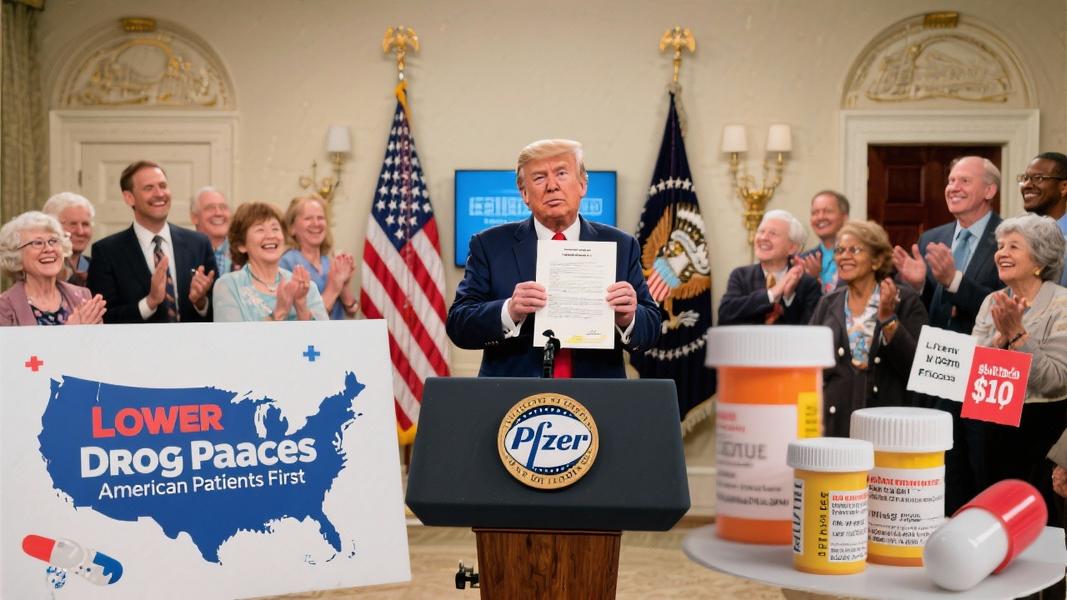
President Trump has secured the first major pharmaceutical deal to bring foreign drug prices to American soil, with Pfizer agreeing to offer “most-favored-nation” pricing across its product line — a move the administration calls a significant win in its battle against high prescription costs.
The landmark agreement, announced by the White House this week, will provide every State Medicaid program access to the lowest prices paid by other developed nations for Pfizer products. It represents the first concrete result of Trump’s May executive order targeting pharmaceutical pricing disparities between the U.S. and other countries.
Americans First: Ending “Foreign Freeloading”
Why has this become such a priority for the administration? Americans currently pay more than three times what other developed nations pay for brand-name drugs, even after accounting for manufacturer discounts. The White House states that while the U.S. represents less than 5% of the global population, American taxpayers provide roughly 75% of global pharmaceutical profits.
“In case after case, our citizens pay massively higher prices than other nations pay for the same exact pill, from the same factory, effectively subsidizing socialism abroad with skyrocketing prices at home,” President Trump said when discussing the pricing disparities. “So we would spend tremendous amounts of money in order to provide inexpensive drugs to another country. And when I say the price is different, you can see some examples where the price is beyond anything — four times, five times different.”
The agreement with Pfizer seeks to end what the administration calls “foreign freeloading” on American innovation. Under the deal, foreign nations can no longer use price controls to benefit from U.S. pharmaceutical research without paying fair prices. The arrangement guarantees most-favored-nation pricing on all new innovative medicines Pfizer brings to market.
Direct-to-Patient Discounts
Perhaps the most immediate impact for consumers comes through mandated direct-to-patient discounts. The agreement requires Pfizer to offer substantial discounts when selling directly to American patients, potentially bypassing traditional insurance and pharmacy benefit manager markups.
Several high-profile medications will see dramatic price reductions. Eucrisa, used to treat atopic dermatitis, will be available at an 80% discount to patients purchasing directly. Xeljanz, widely prescribed for rheumatoid arthritis, psoriatic arthritis, and ulcerative colitis, will come with a 40% discount. And migraine sufferers using Zavzpret will see prices cut by half when buying directly.
These discounts could significantly impact millions of Americans. Over 100 million patients are affected by conditions treated with Pfizer’s medicines across their product portfolio.
The Path to the Deal
The agreement follows months of escalating pressure from the administration. Trump signed an executive order on May 12, 2025, titled “Delivering Most-Favored-Nation Prescription Drug Pricing to American Patients,” which directed his administration to take actions bringing U.S. drug prices in line with those paid by similar nations.
By July 31, the pressure intensified. Letters were sent to leading pharmaceutical manufacturers outlining steps they must take to reduce U.S. prescription drug prices to match the lowest offered elsewhere. The administration demanded that manufacturers provide most-favored-nation pricing to every Medicaid patient and stop offering better prices to other developed nations than to American consumers.
The White House has indicated it’s leveraging trade policies to support this effort, with provisions requiring Pfizer to repatriate increased foreign revenue from existing products gained through America First trade policies.
Will other pharmaceutical giants follow Pfizer’s lead? Industry analysts suggest more deals could be forthcoming as companies weigh the potential implications of resisting the administration’s demands against the benefits of cooperative agreements.
This first agreement represents a significant shift in how prescription drugs are priced in America, though questions remain about implementation timelines and the mechanics of direct patient purchasing. For millions of Americans struggling with prescription costs, however, the promise of international price parity offers a glimmer of hope in the ongoing battle against rising healthcare expenses.
