
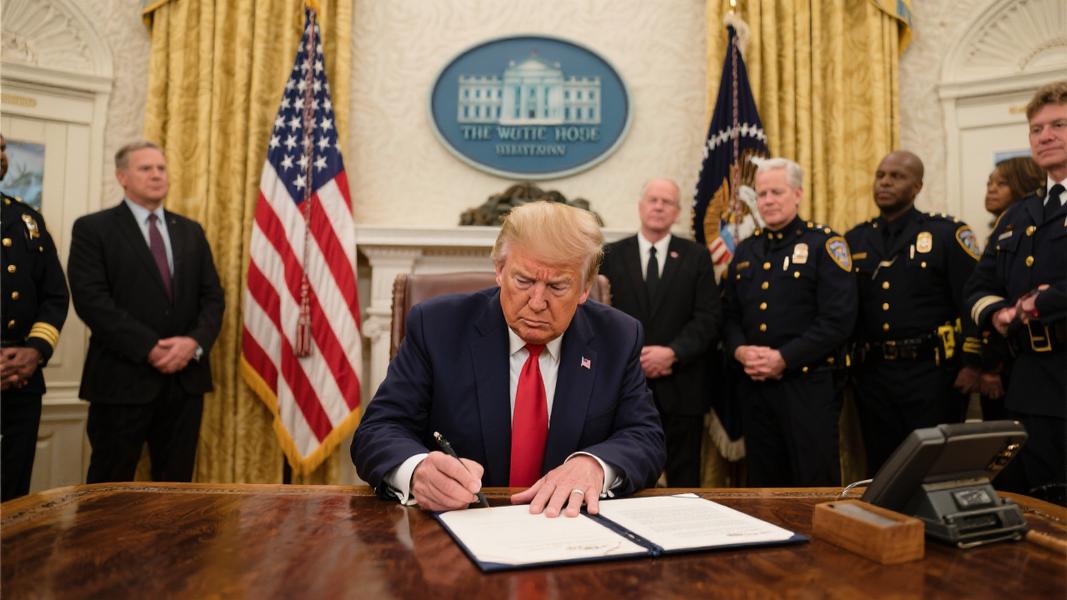
President Trump has signed a sweeping Executive Order aimed at cracking down on American flag desecration, setting up a potential collision course with decades of First Amendment jurisprudence.
The directive, signed Monday at the White House, instructs Attorney General Pam Bondi to “vigorously prosecute” individuals who desecrate the flag and to pursue litigation that might narrow First Amendment protections in this area. It also targets foreign nationals with potential deportation if they engage in flag burning on American soil.
“The American flag is the most sacred and cherished symbol of the United States of America, and desecrating it is uniquely and inherently offensive and provocative,” the order states, characterizing such acts as “a statement of contempt and hostility toward our Nation.” The directive specifically notes that flag desecration is sometimes “used by groups of foreign nationals calculated to intimidate and threaten violence against Americans.”
Pushing Legal Boundaries
The order represents Trump’s latest effort to challenge established legal precedent around flag burning, which the Supreme Court has twice ruled is protected symbolic speech. “If you burn a flag, you get one year in jail. No early exits, no nothing… And it goes on your record,” Trump declared during the signing ceremony.
Is this constitutional? That’s the question legal experts are already raising, pointing to landmark Supreme Court decisions in Texas v. Johnson (1989) and United States v. Eichman (1990) that established flag burning as protected expression.
The order appears carefully crafted to target flag desecration only when it causes “harm unrelated to expression, consistent with the First Amendment,” according to language obtained from the directive. This includes instances involving “violent crimes; hate crimes, illegal discrimination against American citizens, or other violations of Americans’ civil rights; and crimes against property and the peace.”
Trump’s team seems to be exploiting a potential loophole, as the Executive Order claims “the Supreme Court has never held that flag desecration conducted in a manner that is likely to incite imminent lawless action or serve as a form of ‘fighting words’ is constitutionally protected.”
Immigration Consequences
Perhaps the most consequential aspect of the order involves immigration enforcement. The directive instructs officials to “deny, prohibit, terminate, or revoke visas or other immigration permits and benefits” from non-citizens who desecrate the American flag, provided there’s “an appropriate determination” that such actions are permitted under existing law.
During the signing ceremony, Trump cited recent protests in Los Angeles as justification for the crackdown. “All over the world they burn the American flag. The people in this country don’t want to see our American flag burned and spit on and by people that are, in many cases, paid agitators,” he stated.
Part of Broader Patriotic Push
The flag desecration order continues Trump’s broader campaign to promote patriotic imagery and messaging. His administration has already banned the flying of any flag besides the American flag at State Department facilities worldwide and has directed the Smithsonian Institution to “accurately celebrate American exceptionalism” while removing “divisive or partisan narratives.”
The administration has also launched initiatives like the Great American State Fair and the America 250 Commission, aimed at cultivating greater national pride. Trump has ordered an audit of Smithsonian exhibits to ensure they align with what he calls a “pro-America vision,” according to White House materials.
Still, legal experts maintain that despite the Executive Order’s careful wording, flag burning remains protected free speech in most contexts. While states have their own laws regarding flag desecration, prosecutions typically focus on related offenses such as disturbing the peace or arson rather than the symbolic act itself.
As the Justice Department begins implementing the directive, the stage appears set for fresh legal battles that could eventually reach the Supreme Court — potentially testing whether the court’s conservative majority might reconsider precedents that Trump and his supporters have long found objectionable.
