
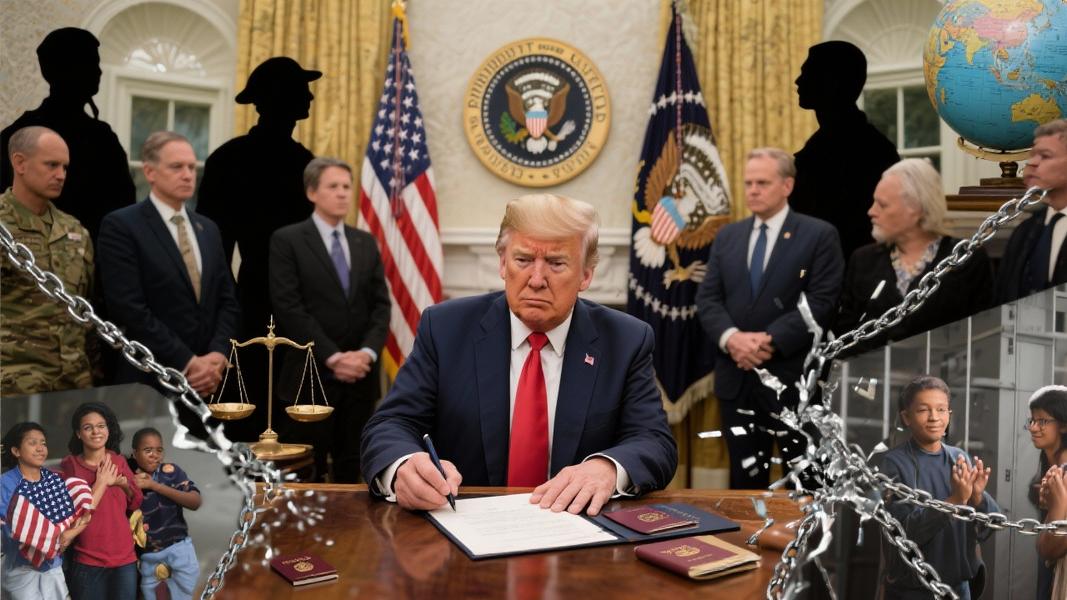
President Trump has signed a sweeping Executive Order aimed at cracking down on the wrongful detention of Americans abroad, empowering the Secretary of State with new tools to designate nations as “State Sponsors of Wrongful Detention” and impose significant penalties against them.
The order, announced today at the White House, represents one of the most aggressive policy shifts to combat what the administration describes as a growing problem of foreign governments using American citizens as bargaining chips. Under the new framework, countries designated as sponsors of wrongful detention could face sanctions, travel restrictions, export controls, and other punitive measures.
“Under the Biden Administration, our adversaries learned that they could take Americans as bargaining chips and that little to nothing would be done about it,” Trump stated in the accompanying fact sheet. The administration claims that during Biden’s term, 24 more Americans were taken captive than rescued.
New Powers Against “Hostage Diplomacy”
The Executive Order establishes specific criteria for when a country can be designated as a State Sponsor of Wrongful Detention. These include situations where a U.S. national is wrongfully detained in that country, or when a government fails to release a wrongfully detained American after being notified by the United States.
What makes this policy particularly noteworthy? It extends beyond just state actors. The order also targets non-state groups that control significant territory and engage in wrongful detentions, potentially affecting organizations in conflict zones that have previously taken Americans hostage.
“The United States must strengthen efforts to protect U.S. nationals from wrongful detention abroad,” the order declares. “The United States Government is committed to using every tool available to curb this coercive tactic used by foreign adversaries and must hold such adversaries to account.”
The Secretary of State can terminate a designation if the foreign government releases detainees, changes its policies, and provides credible assurances against future violations — creating both a stick and carrot approach to addressing the issue.
Claiming Credit for Releases
The Trump administration hasn’t been shy about touting its record on this front. The White House claims to have secured the release of 72 detained Americans abroad since returning to office.
Among those highlighted in the announcement is Marc Fogel, an American teacher who was detained in Russia for years before being returned home in February. Trump reportedly made a personal promise to Fogel’s 95-year-old mother to bring him home. Other notable returns include Ksenia Karelina, Keith Siegel, George Glezmann, Ryan Corbett, William McKenty, and Edan Alexander.
Wrongful detentions often violate basic principles of justice and exploit innocent Americans. Fogel’s case is particularly illustrative — his detention in Russia lasted over three years.
Legal Foundation
The Executive Order draws its authority from multiple sources, including the Robert Levinson Hostage Recovery and Hostage-Taking Accountability Act, named after an American who disappeared in Iran in 2007 and is presumed dead.
Critics may question whether this represents a meaningful policy shift or merely formalizes existing practices. The order explicitly states that it “does not create any right or benefit, substantive or procedural, enforceable at law or in equity by any party against the United States” — a standard disclaimer that could limit its practical impact.
Still, families of Americans currently detained abroad are likely to welcome any increased attention to their loved ones’ cases, regardless of political calculations.
As tensions continue to simmer with nations like Russia, Iran, and China — countries with histories of detaining Americans — this Executive Order signals that hostage-taking as diplomacy may now come with a steeper price tag. Whether that price will be high enough to deter future detentions remains to be seen.
