
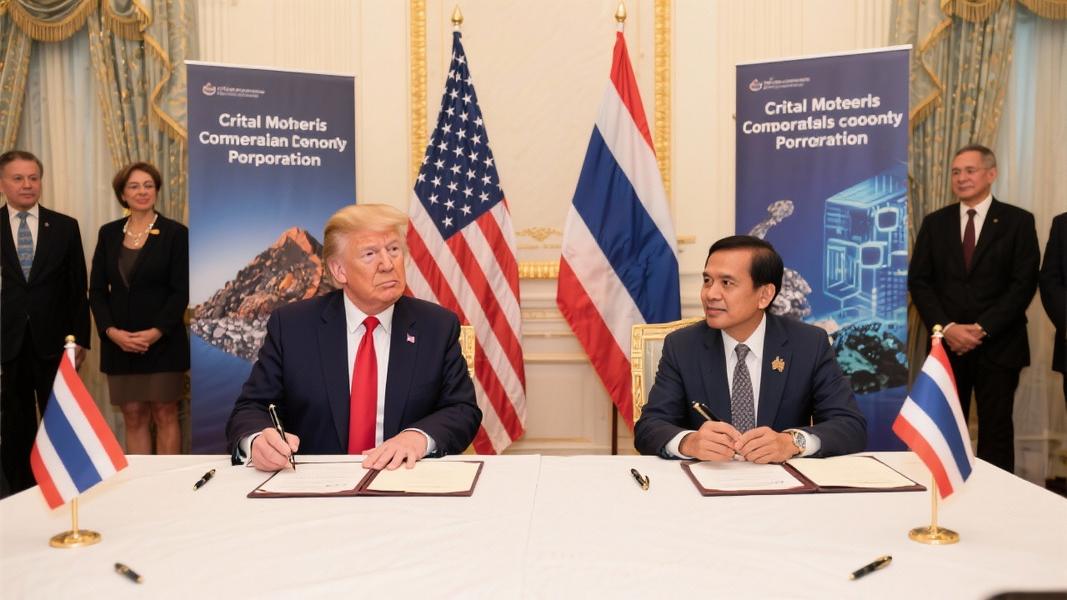
In a move aimed at securing critical mineral supply chains, President Donald Trump signed a Memorandum of Understanding with Thailand during his visit to the ASEAN summit in Kuala Lumpur, Malaysia. The agreement, finalized on October 26, 2025, establishes a framework for cooperation between the two nations on critical minerals while promoting bilateral investment opportunities.
Strategic Partnership for Critical Minerals
The MOU, signed alongside Thai Prime Minister Anutin Charnvirakul, represents a significant step in America’s efforts to diversify global supply chains for minerals essential to modern technologies. White House officials confirmed the deal was part of a broader diplomatic and economic engagement strategy at the ASEAN summit.
What’s actually in this agreement? The MOU outlines several key areas of cooperation, including streamlining permitting processes, facilitating investments, coordinating between sub-national entities, and developing review mechanisms for critical minerals sales that might raise national security concerns. The document emphasizes the importance of creating high-standard, market-oriented, and fair-trade marketplaces for these valuable resources.
Both countries have committed to strengthening governance in critical minerals sectors while promoting partnerships between U.S. and Thai companies. The agreement specifically encourages development of secure and reliable supply chains with a focus on domestic value addition rather than simple raw material exports — a priority for developing economies seeking to move up the value chain.
“Trump described the peace agreement as potentially saving millions of lives,” the Economic Times reported, referring to a related ceasefire deal between Thailand and Cambodia that was signed alongside the minerals and trade agreements.
Technical Cooperation and Implementation
The agreement calls for regular meetings — at least quarterly — where both nations will discuss potential opportunities. It also contains provisions for sharing technical expertise and coordinating on priority projects, with early notification of tenders to enable companies from both countries to participate in critical minerals opportunities.
Technology transfer appears to be a central component of the arrangement. The MOU explicitly permits investment projects to include technology transfer, capacity building, and training of domestic personnel — elements that could prove attractive to Thailand’s developing minerals sector.
Still, the agreement comes with notable limitations. It becomes operative upon signature but is subject to the availability of funds and is not legally binding under international law. Either party may discontinue cooperation with written notice, though ongoing activities prior to such notification would not be affected.
Regional Context
The signing ceremony in Kuala Lumpur included not just the minerals deal but also trade agreements and a peace treaty involving Cambodia. The White House documented President Trump’s participation in these signings with both the Thai and Cambodian prime ministers.
This flurry of diplomatic activity underscores the administration’s efforts to strengthen ties in Southeast Asia — a region where Chinese influence has grown substantially in recent decades. By focusing on critical minerals, the U.S. appears to be countering China’s dominance in rare earth elements and other resources essential to high-tech manufacturing and defense applications.
As implementation begins, the true test of this agreement will be whether it translates into concrete projects that meaningfully diversify global supply chains or simply remains another diplomatic gesture in an increasingly complex geopolitical chessboard.
