
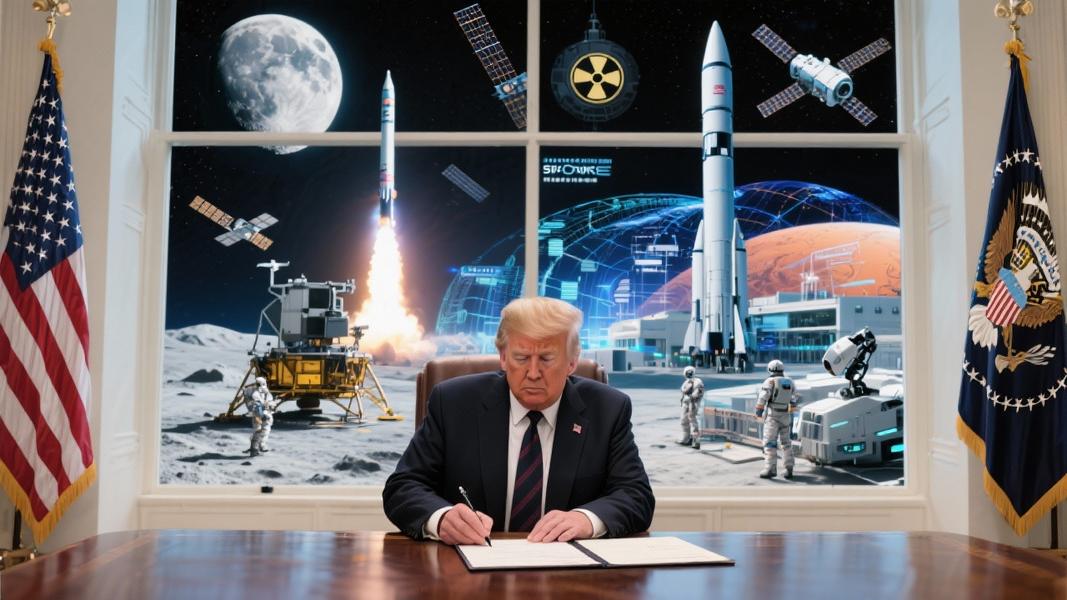
President Trump has set his sights on the stars — literally. A sweeping new executive order aims to put Americans back on the Moon by 2028 and establish the beginnings of a permanent lunar outpost by 2030, marking the most ambitious U.S. space policy directive in decades.
The far-reaching order, titled “Ensuring American Space Superiority,” outlines a comprehensive strategy to reassert American dominance in space exploration while simultaneously developing commercial opportunities and addressing security concerns in Earth’s orbit and beyond. “We will lead humanity back to the moon, and the United States will be the first nation to land an astronaut on Mars,” Trump declared in the announcement.
Nuclear Power: The Moon’s New Energy Source
Perhaps most striking among the directives is the plan to deploy nuclear reactors on the lunar surface and in orbit. The order specifically calls for a lunar surface reactor to be ready for launch by 2030, potentially solving one of the most significant challenges for sustained human presence beyond Earth — reliable power generation. Energy experts have long pointed to nuclear power as the most viable solution for lunar habitation, but this marks the first concrete timeline for deployment.
The administration’s plan doesn’t stop with the Moon. The directive also lays out a path to replace the aging International Space Station by 2030, transitioning to commercially operated platforms that would spur private sector innovation and investment. It’s a move that recognizes the ISS’s approaching end-of-life while attempting to maintain America’s foothold in low Earth orbit.
Security in the Stars
What about the militarization of space? The order doesn’t shy away from security concerns, directing federal agencies to ensure they can “detect, characterize, and counter the full range of security threats to U.S. space interests.” Within 180 days, the Assistant to the President for National Security Affairs must implement a comprehensive space security strategy covering everything from very low-Earth orbit through cislunar space.
Notably, this strategy must include a technology plan for detecting and countering “potential adversary placement of nuclear weapons in space” — language that reflects growing concerns about weaponization beyond our atmosphere.
Commercial Space Boom
This latest order builds on Executive Order 14335, signed in August 2025, which focused on “Enabling Competition in the Commercial Space Industry.” That earlier directive aimed to substantially increase commercial space launch cadence by 2030 through regulatory streamlining and infrastructure development, as noted by industry observers.
The Commerce Department has been tasked with elevating its Office of Space Commerce and creating a streamlined process for authorizing novel space activities, according to the department’s website. Law firms tracking the regulatory changes have highlighted that Commerce must propose a simplified authorization process under Article VI of the Outer Space Treaty.
Why this push toward commercialization? The administration contends that growing a robust space economy will create high-paying aerospace manufacturing jobs across America. Beyond employment, the White House fact sheet claims next-generation space capabilities will improve everything from navigation services to weather forecasts and global broadband access.
From Memory Foam to Heart Pumps
Remember those NASA spinoff technologies we all benefit from? The administration is banking on a new wave of innovation with practical applications. Memory foam, scratch-resistant lenses, cordless power tools, and heart pumps all trace their roots to previous space program developments, and the White House suggests similar technological spillover will result from this renewed push.
The order assigns the Assistant to the President for Science and Technology responsibility for coordinating National Space Policy efforts across federal departments and agencies, creating a single point of leadership for these ambitious goals.
But can all this actually happen by 2030? That’s the multi-billion-dollar question. The timelines outlined in the order are aggressive by any measure, especially considering the technical challenges of establishing even a rudimentary lunar outpost. Previous administrations have announced similarly bold space initiatives that later faced budget constraints, technical setbacks, or changing priorities.
Still, with renewed interest in lunar exploration from multiple countries and growing private sector capabilities, the landscape for space achievement has changed dramatically since the Apollo era. Whether America plants its flag on the lunar surface again by 2028 remains to be seen, but the vision has been clearly articulated — and the clock is now ticking.
