
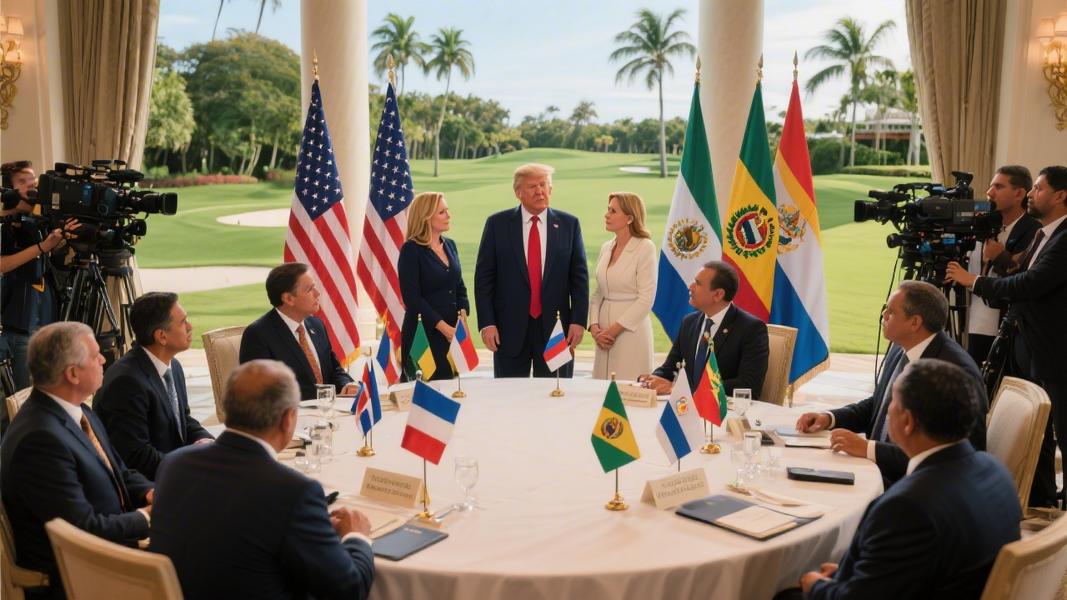
President Trump turned his Doral golf resort into a geopolitical stage Saturday, hosting a dozen Latin American leaders for what the White House is billing as a historic security summit — and announcing a sweeping new Western Hemisphere initiative called the Shield of the Americas.
The summit, held at Trump’s Mar-a-Lago-adjacent resort near Miami, is the centerpiece of a foreign policy push aimed at cementing U.S. dominance in the Western Hemisphere. The agenda is blunt: crush cartels, choke off drug trafficking, expel foreign interference — particularly from China and Russia — and halt illegal migration at its source. Twelve nations sent their leaders. Several major ones did not. And in a twist that’s become something of a Trump administration signature, a cabinet secretary got a new job title on the way in the door.
A Coalition of the Willing — and the Notable Absences
The nations represented at Doral read like a selective map of the hemisphere. Argentina, Bolivia, Chile, Costa Rica, the Dominican Republic, Ecuador, El Salvador, Guyana, Honduras, Panama, Paraguay, and Trinidad and Tobago all sent heads of state or government, according to information reported by LiveNOW from FOX. That’s a respectable turnout — but the missing names are hard to ignore.
Brazil, Mexico, and Colombia — three of the most consequential countries in Latin America, each with deep ties to the drug trade, migration flows, and U.S. foreign policy — were not at the table. Neither was Cuba. Whether those absences reflect diplomatic snubs, scheduling conflicts, or deliberate exclusions wasn’t immediately clear. But it raises an obvious question: can a Western Hemisphere security coalition really work without the hemisphere’s heaviest hitters?
Trump didn’t appear to be dwelling on that irony. In remarks tied to the summit, he framed the gathering in sweeping terms. “The United States will welcome our strongest likeminded allies in our hemisphere to promote freedom, security, and prosperity in our region,” he stated. “This historic coalition of nations will work together to advance strategies that stop foreign interference in our hemisphere, criminal and narco-terrorist gangs and cartels, and illegal and mass immigration.”
Noem Gets a New Assignment
Then there’s the Kristi Noem situation. The former Homeland Security Secretary arrived at Doral not as a cabinet member but as the first-ever Special Envoy for the Shield of the Americas — a role Trump announced just days before the summit, alongside the news that Senator Markwayne Mullin of Oklahoma would be nominated to replace her at DHS.
Trump’s announcement was characteristically effusive. “The current Secretary, Kristi Noem, who has served us well, and has had numerous and spectacular results (especially on the Border!), will be moving to be Special Envoy for The Shield of the Americas,” he wrote, framing the reassignment as a promotion rather than a departure. Whether Noem sees it that way — well, she’s playing along. She attended the summit and told reporters that Trump would announce “a big agreement” detailing “how we’re going to go after cartels and drug trafficking in the entire Western Hemisphere.”
Noem also took the opportunity to run through her DHS scorecard before walking out the door: “We delivered the MOST secure border in American history, 3 million illegal aliens have left the U.S., we have located 145,000 children, FEMA delivered disaster relief at a 100% faster rate, we ushered in the golden age of travel, saved the American taxpayer $13 billion and revitalized the U.S. Coast Guard.” That’s a lot of accomplishments to pack into a farewell statement — though it’s worth noting that several of those figures remain contested by independent analysts.
The Bigger Picture
The Shield of the Americas isn’t being rolled out in a vacuum. It’s arriving two months after Trump ordered a U.S. military operation to capture Venezuelan President Nicolás Maduro, who was subsequently extradited to face federal drug conspiracy charges — a move that rattled governments across the region and made clear that the administration’s “America First” posture in the hemisphere comes with real teeth, not just rhetoric.
The initiative is designed to leverage U.S. military and intelligence assets across the region, though the specific architecture of that arrangement is still being outlined. Saturday’s summit was meant to put flesh on those bones — and give participating leaders a chance to align publicly with Washington before the details get complicated.
Still, Saturday wasn’t only about diplomacy. Trump was expected to leave the summit to attend a dignified transfer ceremony for six U.S. troops killed in a drone strike following joint U.S. and Israeli military operations against Iran — a somber reminder that even the most choreographed foreign policy moments don’t happen in isolation from the rest of the world.
What Comes Next
That’s the catch, isn’t it? Summits produce communiqués. Communiqués produce commitments. Commitments, in this part of the world, have a complicated history of actually being kept. The Shield of the Americas may be a genuine strategic pivot — or it may be a well-branded framework that looks more impressive on a resort stage than it does in the jungles of Darién or the ports of Cartagena.
What’s undeniable is that Trump is making a deliberate, high-profile play to reshape the U.S. relationship with Latin America on his own terms — with the allies he’s chosen, on a timeline he controls, announced at a property he owns. Whether the hemisphere’s most powerful absent nations eventually come to the table, or whether they watch from a distance and wait him out, will likely determine whether the Shield of the Americas becomes a lasting security architecture — or just another chapter in a very long history of American ambitions south of the border.
