
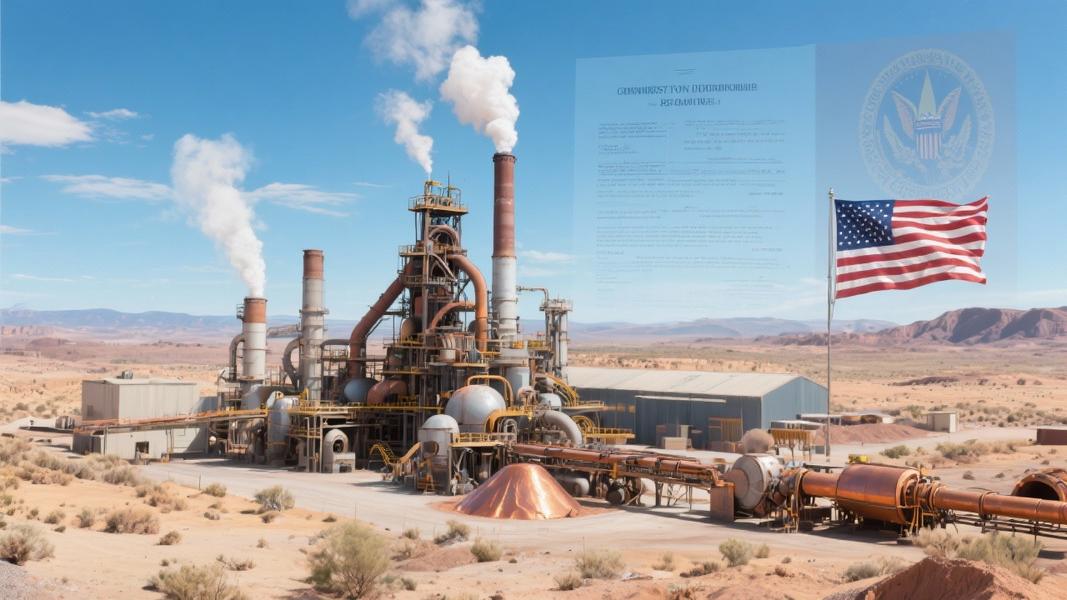
Copper, a metal most Americans rarely think about, has quietly become a flashpoint in the Trump administration’s push for national security and economic dominance. The administration has declared the reddish-brown metal “essential” to America’s future, setting off a cascade of policy actions that could reshape global trade relationships.
President Trump has implemented a sweeping 50% tariff on imported copper products, citing national security concerns and the need to revitalize domestic production. The move comes after a Commerce Department investigation concluded that reliance on foreign copper threatens critical infrastructure, defense capabilities, and manufacturing sectors.
“Copper is essential to America’s energy, defense, and manufacturing sectors. From the electric grid to semiconductors, copper plays a critical role in supporting our modern economy,” the White House stated in its recent policy directive.
The National Security Connection
Why copper? The metal’s unique properties make it irreplaceable in many applications, from electrical wiring to advanced weaponry. According to a recent Commerce Department assessment, “The Secretary found that the present quantities of copper imports and the circumstances of global excess capacity for producing copper are weakening our economy, resulting in the persistent threat of further closures of domestic copper production facilities and the shrinking of our ability to meet national security production requirements.”
The Pentagon has particular concerns. Copper is “the Department of Defense’s second-most used material,” according to industry reports. The metal’s conductivity, corrosion resistance, and durability make it crucial for everything from ammunition to communications equipment.
But America’s copper industry has been struggling for decades. Cheaper foreign imports, particularly from Chile and Peru, have undercut domestic producers. Many smelting operations have shuttered, leaving the U.S. increasingly dependent on overseas suppliers.
The 50% Solution
The administration’s response has been forceful. “Based on the Commerce Department’s findings, President Trump determined that a 50% tariff must be applied to all imports of semi-finished copper products and intensive copper derivative products,” according to trade policy documents.
To prevent circumvention of these protections, the administration has established a mechanism to identify and impose tariffs on copper derivatives. “To ensure that the tariffs on copper in this proclamation are not circumvented and that the purpose of this action to address the threat to impair the national security of the United States posed by imports of copper is not undermined,” the administration explained, “I also deem it necessary and appropriate to set up a process to identify and impose tariffs on certain derivatives of copper.”
The Commerce Department must monitor the situation closely, with a comprehensive update on domestic copper markets required by June 30, 2026.
Mining America’s Future
Is imposing tariffs enough? The administration doesn’t think so. It’s also moving to expand domestic copper production through new mining projects.
A prime example is the controversial Ambler Road Project in Alaska, which Trump recently approved after overturning a Biden-era ban. “This is not just a figurative, but a literal gold mine. There’s gold. There’s silver. There’s cobalt. There’s lead. There’s copper. This is one of the richest copper concentrations in the entire world,” the president declared at the approval ceremony.
Environmental groups have criticized the project, citing potential damage to pristine wilderness and indigenous communities. But administration officials counter that domestic mining reduces reliance on foreign sources that might have lower environmental standards.
The administration has also provided regulatory relief for domestic copper smelters, aiming to keep existing facilities operational while encouraging new investments.
Global Ripples
The copper tariffs are already sending shockwaves through international markets. Major copper exporters like Chile and Peru have expressed concern, while manufacturing industries that rely on copper inputs warn of higher costs potentially being passed to consumers.
Trade analysts note that the tariffs could complicate ongoing trade negotiations with several countries. Some fear retaliatory measures targeting U.S. exports.
Still, supporters of the administration’s approach argue that short-term economic disruption is worth the long-term benefit of a revitalized domestic copper industry. They point to national security considerations that transcend purely economic calculations.
As the tariffs take effect and new mining projects move forward, one thing is clear: a metal that most Americans encounter daily but rarely think about has become central to the administration’s vision of economic security in an increasingly uncertain world.
