
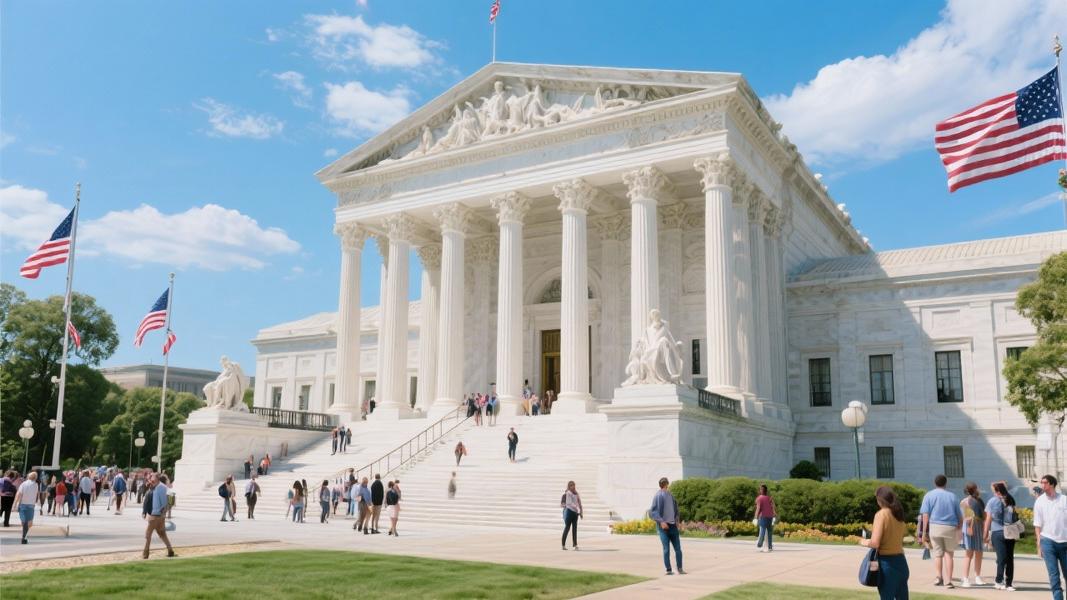
President Trump has issued an executive order that could dramatically reshape the appearance of federal buildings across the nation, establishing classical architecture as the government’s preferred style and setting up new hurdles for modern designs.
The sweeping directive, titled “Making Federal Architecture Beautiful Again,” mandates that classical architectural styles should be the default choice for new federal buildings, particularly in Washington, D.C. The order represents a significant shift in federal design policy, effectively reinstating stylistic guidelines that President Biden had rescinded in 2021 and reigniting a long-simmering debate about what American civic architecture should look like.
A Return to Classical Traditions
At its core, the executive order frames classical architecture as a visual connection to America’s democratic foundations. “President George Washington and Secretary of State Thomas Jefferson consciously modeled the most important buildings in Washington, D.C., on the classical architecture of ancient Athens and Rome,” the order states, noting they sought to “remind citizens not only of their rights but also their responsibilities in maintaining and perpetuating its institutions.”
The directive specifically targets modernist and brutalist styles that gained prominence in federal buildings during the 1960s. These architectural approaches, which often featured exposed concrete and block-like forms, have long been criticized as disconnected from public taste. The order defines Brutalist architecture as a style “characterized by a massive and block-like appearance with a rigid geometric style and large-scale use of exposed poured concrete.”
Why the focus on architectural style? The administration argues that federal buildings should “uplift and beautify public spaces, inspire the human spirit, ennoble the United States, and command respect from the general public.” Classical architecture, in this view, better embodies “dignity, enterprise, vigor, and stability” than modernist alternatives.
New Hurdles for Non-Classical Designs
The order doesn’t completely ban modern architectural styles, but it creates significant procedural obstacles. For any federal building project with a budget exceeding $50 million in 2025 dollars, departures from classical design will require special approval. The General Services Administration (GSA) Administrator must notify the President at least 30 days before approving any design that “diverges from the preferred architecture,” including “Brutalist or Deconstructivist architecture or any design derived from or related to these types of architecture.”
The directive also reshapes who gets to make decisions about federal buildings. The GSA must now ensure that architects involved in reviewing or approving federal building designs have “formal training in, or substantial and significant experience with, classical or traditional architecture.” This requirement could significantly alter the pool of professionals who influence federal architecture.
Design competitions for federal buildings “should be held where appropriate,” and the order mandates that “the advice of distinguished architects practiced in classical or traditional architecture should, as a rule, be sought prior to the award of important design contracts.”
A Broader Architectural Debate
The executive order arrives just days after Justin Shubow of the National Civic Art Society appeared on CBS Sunday Morning to discuss what he called the “blight of Brutalist buildings, especially in Washington, D.C.” The timing suggests a coordinated push to change the federal approach to architectural aesthetics.
Not everyone in the architectural community is embracing these changes. The Society of Architectural Historians has expressed opposition to the order’s stylistic mandates, though the organization supports “a renewed national dialogue around architectural excellence” that advances civic architecture that is “enduring, innovative, and democratic in both process and expression.”
The directive represents a sharp critique of the GSA’s 1994 Design Excellence Program, which was established in response to public criticism of federal buildings. According to the executive order, while the program intended to provide “visual testimony to the dignity, enterprise, vigor, and stability of the American Government,” it has “unfortunately” failed to meet this goal, instead favoring designs that don’t connect with the public.
How will this play out in practice? The order creates a mechanism for presidential review of architectural decisions that previously would have been handled within the GSA. This centralization of aesthetic judgment represents a significant shift in how federal architecture is approved.
Historical Context
The battle over federal architectural style isn’t new. Since the 1960s, when modernist and brutalist styles began replacing traditional designs in government buildings, there’s been tension between architectural professionals and public opinion. Many of these buildings were “unpopular with Americans” and ranged “from the undistinguished to designs even GSA now admits many in the public found unappealing,” according to the executive order.
The Trump administration’s move essentially argues that the architectural establishment has drifted too far from public preferences, particularly when it comes to buildings that represent American democracy and civic values. By emphasizing that federal buildings should “respect regional architectural heritage” and be “visibly identifiable as civic buildings,” the order suggests a more populist approach to architectural decision-making.
Yet critics might view this as an unnecessary government intervention in creative expression and professional judgment. The pendulum of architectural taste has swung before, and some might argue that mandating classical styles from the top down runs counter to the innovation and evolution that characterizes American culture.
For now, the marble columns and symmetrical facades of classical architecture have gained a powerful advocate in the federal government. Whether this represents a lasting shift or another chapter in America’s ongoing architectural identity crisis remains to be seen.
