
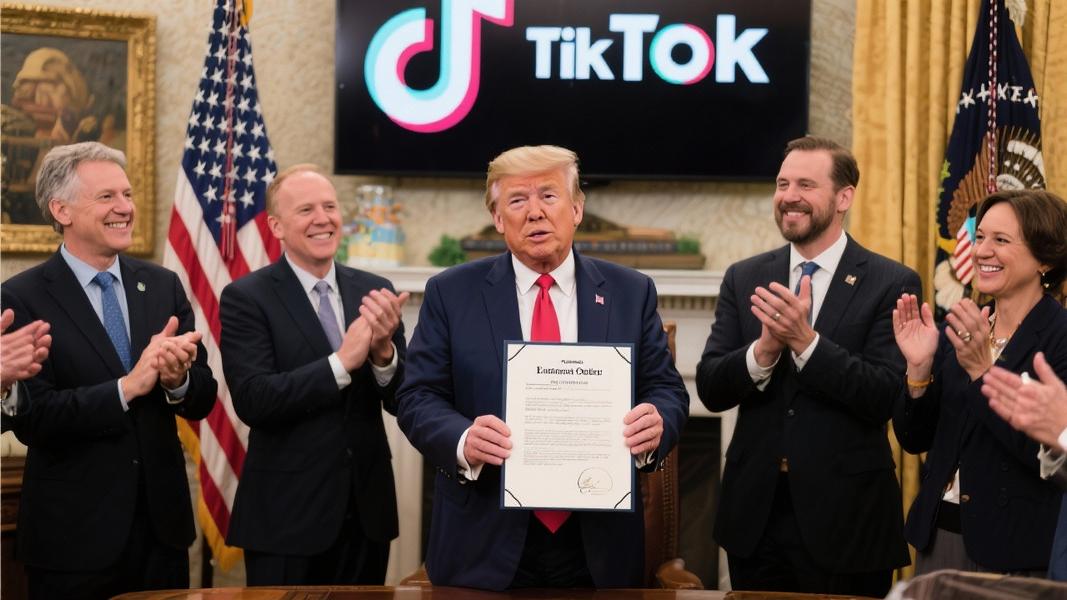
President Trump has saved TikTok from a nationwide ban through an Executive Order that dramatically reshapes the popular social media platform’s ownership structure in the U.S., requiring majority American control while addressing longstanding national security concerns.
The order, signed today, establishes a framework that forces ByteDance, TikTok’s Chinese parent company, to reduce its ownership stake to less than 20% in a new U.S.-based joint venture. This restructuring aims to protect the data of 170 million American users while preserving a platform that has become integral to content creators and businesses across the country.
A New Security-Focused Structure
Under the divestiture plan, ByteDance’s influence will be severely curtailed. The company will be limited to selecting just one director on a seven-seat board and will be entirely excluded from the joint venture’s security committee. Meanwhile, Oracle — one of America’s leading tech companies — will serve as TikTok’s security provider, independently monitoring operations within the United States.
“Today, President Donald J. Trump signed an Executive Order saving TikTok from a ban while protecting America’s national security,” the White House stated in announcing the decision.
Perhaps most significantly, the new structure places TikTok’s algorithm, code, and content moderation decisions — elements that have sparked intense concern among lawmakers — under U.S. control. All user data will be stored in a “trusted, secure, and purpose-built cloud environment” operated by Oracle within the United States.
Breathing Room for Implementation
What about the TikTok ban that was set to take effect? The Executive Order provides a 120-day grace period, directing the Attorney General to delay enforcement of the Protecting Americans from Foreign Adversary Controlled Applications Act while the divestiture is completed. This temporary reprieve gives ByteDance and U.S. investors time to finalize the complex ownership transition.
The decision represents a significant shift from the outright ban that many had expected. Instead, the White House has opted for a solution that aims to address security concerns while preserving a platform that has become economically vital to many Americans.
Economic Impact
The stakes couldn’t be higher for American businesses and content creators who have built their livelihoods on the platform. According to White House figures, preserving TikTok’s U.S. operations will generate approximately $178 billion in economic activity over the next four years and support thousands of jobs.
“American content creators rely on TikTok for their livelihood, using it to build audiences, share their talents, and generate income in an increasingly digital economy,” the White House explained. “Similarly, American businesses—large and small alike—depend on TikTok’s vast reach for advertising, connecting with customers, and driving economic growth.”
The platform has become particularly important for small businesses and independent creators who have found TikTok’s algorithm more accessible than other social networks for building audiences from scratch.
Part of a Broader Strategy
Is this just about a single app? Not according to the White House, which framed the decision within Trump’s broader foreign policy and national security achievements. The announcement highlighted other accomplishments, including the Abraham Accords, replacing NAFTA with USMCA, the Phase One China Trade Deal, and securing the release of 72 detained Americans.
The White House also pointed to recent diplomatic victories, such as pressuring Panama to exit China’s Belt and Road Initiative, which it characterized as a “debt-trap diplomacy scheme” used by the Chinese Communist Party to gain influence over developing nations.
Trump himself has expressed optimism about the solution. “And if we can save it, I think that would be a very good thing. And I think it would be economically good for America,” he remarked about the platform’s future.
For TikTok’s millions of American users, the Executive Order means they can continue scrolling through their feeds — at least for now. But behind the dance videos and viral challenges, a complex restructuring of one of the world’s most popular apps is about to unfold, testing whether national security concerns and social media entertainment can truly coexist in today’s geopolitical landscape.
