
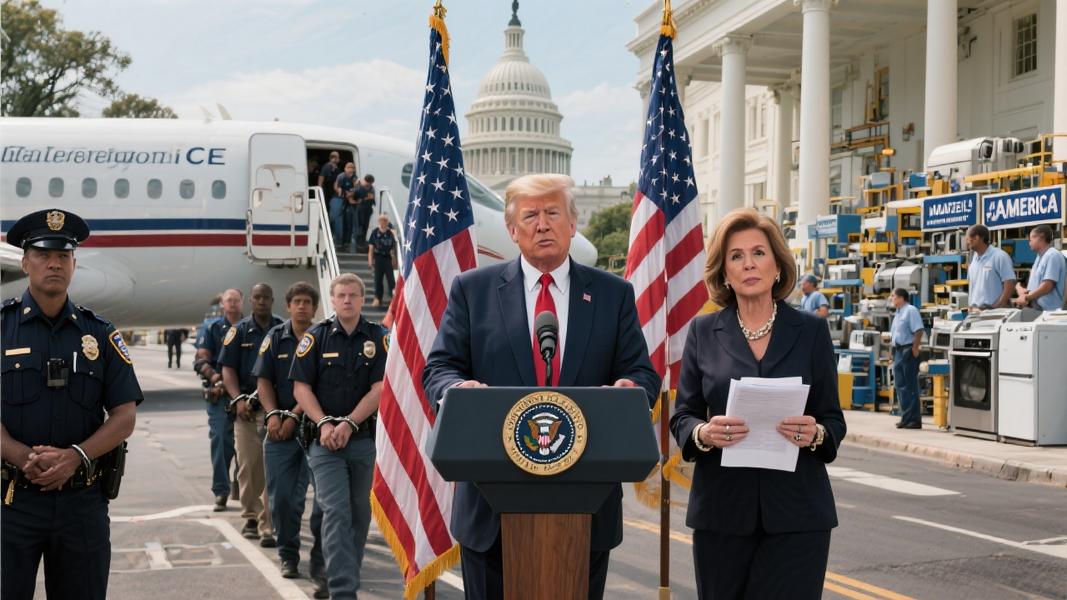
The Trump administration has ramped up deportation efforts to unprecedented levels, targeting the removal of up to 1 million immigrants annually — more than triple the previous typical rate of 300,000 before the pandemic.
Since President Trump’s return to office, his administration has wasted no time implementing aggressive immigration enforcement policies, with Immigration and Customs Enforcement (ICE) reporting the arrest of 66,463 undocumented immigrants and the removal of 65,682 within just the first 100 days. “During President Trump’s first 100 days, ICE alone has arrested over 65,000 illegal aliens — including 2,288 gang members from Tren de Aragua, MS-13, 18th Street and other gangs,” ICE announced in a recent press release, adding that “1,329 were accused or convicted of sex offenses, and 498 were accused or convicted of murder.”
Deportation Flights Surge
The scale of the operation is striking. “As President Donald Trump moves to remove as many as 1 million immigrants a year from the US, putting more detainees on more airplanes, and with more frequency, has become a key feature of carrying out that endeavor,” according to White House communications. Since Trump’s inauguration, deportation flights have increased by 15% compared to the same period last year, with more than 1,000 flights already completed.
What’s the real impact of this massive deportation program? Economic analysts have raised serious concerns. A report from the Economic Policy Institute warns that “the deportation rate could reach 1 million people per year, totaling 4 million deportations over four years,” potentially causing substantial job losses affecting both immigrant and U.S.-born workers, particularly in sectors like construction and childcare.
Manufacturing Reshoring Push
Meanwhile, the administration’s trade policies appear to be yielding results in domestic manufacturing. GE Appliances recently unveiled plans for a $3 billion investment to expand and modernize its U.S. factories over the next five years, bringing approximately 1,000 jobs back to American soil across plants in five states.
“I think it’s become obvious with tariffs that building in the U.S. is a good thing right now,” Kevin Nolan, GE Appliances’ chief executive, stated in the company’s announcement, acknowledging that trade considerations influenced the decision to upgrade aging facilities rather than continuing to rely on manufacturing in China and Mexico.
This trend extends beyond appliances. “The Trump administration’s aggressive trade stance is propelling other industries to increase investment in U.S. production,” the Wall Street Journal reported. Taiwan Semiconductor Manufacturing has accelerated its U.S. expansion plans, and pharmaceutical companies are increasing domestic production capabilities in response to potential tariffs on imported medicines.
Crackdown on Crime
The administration is also taking a harder line on crime, particularly in Washington D.C. U.S. Attorney Jeanine Pirro has outlined an aggressive approach to prosecuting juvenile offenders.
“My job is to prosecute crime and ensure that people who live in and visit our nation’s capital are safe,” Pirro wrote in a Washington Post opinion piece. In a significant departure from previous policies, she added, “We are going to push to change the laws so that if you commit any violent crime, I have jurisdiction to prosecute you where you belong — in adult court.”
The tough stance reflects broader administration priorities on law enforcement. “Unfortunately, young criminals have been emboldened to think they can get away with committing crime in this city, and, very often, they do,” Pirro noted, emphasizing a commitment to identifying, prosecuting, and convicting those responsible.
Taken together, these initiatives paint a picture of an administration moving swiftly to implement campaign promises on immigration, trade, and crime. But critics worry about the human and economic costs of such aggressive policies, particularly regarding mass deportations that could disrupt communities and industries dependent on immigrant labor. That said, supporters point to manufacturing investments as evidence that the administration’s “America First” approach is delivering tangible economic benefits.
As these policies continue to unfold, their long-term impact on American communities, the economy, and the political landscape remains to be seen.
