
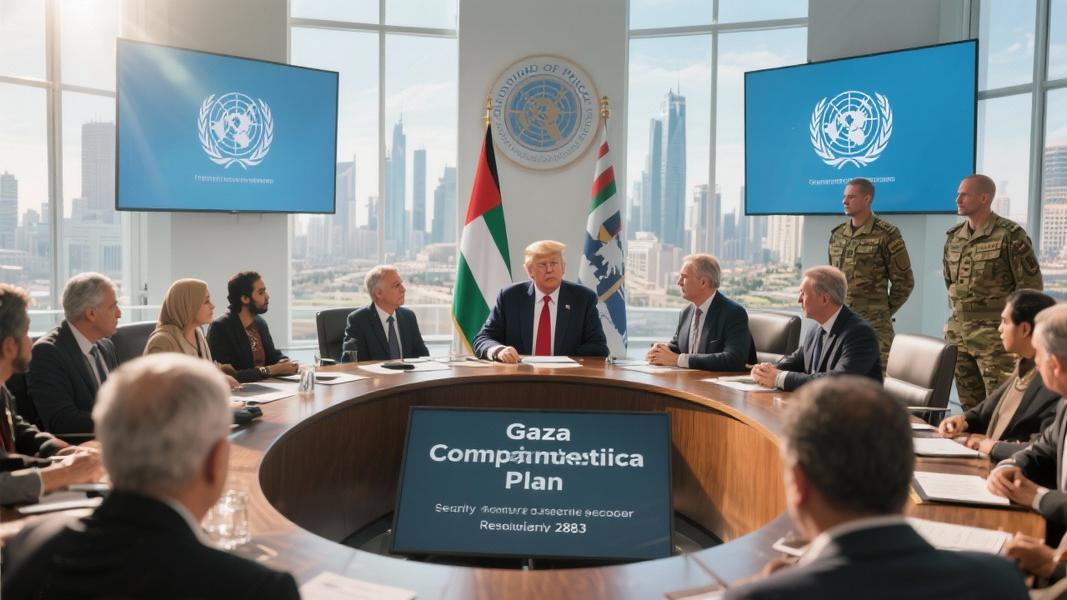
Former President Trump’s ambitious Gaza peace initiative has officially entered its second phase, with the White House announcing a comprehensive 20-point roadmap aimed at establishing lasting peace and prosperity in the war-torn region.
New Leadership Structure Takes Shape
The plan’s centerpiece includes the formation of the National Committee for the Administration of Gaza (NCAG), to be led by Dr. Ali Sha’ath, described as “a widely respected technocratic leader” tasked with restoring public services and rebuilding civil institutions. This development marks a significant shift toward what the administration calls “demilitarization, technocratic governance, and reconstruction.”
Implementation of the plan aligns with United Nations Security Council Resolution 2803 (2025), which formally endorsed Trump’s strategy and welcomed the establishment of the Board of Peace — a multi-national oversight body charged with guiding the reconstruction process.
“This milestone perfectly aligns with United Nations Security Council Resolution 2803,” the White House stated, positioning the initiative as having international legitimacy despite ongoing controversies.
Who’s Running the Show?
The Board of Peace’s Executive Board comprises seven high-profile appointees: Secretary Marco Rubio, real estate magnate Steve Witkoff, former presidential advisor Jared Kushner, former UK Prime Minister Sir Tony Blair, investment executive Marc Rowan, Ajay Banga, and Robert Gabriel. Each member will oversee specific portfolios related to Gaza’s reconstruction.
Day-to-day operations will be managed by senior advisors Aryeh Lightstone and Josh Gruenbaum, who have been tasked with “translating the Board’s mandate and diplomatic priorities into disciplined execution.”
On the ground, H.E. Nickolay Mladenov will serve as High Representative for Gaza, acting as the crucial link between the international Board of Peace and the local NCAG leadership. Meanwhile, Major General Jasper Jeffers has been appointed Commander of the International Stabilization Force to oversee security operations and facilitate humanitarian aid delivery.
Expanded Gaza Executive Board
A separate Gaza Executive Board with eleven members has also been established, including several crossover appointments from the main Board of Peace. This expanded group includes Turkish Foreign Minister Hakan Fidan, Ali Al-Thawadi, General Hassan Rashad, UAE Minister Reem Al-Hashimy, real estate investor Yakir Gabay, and former UN official Sigrid Kaag, creating a more regionally diverse oversight structure.
The plan represents a significant evolution from its controversial February 2025 predecessor. That earlier proposal had called for “the forced displacement of approximately two million Palestinians to neighboring lands” and would have required clearing over 50 million tonnes of debris and unexploded ordnance — elements that drew sharp criticism from humanitarian organizations.
Still, questions remain about the practical implementation of such an ambitious agenda. Can a technocratic committee effectively manage Gaza’s day-to-day operations amid deep political divisions? The presence of prominent Trump allies like Kushner on both boards has already raised eyebrows among critics concerned about potential conflicts of interest.
As Gaza enters this new phase under the watchful eyes of this multinational coalition, the success of Trump’s “roadmap for lasting peace” will ultimately depend on whether these carefully structured committees can translate diplomatic ambitions into tangible improvements for a population that has endured years of conflict and devastation.
