
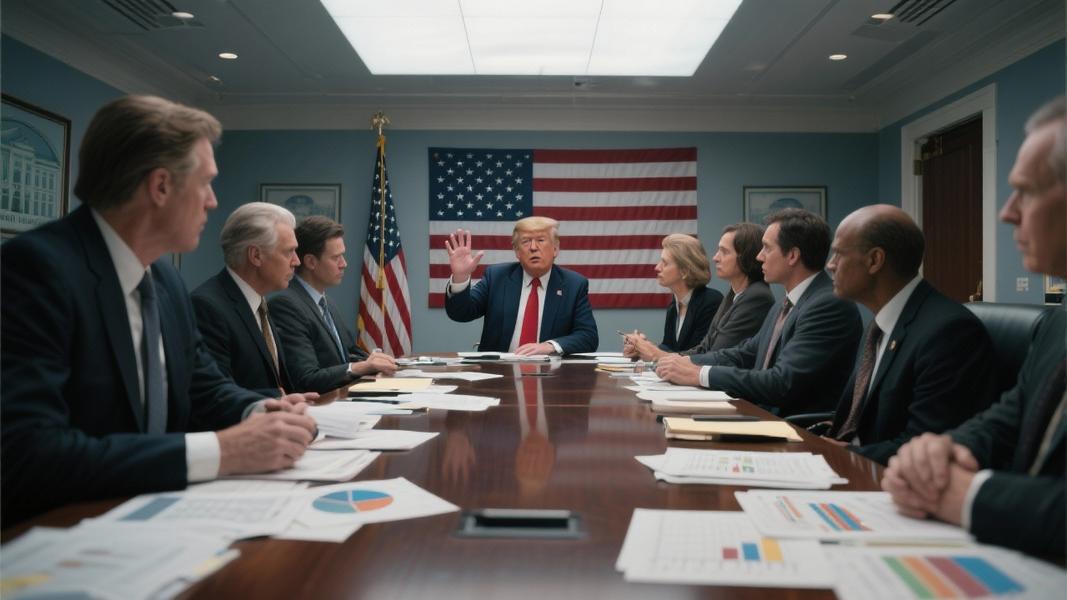
President Donald Trump has made a striking claim on the campaign trail: tariffs, he says, could eventually replace federal income taxes altogether, potentially ushering in a new era for America’s tax system.
“And I believe that at some point in the not too distant future, you won’t even have income tax to pay. Because the money we’re taking in is so great, it’s so enormous, that you’re not going to have income tax to pay,” Trump declared at a recent rally.
The former president’s vision involves implementing a 10% across-the-board tariff on imports from all trading partners, with significantly higher tariffs — potentially 60% or more — on Chinese goods. He suggests the resulting revenue would be substantial enough to fund income tax cuts and eventually eliminate income taxes entirely.
But is this economically feasible? Not even close, according to experts across the political spectrum.
The Numbers Don’t Add Up
Treasury Department data paints a stark mathematical reality: individual income taxes generated approximately $2.66 trillion in the last fiscal year. Tariffs? They brought in just $195 billion — amounting to a mere 3.7% of total U.S. revenue, according to figures from the federal government.
“It’s not possible. It’s not feasible mathematically or economically. And analysts from a range of different perspectives agree with that conclusion,” one economist explained to Intereconomics. “Even the very substantial tariffs imposed this year, which are at the highest levels in the postwar era, raise nowhere near the revenue that income tax does.”
Even under the most aggressive tariff scenarios, analysts estimate the revenue would fall dramatically short of what’s needed. The fundamental problem? As tariff rates climb higher, imports tend to decline — shrinking the very tax base the tariffs rely on.
“It is impossible for tariffs to fully replace income taxes,” a policy analyst noted. “Tariff rates would have to be implausibly high on such a small base of imports to replace the income tax, but as tax rates rise, the base itself would shrink as imports fall.”
Who Actually Pays?
A common misconception is that tariffs are paid by foreign countries. In reality, they’re paid by American importers, who typically pass these costs on to consumers through higher prices. This means American shoppers — not foreign governments — ultimately foot the bill for tariff increases.
What would a shift from income taxes to tariffs mean for average Americans? Economic experts suggest it would fundamentally alter who bears the tax burden in society.
Income taxes are progressive, with higher earners paying higher rates. Tariffs, by contrast, function more like regressive sales taxes, potentially hitting lower-income households hardest as a percentage of their income.
“Inequality is very highly skewed toward the top. We’ve got more billionaires than we’ve ever had. We’ve got more millionaires than we’ve ever had,” one tax policy expert pointed out. “So it’s a strange time to be reducing the tax burden on the top and increasing it on the middle. It’s a proposal that is very effective for fundraising for Republicans and it always has been.”
A Return to the 19th Century?
There’s historical precedent for tariff-based federal funding — but you’d need to look back well over a century to find it.
“We would be talking about living in a completely different world than the one we live in now. There was a time when the government’s finances were provided through tariffs. But I believe people were getting around with a horse and buggy back then and not cars,” a fiscal policy expert observed. “I mean, that was a completely different time.”
Beyond the revenue question, economists warn that heavy tariffs could disrupt supply chains, potentially slow economic growth, and eliminate important tax incentives built into the current system that encourage behaviors from homeownership to retirement savings.
Could tariffs play a bigger role in America’s revenue picture? Perhaps. Would they completely replace income taxes? The math suggests that’s more campaign promise than economic reality.
