
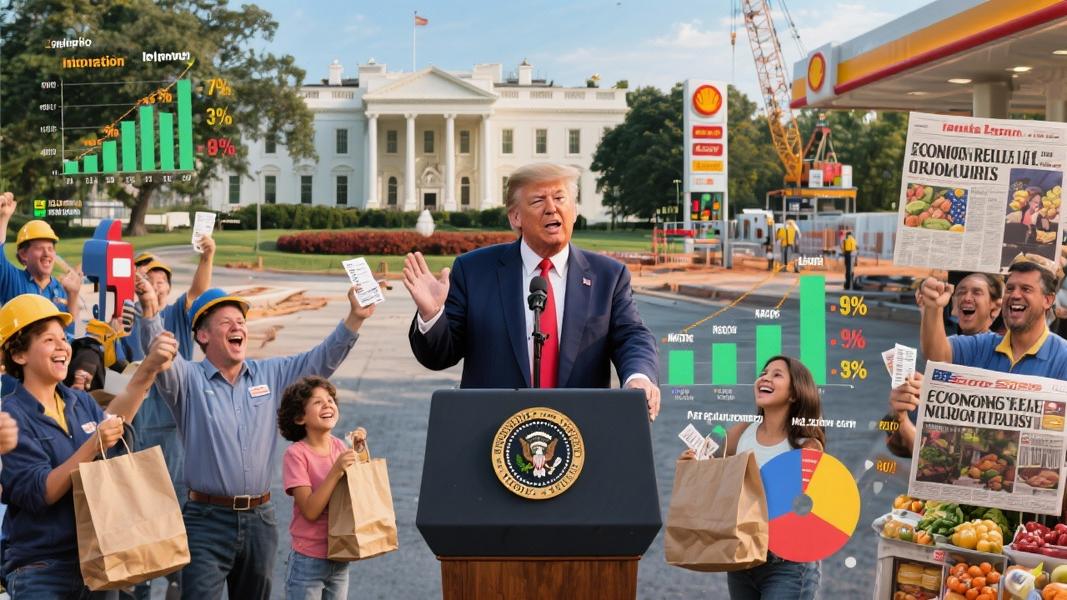
President Trump’s economic policies appear to be yielding mixed results in his second term, with inflation showing signs of moderation but remaining stubbornly above pre-pandemic levels, according to multiple economic analyses.
The White House Narrative vs. Economic Reality
The White House has trumpeted recent economic data as proof that “President Donald J. Trump’s bold economic agenda is delivering real results for American families,” claiming that “inflation has been tamed” and “everyday prices are beginning to drop.” Administration officials point to declining costs in certain grocery categories, with the Breakfast Basics Index reportedly falling 14% between March and September 2025.
“Under Biden, inflation averaged nearly 5% — hitting 9.1% during the worst inflation crisis in decades,” the administration stated, contrasting this with what they describe as Trump’s success in dropping inflation “to an average of just 2.7% — the critical first step in reversing Democrats’ cost-of-living disaster.”
But the full picture is more complicated. While inflation has indeed moderated from the peaks seen during the Biden administration, it remains elevated compared to historical norms and appears to be trending upward again.
The Numbers Tell a Nuanced Story
Independent analyses paint a more tempered view of the economic landscape. During the first nine months of Trump’s second term, inflation has averaged around 2.7% — better than Biden’s peak but still above the Federal Reserve’s 2% target.
As of September 2025, the Consumer Price Index (CPI) stood at 3.0% annually, with core CPI inflation (which excludes volatile food and energy prices) also at 3.0% over the previous 12 months, according to Treasury Department figures. The Personal Consumption Expenditures (PCE) inflation — the Fed’s preferred inflation gauge — was slightly lower at 2.7% headline and 2.9% for core inflation through August 2025.
What’s driving these numbers? The administration’s tariff policies appear to be a significant factor.
Tariffs: Economic Double-Edge
Economic experts suggest that while tariffs may be helping reduce federal deficits, they’re simultaneously putting upward pressure on prices. The Congressional Budget Office estimates that Trump’s tariffs could reduce federal deficits by $2.8 trillion over 10 years — a significant fiscal achievement — but at the cost of reducing GDP by 0.6% and increasing inflation by an annual average of 0.4 percentage points in both 2025 and 2026.
Financial analysts at PIMCO have determined that “around 40% to 50% of the tariff costs were passed onto consumers, lifting core inflation by around 0.4 to 0.5 percentage points.” This suggests that without tariff-related price pressures, inflation might be closer to the Fed’s 2% target.
Is there a silver lining? The administration points to price decreases in specific consumer categories, particularly certain grocery staples like eggs, butter, and fresh fruit. They also highlight deregulatory policies that they claim have saved Americans $180 billion, including the reversal of Biden-era efficiency standards on appliances.
Looking Ahead
Forecasts suggest inflation may continue to edge higher in the near term. Analysts predict average CPI growth could reach about 2.9% for 2025 overall and potentially accelerate to 3.2% in 2026 if current tariff policies remain in place.
Meanwhile, real GDP growth has remained relatively resilient despite these headwinds, with 2025 growth estimated between 1.5% and 2.0%.
The administration’s narrative of economic triumph faces the stubborn reality of economic data showing inflation that’s improved but not conquered. For American consumers, the experience remains mixed — some grocery items cost less, but tariffs continue to push prices higher in other sectors, creating an economic picture that defies simple characterization as either success or failure.
