
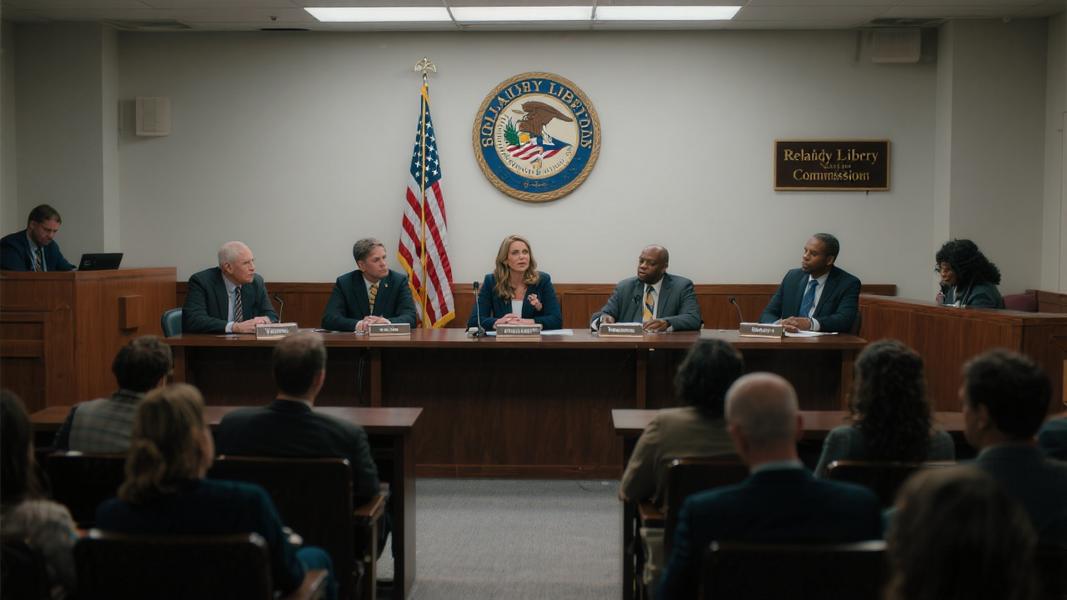
The Trump administration launched its first-ever White House Religious Liberty Commission Monday, marking what supporters call a historic step to reclaim the founders’ vision of faith in American civic life — and what critics fear could blur the line between church and state.
Held at the Museum of the Bible in Washington, D.C., the inaugural hearing brought together religious leaders, legal experts, and administration officials to begin work on a comprehensive report examining religious liberty in America. The commission, established through President Trump’s executive order signed May 1, represents one of his most significant faith-related initiatives since returning to office.
Prayer Opens Proceedings
Mary Margaret Bush, the commission’s director, officially opened the session before turning proceedings over to Texas Lieutenant Governor Dan Patrick, who serves as chairman. “Welcome to this historic first meeting of the Presidential Commission on Religious Liberty,” Patrick said before inviting Bishop Robert Barron to open with prayer.
Bishop Barron’s invocation set a tone that would echo throughout the hearing. “We thank you, Lord, for our country, which is based upon the acknowledgment that our freedoms and rights come from You,” he prayed, asking for “wisdom, the prudence, the courage, and the charity” needed to enhance religious liberty.
The choice to begin official government proceedings with prayer — while common in many contexts — immediately highlighted the commission’s view that faith belongs squarely in the public square, not merely as a private practice.
Beyond “Freedom to Worship”
Participants repeatedly emphasized that religious liberty extends beyond the right to private worship. “Where can I pray? When can I pray? Who can I pray to? Because this commission is about all faiths,” one speaker declared, pushing against what many conservatives have long viewed as attempts to confine religion to houses of worship.
Rabbi Meir Soloveichik offered perhaps the day’s most succinct articulation of the commission’s philosophical foundation. Religious freedom, he argued, “does not seek a secular civic space, it welcomes faith into society in all its multi-faceted forms. We bring our faith with us into society. For it is faith that fuels, inspires, and guides our engagement with the civic realm.”
Is this a departure from traditional interpretations of the First Amendment’s Establishment Clause? The commission doesn’t think so. Instead, members framed their work as a return to original intent, with Carrie Prejean Boller presenting specifically on “Founders on Religious Liberty” during the hearing.
The “First Freedom”
Attorney General Pam Bondi, representing the administration, characterized the commission as fulfilling Trump’s campaign promises. “President Trump’s action reaffirmed our nation’s enduring commitment to the freedoms of our founders,” Bondi stated, setting the stage for other speakers who frequently invoked the founders’ intent.
Several commission members described religious liberty as America’s “first freedom” — both chronologically in the Bill of Rights and conceptually as the foundation for other liberties. “Our founders called this our first freedom because they understood if you lose this freedom, you will lose all of your freedoms,” Speaker Shackelford warned.
This framing wasn’t limited to constitutional scholars. Mental health professional McGraw made a surprising connection between religious liberty and social stability: “I’ve been a mental health professional for 50 years, and it is clear to me that the family unit is the backbone of any society, none more than American society and that liberty to freely practice a religion of choice is critical because it is the glue that can hold that family together,” he testified.
Looking Ahead
The commission now begins the substantive work of producing a comprehensive report on religious liberty’s foundations and current challenges in American society. While Monday’s hearing was largely ceremonial, it signals what will likely be an ambitious agenda under the second Trump administration.
For supporters, the commission represents a long-overdue correction to perceived hostility toward faith in public life. For critics, who were notably absent from the inaugural proceedings, questions remain about how the commission will navigate America’s increasing religious diversity and maintain separation between government and religious institutions.
But as Rabbi Soloveichik suggested in his remarks, perhaps the commission’s most significant contribution will be reframing the debate itself — away from seeing faith as something to be contained and toward viewing diverse religious expressions as vital contributors to civic engagement in a pluralistic society.
