
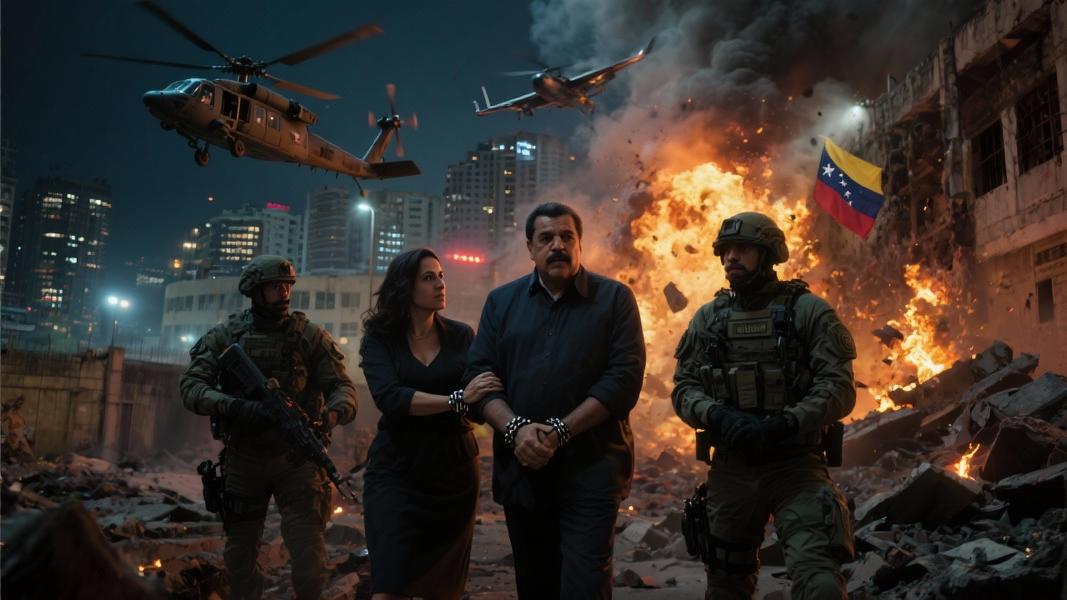
In a stunning military operation that has upended the political landscape of South America, the United States conducted airstrikes across northern Venezuela on January 3, 2026, culminating in the reported capture of President Nicolás Maduro and his wife, Cilia Flores. The operation, dubbed “Absolute Resolve,” targeted multiple locations including the capital Caracas and military installations such as Fort Tiuna, according to U.S. officials.
President Donald Trump made the bombshell announcement himself, declaring that Maduro and Flores had been “captured and flown out of the country” to face prosecution in the United States. “We are going to run the country until such time as we can do a safe, proper and judicious transition,” Trump stated in remarks that have sent shockwaves through diplomatic circles.
Narcoterrorism Charges Await
U.S. Attorney General Pam Bondi elaborated that the Venezuelan leader and his wife would face narcoterrorism charges, stating they would “face the full wrath of American justice on American soil in American courts.” The administration has previously designated two Venezuelan organizations — Tren de Aragua and Cartel de los Soles — as Foreign Terrorist Organizations, with Trump alleging the latter was led by Maduro himself.
Is this the culmination of years of escalating tensions between Washington and Caracas? The operation follows the Trump administration’s increasingly aggressive stance toward the Maduro regime, which it has long accused of drug trafficking, human rights abuses, and undermining democratic institutions in Venezuela.
Meanwhile, Venezuelan Vice President Delcy Rodríguez has issued a defiant response, confirming that Maduro and Flores are indeed missing while demanding proof of life. The situation remains fluid as the international community grapples with the implications of what appears to be the most direct American military intervention in Latin America in decades.
Military Infrastructure Targeted
The strikes weren’t just aimed at capturing Venezuela’s leadership. Fort Tiuna, a major military installation, was among the primary targets, suggesting a coordinated effort to neutralize potential resistance from Venezuela’s armed forces. This strategic targeting indicates extensive intelligence operations preceding the attack.
Analysts note that the operation’s scope and precision reflect significant pre-planning by U.S. military and intelligence agencies. The successful extraction of Maduro and his wife from a heavily guarded presidential compound would have required detailed intelligence and precise execution.
The international community has yet to form a consensus response. Several Latin American nations have condemned the unilateral military action, while others have remained conspicuously silent. The United Nations Security Council has called an emergency session to address what some members are characterizing as a violation of Venezuelan sovereignty.
For ordinary Venezuelans, already suffering through years of economic collapse, hyperinflation, and political instability, the future remains uncertain. The power vacuum created by Maduro’s removal raises serious questions about governance in a country where democratic institutions have been systematically weakened.
As dusk falls on this extraordinary day, Venezuela stands at a crossroads. Whether Trump’s promise of a “safe, proper and judicious transition” materializes or whether the country descends into deeper chaos remains to be seen. What’s certain is that January 3, 2026, will be remembered as the day American military power dramatically reshaped Venezuelan history.
