
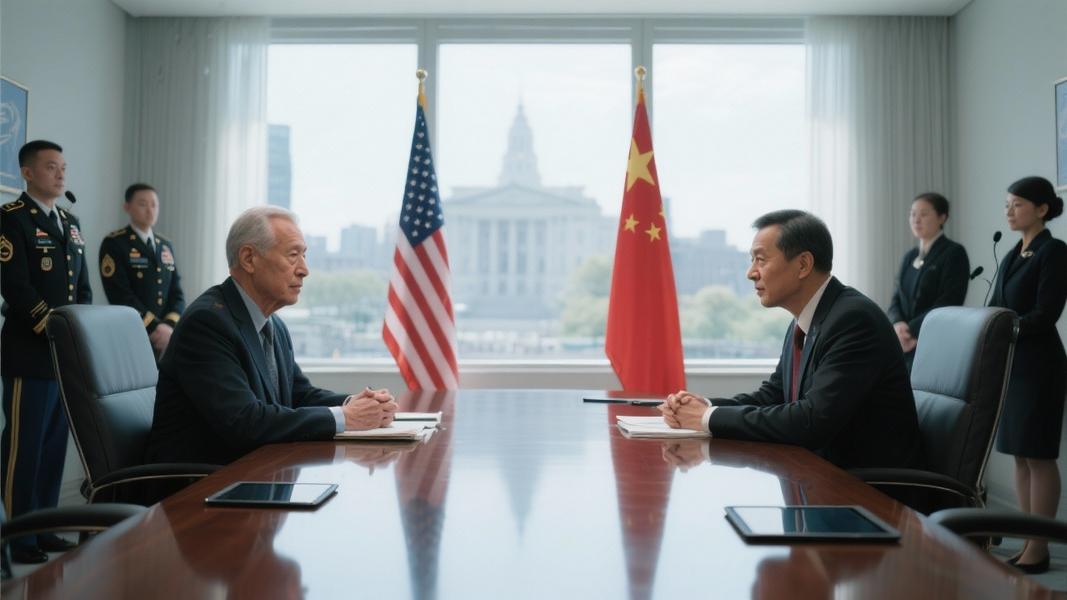
The United States and China have resumed high-level defense talks, marking a potential thaw in military communications between the two global powers. Deputy Assistant Secretary of War for China Alvaro Smith met with Chinese Major General Ye Jiang in Washington for the 19th annual U.S.-China Defense Policy Coordination Talks on December 15-16, 2025, according to a statement from the Department of War.
The two-day discussions centered on establishing more robust military-to-military communication channels, with DASW Smith emphasizing their importance for “strategic stability and crisis deconfliction and de-escalation.” This language echoes similar terminology used in November, when officials from both nations sought to establish clearer military communication protocols.
During the talks, Smith highlighted that these communication efforts align with President Trump’s broader strategy to foster “stable peace and respectful relations” between Washington and Beijing. He also made clear that America’s interests in the Indo-Pacific, while “significant,” are “scoped and reasonable” — but added that the Department of War “stands ready to defend them,” according to the official readout.
Building on Recent Diplomatic Momentum
The December meetings follow a notable high-level encounter between Secretary of War Pete Hegseth and China’s Minister of National Defense Admiral Dong Jun on October 31, 2025, on the sidelines of the ASEAN Defense Ministers Meeting Plus in Southeast Asia. That engagement represented one of the highest-profile military exchanges between the two countries in recent years.
These interactions appear to be part of a carefully choreographed diplomatic dance. NewsChina previously reported that the 18th round of Defense Policy Coordination talks took place just three months earlier, on September 15, suggesting an accelerated pace of military dialogue between the superpowers.
What’s behind this apparent urgency in establishing military communication channels? The moves come amid increasing tensions in the Indo-Pacific region, particularly regarding Taiwan and disputed territories in the South China Sea. A year earlier, the Department of Defense had documented strategies for military engagement with China in its annual Military and Security Developments report.
Differing Security Perspectives
The talks take place against a backdrop of competing security visions. Recent analysis of China’s arms-control positions shows Beijing emphasizing its commitment to maintaining only a “minimum level” nuclear arsenal and highlighting its moratorium on testing since 1996. China has also advocated for treaties preventing the weaponization of outer space — positions that sometimes stand in contrast to U.S. defense priorities in the region.
Despite these differences, both sides appear to recognize the dangers of miscommunication. The establishment of reliable military-to-military channels could prove crucial in preventing unintended escalation during moments of crisis — a concern that has grown as both nations’ military capabilities and operations in the Indo-Pacific have expanded.
For now, these talks represent baby steps toward what could be a more stable security relationship. But the path forward remains fraught with challenges, as both powers navigate complex regional dynamics while attempting to safeguard their core national interests in an increasingly contested part of the world.
