
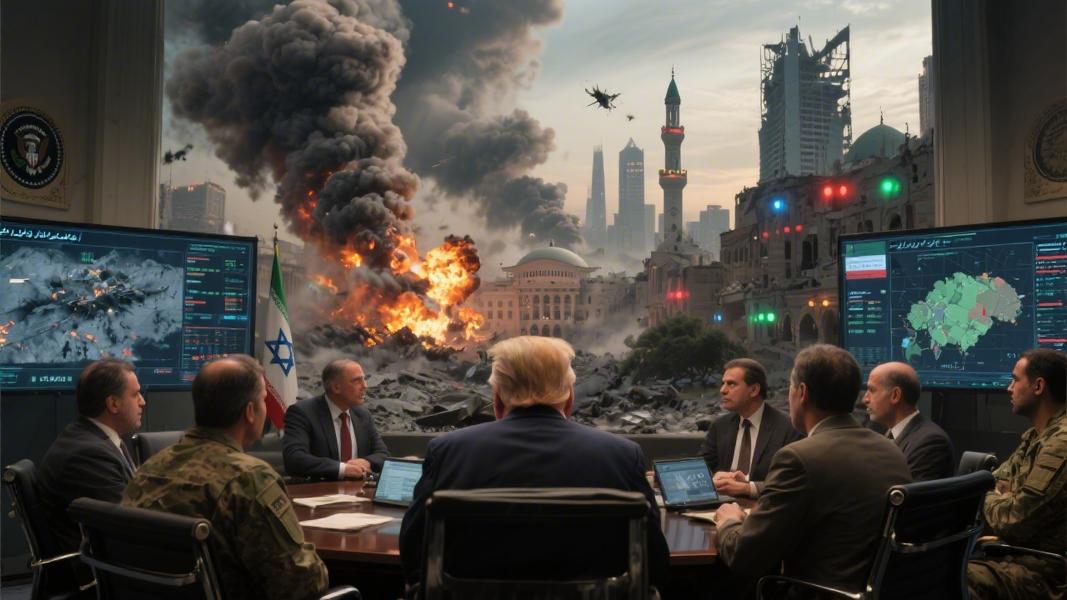
The Middle East woke up to a different world on Saturday. In a sweeping military action that had been weeks in the making, the United States and Israel struck Iran directly — hard, and with stated ambitions that go well beyond anything seen in recent memory.
On February 28, 2026, the two allies launched a coordinated assault on multiple targets across Iran, with Israel dubbing the campaign Roaring Lion and the United States operating under the name Operation Epic Fury. The goals, as outlined by officials on both sides, were sweeping: dismantle Iran’s nuclear program, destroy its missile infrastructure, neutralize its naval forces, and — most strikingly — topple the Islamic Republic itself. This wasn’t a warning shot. It was an attempt to fundamentally reshape the region’s most volatile power.
A Second Strike, Bigger Than the Last
It’s worth remembering that this isn’t the first time these two allies have hit Iran together. A previous round of strikes occurred in June 2025, setting off a tense cycle of exchanges that never quite resolved. What’s different now is scale. Officials confirmed the current operation is significantly larger in scope — and the warnings leading up to it had been building for weeks, loud enough that few in Washington or Tel Aviv were pretending this wasn’t coming.
The stated U.S. justification framed the assault in defensive terms — acting, as one official put it, “to defend the American people by eliminating imminent threats from the Iranian regime.” That’s the language governments tend to reach for when they want to sound measured while doing something quite dramatic. And make no mistake: launching a regime-change campaign against a nation of 90 million people is dramatic, by any definition.
The Message to the Iranian People
What made the political framing of this operation unusual — maybe even audacious — was how explicitly it was aimed at ordinary Iranians, not just the government. Leaders from both countries leaned into the idea that the strikes were meant to create an opening for the Iranian public. “Our joint action,” one statement read, “will create the conditions for the brave Iranian people to take their destiny into their own hands.”
That’s a remarkable thing to say while bombs are falling. The message went further still — almost messianic in tone — with one address to Iranians warning that the opportunity described as “will be yours to take. This will be probably your only chance for generations.” Whether Iranians inside the country received that framing as liberation or provocation remains, at this hour, genuinely unclear.
What They Were Targeting — and Why It Matters
The military objectives themselves were outlined with unusual specificity: prevent Iran from acquiring nuclear weapons, dismantle its ballistic missile capabilities, destroy its naval forces, and protect broader U.S. interests in the region. That’s a long list. Executing even one of those goals cleanly has proven difficult for Western powers in past conflicts. Attempting all four simultaneously, against a deeply entrenched regime with decades of experience surviving pressure, is the kind of thing that military historians tend to write about at length — sometimes admiringly, sometimes not.
Still, the sheer coordination on display here is hard to dismiss. This wasn’t improvised. The operational planning, the dual codenames, the synchronized messaging — it signals something that has been in motion for a long time, even if the final decision came quickly.
An Emergency Meeting, and a World Watching
The United Nations Security Council convened an emergency session in the hours following the strikes, with members divided along predictably familiar lines. Allies of the U.S. largely held their tongues or offered muted support; adversaries condemned the action as illegal aggression. The debate inside that chamber, for all its procedural weight, felt almost secondary to the events unfolding on the ground.
So where does this go? That’s the question no one can honestly answer right now. Regime change is an objective that sounds clean on a slide deck and tends to get messy the moment it makes contact with reality. Iran is not a small country with a brittle government — it has survived revolutions, wars, and decades of sanctions. Whether the combination of external military force and an internal population with genuine grievances against its leadership produces the outcome Washington and Tel Aviv are hoping for is, at best, uncertain.
What isn’t uncertain is that the world changed on February 28th. The only real question now is what it’s changing into.
