
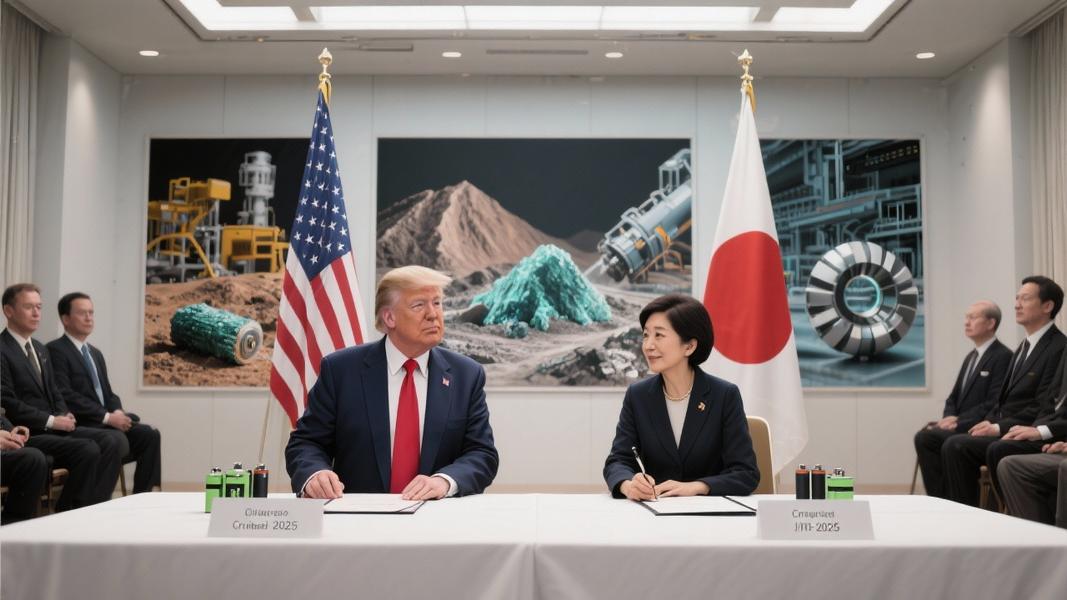
U.S. and Japan Sign Landmark Deal to Counter China’s Grip on Critical Minerals
In a strategic move that directly challenges China’s dominance in the global rare earths market, the United States and Japan have formalized a framework to secure and diversify critical mineral supply chains crucial for advanced technologies. The agreement, signed in Tokyo on October 28, 2025, by U.S. President Donald Trump and Japanese Prime Minister Takaichi Sanae, represents an unprecedented level of cooperation between the two economic powerhouses.
Why now? The timing couldn’t be more critical. China currently controls more than 70% of global rare-earth production and over 85% of refining capacity, creating substantial vulnerabilities for both American and Japanese industries that rely on these materials for everything from electric vehicles to defense systems, according to supply chain experts monitoring the situation.
Breaking China’s Monopoly
“The United States and Japan intend to support the supply of raw and processed critical minerals and rare earths crucial to the domestic industries of the United States and Japan,” reads a portion of the agreement, which outlines how both nations will leverage economic policy tools and coordinated investments to accelerate the development of “diversified, liquid, and fair markets” for these strategic materials.
The framework is part of a broader effort to counter Beijing’s growing willingness to weaponize its market position, as indicated by recent export controls that sent shockwaves through global technology supply chains.
Central to the agreement is a commitment to establish high-standard marketplaces that “reflect the real costs of responsible extraction, processing, and trade” while addressing “non-market policies and unfair trade practices” — diplomatic language that barely disguises its target.
Financial Muscle and Fast-Track Implementation
The deal isn’t just words on paper. Both countries have committed to concrete action within an ambitious timeframe. Within six months, financial support measures will be implemented for selected projects to ensure end products reach U.S. and Japanese buyers.
“The Participants intend to mobilize government and private sector support including for capital and operational expenditures via grants, guarantees, loans, or equity; offtake arrangements; insurance; or regulatory facilitation,” the framework states, essentially creating a government-backed investment vehicle to jumpstart new mining and processing operations.
A bilateral ministerial meeting will be convened within 180 days to prioritize investment approaches and engage with stakeholders. Additionally, both nations have pledged to streamline permitting processes for mining, separation, and processing operations — a longstanding bottleneck for Western companies attempting to enter the sector.
Beyond Mining: A Comprehensive Approach
The agreement extends beyond simply extracting more minerals from the ground. Both countries have committed to investing in recycling technologies and better management of scrap materials to create circular supply chains.
“The Participants commit to investing in minerals recycling technologies and to working together to ensure management of critical minerals and rare earth scrap that supports supply chain diversification,” according to the document.
They’ll also collaborate on geological mapping both domestically and internationally to identify new resource deposits, potentially expanding the global supply base beyond its current concentration in China.
Perhaps most intriguing is the establishment of a “U.S.-Japan Critical Minerals Supply Security Rapid Response Group” led by the U.S. Secretary of Energy and the Japanese Minister of Economy, Trade, and Industry. This high-level team will identify supply vulnerabilities and develop plans to accelerate delivery of processed minerals — essentially creating an emergency response system for potential supply disruptions.
National Security Implications
The framework doesn’t shy away from acknowledging the national security dimensions of the minerals race. Both countries will “review and deter critical minerals and rare earths asset sales on national security grounds,” strengthening diplomatic and legal tools to prevent strategic acquisitions by unfriendly powers.
The agreement also contemplates a complementary stockpiling arrangement, utilizing each country’s existing systems. Such stockpiles would serve as strategic reserves in case of supply disruptions or trade conflicts.
“The Participants intend to work together to consider a mutually complementary stockpiling arrangement, utilizing existing national systems in accordance with each country’s regulations,” the document states.
The Fine Print
Despite its ambitions, the framework includes some notable caveats. It’s not legally binding, and either party may withdraw with 30 days’ written notice — a flexibility that may raise questions about its long-term durability across changing administrations.
The agreement also extends an invitation to “like-minded countries” to participate, suggesting that this U.S.-Japan partnership could potentially expand into a broader coalition of democratic nations seeking to reduce dependency on Chinese rare earths.
For all its bold language, the true test will come in implementation. Can bureaucratic processes be truly streamlined? Will private capital flow into an industry long dominated by Chinese state-backed enterprises? And most importantly, will consumers be willing to pay potentially higher prices for products containing “responsibly sourced” rare earths?
What’s clear is that this framework represents the most significant attempt yet to challenge China’s strategic advantage in a resource sector that underpins much of modern technology. In the high-stakes game of critical mineral supply chains, the U.S. and Japan have just made their move. Beijing’s response will be closely watched.
