
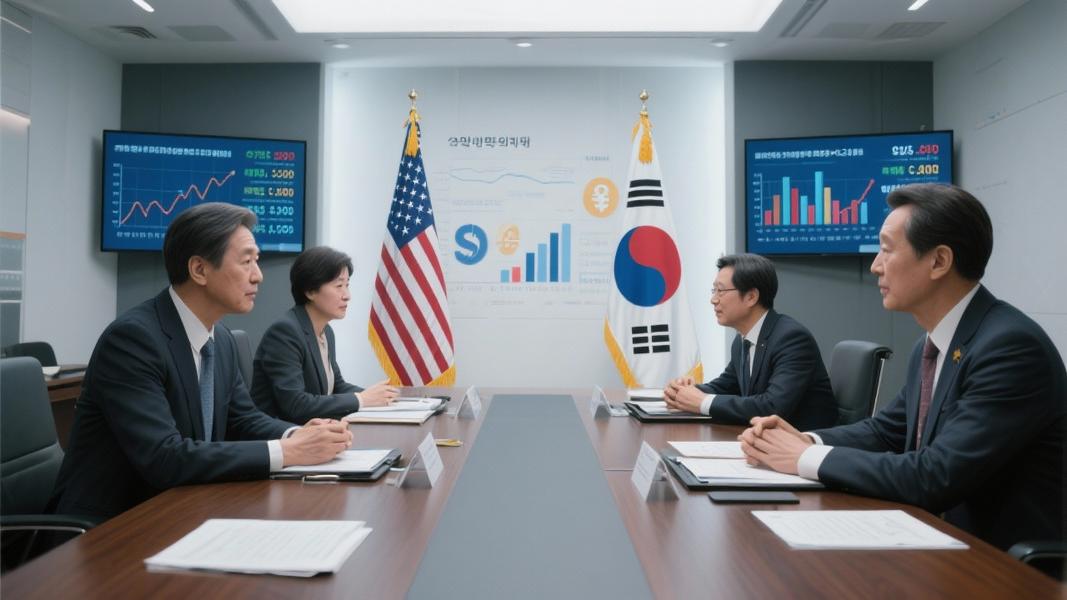
U.S. and South Korea Strike Currency Agreement, Pledge Not to Manipulate Exchange Rates
In a move aimed at fostering financial stability and fair trade practices, the United States and South Korea have formalized an agreement not to manipulate their exchange rates for competitive advantage in global markets.
The pact, announced by the U.S. Department of the Treasury and South Korea’s Ministry of Economy and Finance, reaffirms both nations’ commitment under the International Monetary Fund’s Articles of Agreement to maintain transparent and market-oriented currency practices. It comes amid growing global concerns about competitive currency devaluations and their potentially destabilizing effects on international trade.
“The United States and the Republic of Korea reconfirmed they have undertaken under the IMF Articles of Agreement to avoid manipulating exchange rates or the international monetary system to prevent effective balance of payments adjustment or to gain an unfair competitive advantage,” the Treasury Department stated in its announcement.
Enhanced Transparency and Communication
What makes this agreement particularly significant? Beyond the core commitment not to artificially weaken currencies, both countries have pledged unprecedented transparency in their foreign exchange operations.
The two economic powers will exchange monthly data on any foreign exchange intervention operations and publicly disclose their foreign exchange reserves according to IMF standards. They’ve also committed to annual disclosure of the currency composition of these reserves – a level of transparency that goes beyond typical international practice.
This information sharing is designed to build trust between the nations and allow for better monitoring of market stability, officials explained.
The agreement specifically outlines that any macroprudential or capital flow measures won’t target exchange rates for competitive purposes. Similarly, government investment vehicles will focus on “risk-adjusted return and diversification purposes” rather than exchange rate manipulation.
Market Intervention Guidelines
Perhaps most notably, the agreement establishes clear parameters for when intervention in currency markets might be warranted. Both sides agreed that such actions should be “reserved for combatting excess volatility and disorderly movements in exchange rates,” according to the Treasury Department.
It’s a delicate balance. The agreement explicitly notes that intervention tools “would be considered equally appropriate for addressing excessively volatile or disorderly depreciation or appreciation” – language that gives both countries some flexibility while preventing systematic manipulation.
Currency manipulation has been a thorny issue in international economic relations for decades. When countries artificially devalue their currencies, they can make their exports cheaper and more competitive in global markets – often at the expense of trading partners.
The U.S. has previously criticized several countries, including China, for such practices, though South Korea hasn’t been among recent targets of such complaints.
South Korean officials have emphasized that the agreement reflects their commitment to market-determined exchange rates. “This agreement reinforces our shared values of transparency and fair competition in international markets,” one official noted in background discussions with reporters.
The pact builds on years of economic cooperation between the two allies, who already maintain close coordination on a range of financial and trade issues. Given the combined economic might of both nations – representing over a quarter of global GDP – their commitment sets an important precedent for other countries.
Will this agreement become a template for similar arrangements with other U.S. trading partners? That remains to be seen, but Treasury officials haven’t ruled out pursuing comparable transparency measures with additional countries in the future.
