
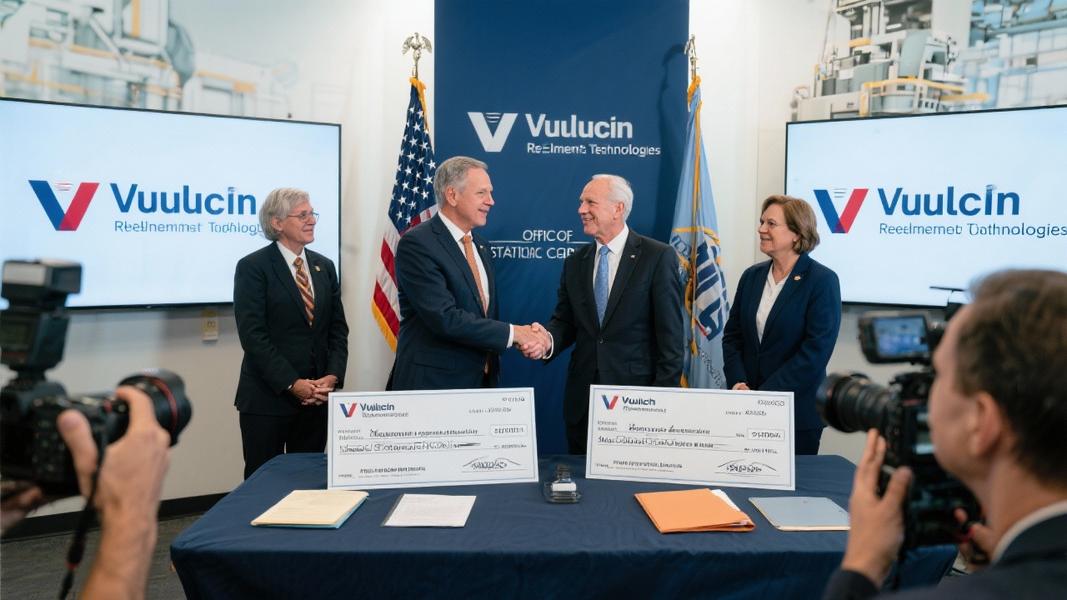
The Office of Strategic Capital announced a major move to bolster America’s domestic rare earth magnet supply chain on Monday, committing $700 million in conditional loans to two U.S. companies in an effort to reduce dependence on foreign suppliers for critical materials used in everything from fighter jets to electric vehicles.
The financing package will direct $620 million to Vulcan Elements and $80 million to ReElement Technologies, supporting their efforts to develop advanced rare earth element processing capabilities on American soil, according to a statement released by the Department of War.
Building a Domestic Supply Chain
Why does this matter? The rare earth magnets in question — specifically NdFeB (neodymium-iron-boron) magnets — are crucial components in technologies ranging from semiconductors to defense systems, but the U.S. has long struggled with a severe supply gap in domestic production.
“Following the Department of War’s agreement earlier this year with MP Materials, these conditional loan commitments with Vulcan and ReElement present a forward-leaning approach to further strengthen America’s magnet production,” said Emil Michael, Under Secretary of War for Research and Engineering, in a statement shared by the department.
The combined efforts of Vulcan and ReElement are expected to produce up to 10,000 metric tons of NdFeB magnet material “in the next several years,” which officials say will significantly reduce America’s dependency on foreign suppliers. These magnets are essential components in chip manufacturing, drones, electric vehicles, fighter jets, industrial motors, nuclear submarines, and satellites, the Department confirmed.
Multi-Agency Support
The financing doesn’t stop with the OSC loans. In a coordinated effort, the Department of Commerce’s CHIPS Program Office has signed a preliminary non-binding letter of intent to provide an additional $50 million in proposed federal incentives for equipment purchases. The Commerce Department will also receive $50 million in equity in Vulcan Elements as part of the arrangement, according to the announcement.
But the money isn’t flowing just yet. Both companies must first complete extensive financial, legal, technical, and other due diligence requirements before the loans reach financial close. The Department of War emphasized that “no OSC funds are disbursed until all parties have completed or met the conditions for disbursement as specified in the loan commitment.”
The funding is made possible through the One Big Beautiful Bill Act, signed by President Trump in July 2025, which provides up to $100 billion in total OSC lending authority specifically for critical minerals production and related industries. This represents just a fraction of the potential investment available under the legislation.
National Security Implications
Ryan Lindner, Chief Investment Officer of OSC, highlighted the strategic importance of the investment. “These commitments demonstrate that OSC’s federal financing tools can successfully scale private capital investment in sectors vital to our economic and national security,” he stated.
The announcement comes amid growing concerns about supply chain vulnerabilities exposed during the pandemic and heightened geopolitical tensions with China, which currently dominates global rare earth element production and processing. The push to develop domestic capabilities has accelerated in recent years as policymakers recognize the national security implications of relying on foreign nations for critical minerals.
The Department of War described the effort as part of “swift and decisive actions taken by the Trump Administration to secure a domestic supply chain” for these critical materials, according to their statement.
For industry observers, the key question remains: Will this investment be enough to meaningfully close America’s rare earth supply gap? With China controlling approximately 85% of global rare earth processing capacity, these loans represent a significant but still modest step toward building truly resilient domestic capabilities.
