
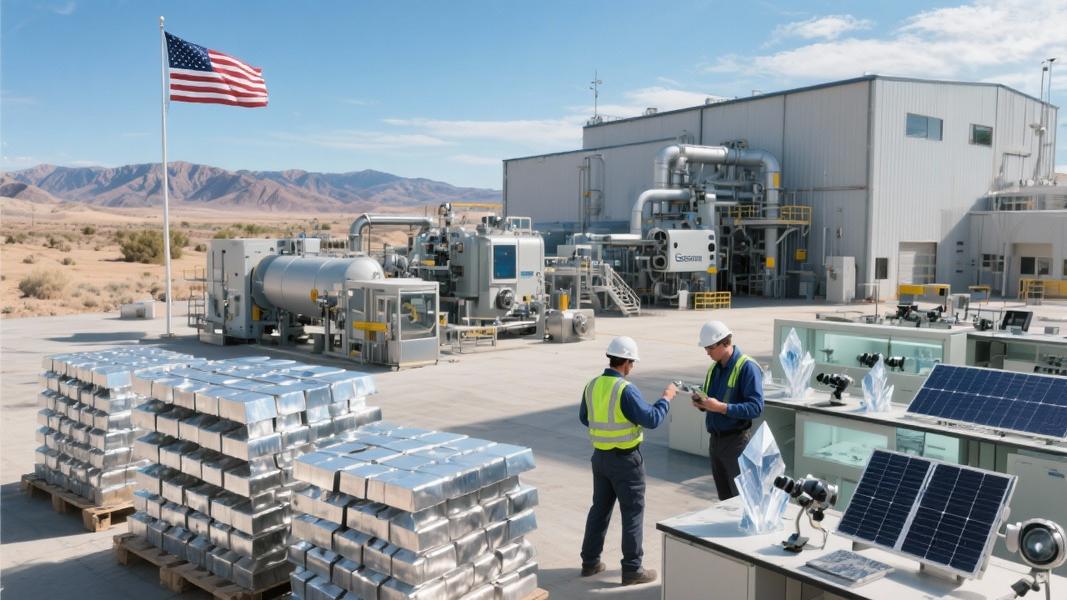
The Department of War is betting big on germanium, investing $18.1 million to dramatically expand U.S. refining capacity for the critical mineral essential to military optics and targeting systems.
The investment, announced on December 15, 2025, will fund 5N Plus Inc.’s expansion of germanium metal refining at their St. George, Utah facility — boosting production sevenfold to more than 20 metric tons annually.
“Our warfighters depend on next generation optics for surveillance, reconnaissance, and targeting, and germanium is a key element in their manufacture,” said Assistant Secretary of War for Industrial Base Policy Mike Cadenazzi.
Critical Minerals Race Accelerates
The move represents just one piece of a much larger strategic puzzle. The U.S. is rapidly scaling up domestic production of critical minerals previously dominated by Chinese suppliers, with germanium and gallium receiving particular attention from defense planners.
Jeffrey Frankston, Acting Deputy Assistant Secretary of War for Industrial Base Resilience, explained the urgency: “Optics are a pacing item for major weapons platforms across all the military Services.” The expansion at 5N Plus “addresses a capability bottleneck that affects some of our most critical weapons platforms,” he added.
Just months earlier, in September 2025, the Department committed $18.5 million to Lattice Materials to increase capacity for optical-grade germanium and silicon crystals while developing capabilities to produce germanium metal from recycled materials.
Korea Zinc’s Game-Changing Investment
Perhaps the most significant development in this mineral strategy is Korea Zinc’s decision to build a $6.6 billion critical minerals smelter in Tennessee. The massive facility will process 1.1 million tons of raw materials annually, producing 540,000 tons of finished products — including approximately 44 tons of germanium per year after operations fully ramp up in 2029.
“Korea Zinc’s critical minerals project in Tennessee is a transformational deal for America,” said Secretary of Commerce Howard Lutnick, whose department partnered with the Department of War on the project.
Why Tennessee? The location provides strategic advantages while creating hundreds of high-paying jobs. Montgomery County Mayor Wes Golden celebrated the announcement: “This project will expand the United States’ capacity to produce the minerals that power our advanced industries and defense capabilities, strengthening national security while delivering high-paying jobs for hundreds of Tennessee families.”
The smelter represents a significant geopolitical shift. Deputy Secretary of War Steve Feinberg noted that “President Trump has directed his Administration to prioritize critical minerals as essential to America’s defense and economic security.”
Legislative Backing
These investments aren’t happening in a policy vacuum. The FY26 National Defense Authorization Act explicitly prohibits acquisition of critical minerals including germanium from China and enables Department of War Industrial Base Fund investments in critical mineral refining, according to a summary from the House Armed Services Committee.
Atlantic Alumina also received a hefty boost — $150 million from the Department of War to expand gallium recovery capacity at its Louisiana refinery, according to Project Blue, an industry analysis firm.
Will these investments be enough to secure America’s supply chain for these critical minerals? That remains to be seen. The Korea Zinc facility won’t begin producing significant quantities of germanium until after 2029, and China still dominates global production.
But the strategy is clear: after decades of outsourcing critical mineral production, the U.S. is making an aggressive push to bring these capabilities home — with the Department of War leading the charge to ensure American warfighters aren’t left dependent on potentially hostile foreign suppliers for the materials that power their most advanced weapons systems.
