
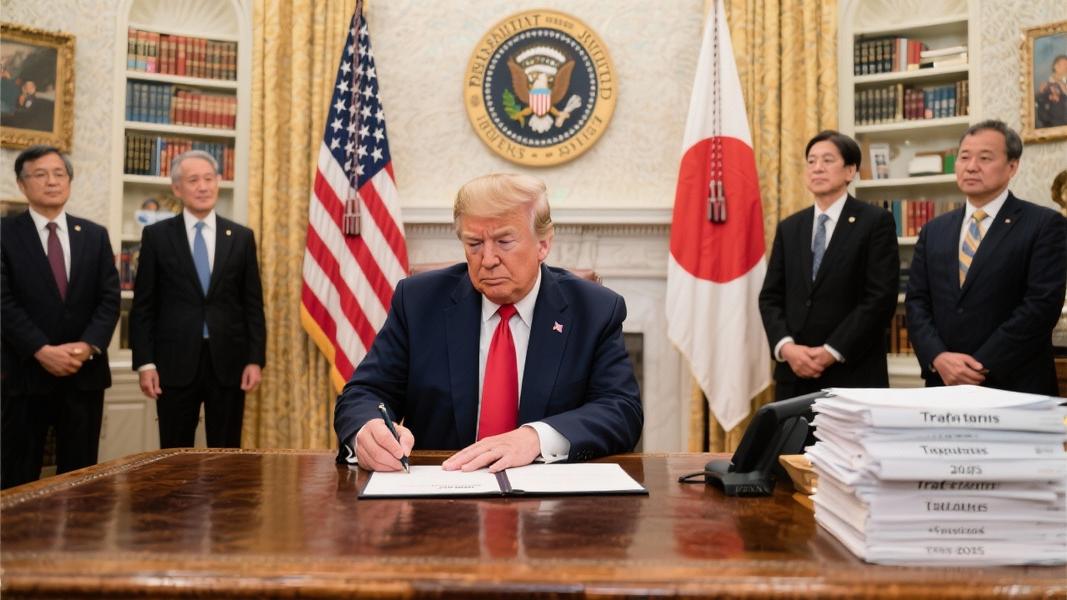
The United States and Japan have struck a groundbreaking trade agreement that will fundamentally reshape economic relations between the two global powers. The deal includes a baseline 15 percent tariff on nearly all Japanese imports while securing unprecedented market access for American producers across multiple sectors.
At the heart of the agreement is Japan’s extraordinary commitment to invest $550 billion in the United States — a provision the White House calls “unlike any other agreement in American history.” These investments, which will be selected by the U.S. government, are expected to generate hundreds of thousands of jobs and expand domestic manufacturing capacity.
Breaking Down Barriers
For decades, American companies have struggled to gain meaningful access to Japanese markets. That’s changing dramatically under the new framework. Japan has agreed to increase imports of U.S. rice by 75 percent, with major expansions of import quotas across agricultural products, according to a White House statement.
“This agreement delivers breakthrough openings across key sectors,” including commitments from Japan to purchase $8 billion in U.S. goods annually — everything from corn and soybeans to fertilizer and sustainable aviation fuel. Perhaps most notably for American manufacturing, Japan has committed to purchase 100 Boeing aircraft and billions in defense equipment.
What about automobiles? Longstanding restrictions on U.S. vehicles will be lifted, finally granting American automakers access to the Japanese consumer market. For the first time ever, U.S. automotive standards will be approved in Japan, potentially opening significant new opportunities for Detroit’s manufacturers.
Meat of the Matter
American beef and pork producers stand to benefit substantially. The agreement returns U.S. meat products to a level playing field in Japan, reducing tariffs to rates comparable to those enjoyed by Comprehensive and Progressive Agreement for Trans-Pacific Partnership (CPTPP) members and the European Union, as industry group USMEF explains.
Japan’s tariffs on U.S. pork muscle cuts will be eliminated over nine years, while most processed pork products will see tariffs phased out over five to ten years. Meanwhile, Japan’s 38.5% tariffs on U.S. chilled and frozen beef cuts will drop dramatically to 9% over 15 years.
The agreement does include safeguard mechanisms that allow for temporary tariff increases when imports surpass predetermined trigger levels for certain products like beef, pork, whey, oranges, and racehorses, as documented by U.S. agricultural officials.
Building on Recent Progress
This expanded agreement builds upon the foundation established by the initial U.S.-Japan Trade Agreement that entered into force on January 1, 2020. That earlier deal already provided substantial market access, with over 90 percent of U.S. food and agricultural products imported into Japan becoming duty-free or receiving preferential tariff treatment.
Together, the United States and Japan account for approximately 30 percent of global GDP, making the economic implications of their trade relationship difficult to overstate. The partnership was officially initiated on October 7, 2019, with the signing of the first agreement aimed at eliminating or reducing tariffs on various agricultural and industrial products.
But why the 15 percent baseline tariff on Japanese imports? The agreement frames this as necessary to “level the playing field for American producers” while addressing national security needs. Certain sectors receive specialized treatment, including automobiles, aerospace products, generic pharmaceuticals, and natural resources not readily available in the United States.
The deal appears strategically designed to address longstanding U.S. concerns about trade imbalances while creating specific opportunities for American producers to expand their presence in Japanese markets. With its massive investment commitments and market access provisions, the agreement represents one of the most significant bilateral economic arrangements in recent U.S. history.
