
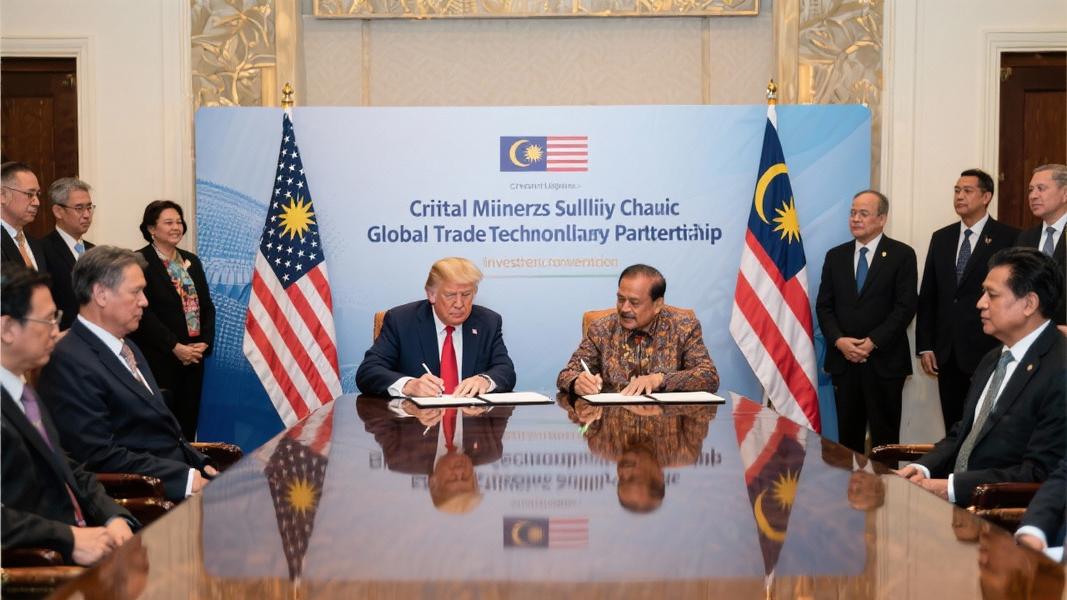
U.S. and Malaysia Strike New Trade Deal, Lowering Tariffs and Opening Markets
The United States and Malaysia have inked a comprehensive new trade agreement that will reduce tariffs, remove trade barriers, and potentially unleash billions in cross-border investment. The deal, announced by the White House this month, marks a significant shift from the 24% reciprocal tariffs the U.S. imposed on Malaysian goods earlier this year.
Tariff Reductions and Market Access
Under the new agreement, the U.S. will lower its reciprocal tariff rate on Malaysian goods to 19%, while maintaining zero-percent duties on select products. This represents a notable change from April 2025, when Malaysia was hit with a 24% tariff on most imports, though key industries including semiconductors and pharmaceuticals had received temporary exemptions.
“Malaysia shall apply a rate of customs duty on originating goods of the United States as set out in Schedule 1 to Annex I. The United States shall apply a revised reciprocal tariff rate on originating goods of Malaysia as set out in Schedule 2 of Annex I,” the agreement states.
What’s in it for American businesses? Quite a lot, apparently. Malaysia has committed to “provide significant preferential market access for U.S. industrial goods exports, including chemicals, machinery and electrical equipment, metals, and passenger vehicles,” along with agricultural products ranging from dairy and poultry to rice and fuel ethanol.
Beyond Tariffs: Removing Trade Barriers
The agreement goes well beyond simple tariff adjustments. Malaysia has pledged to streamline import licenses for U.S. alloy steel and pipe products, simplify halal requirements for cosmetics and pharmaceuticals, and address American concerns with conformity assessment procedures.
In a win for U.S. automakers, Malaysia will now accept American-manufactured vehicles built to U.S. motor vehicle safety and emissions standards — a long-standing point of contention in bilateral trade relations.
The deal also tackles non-tariff barriers that have frustrated American agricultural exporters. Malaysia has agreed to accept U.S. regulatory certificates and implement regionalization policies for animal diseases, potentially opening doors for American meat producers.
Digital Economy and Intellectual Property
Both countries have committed to maintaining the moratorium on customs duties for electronic transmissions, which should benefit the growing digital trade sector. “Each Party shall not impose customs duties on electronic transmissions, including content transmitted electronically,” the agreement specifies.
Malaysia has also committed not to impose discriminatory value-added or digital services taxes targeting U.S. companies — a significant protection for American tech firms operating in Southeast Asia.
Intellectual property protections received considerable attention in the deal. Malaysia will “provide a robust standard of protection for intellectual property” and ensure “effective systems for civil, criminal, and border enforcement of intellectual property rights,” including in online environments, according to the text.
Labor, Investment, and Environmental Provisions
Perhaps most ambitious is Malaysia’s pledge to facilitate approximately $70 billion in job-creating investment in the United States over the next decade. This includes “greenfield investment” — building new facilities from the ground up rather than acquiring existing ones.
Labor rights also feature prominently. The agreement requires Malaysia to “adopt and implement a prohibition on the importation of goods mined, produced, or manufactured wholly or in part by forced or compulsory labor” and to protect internationally recognized labor rights — provisions that appear designed to address long-standing human rights concerns in certain Malaysian industries.
Environmental protections haven’t been overlooked either. Malaysia commits to “adopt and maintain environmental protections, effectively enforce its environmental laws,” and address environmental issues that contribute to non-reciprocal trade.
Implementation Timeline
When will all this take effect? According to the agreement, it “shall enter into force 60 days after the date on which the Parties have exchanged written notifications certifying completion of their applicable legal procedures.” Either party can terminate the deal with 180 days’ notice.
The agreement represents a significant shift in U.S. trade policy toward Malaysia, which had been targeted in the broader push to reduce trade deficits with various countries. The joint statement suggests that Malaysia has made substantial concessions to secure the lower tariff rate and preferential access to American markets.
For businesses on both sides of the Pacific, the deal offers a measure of certainty after months of tension — though as with all trade agreements, the true impact will only become clear once implementation begins in earnest.
