
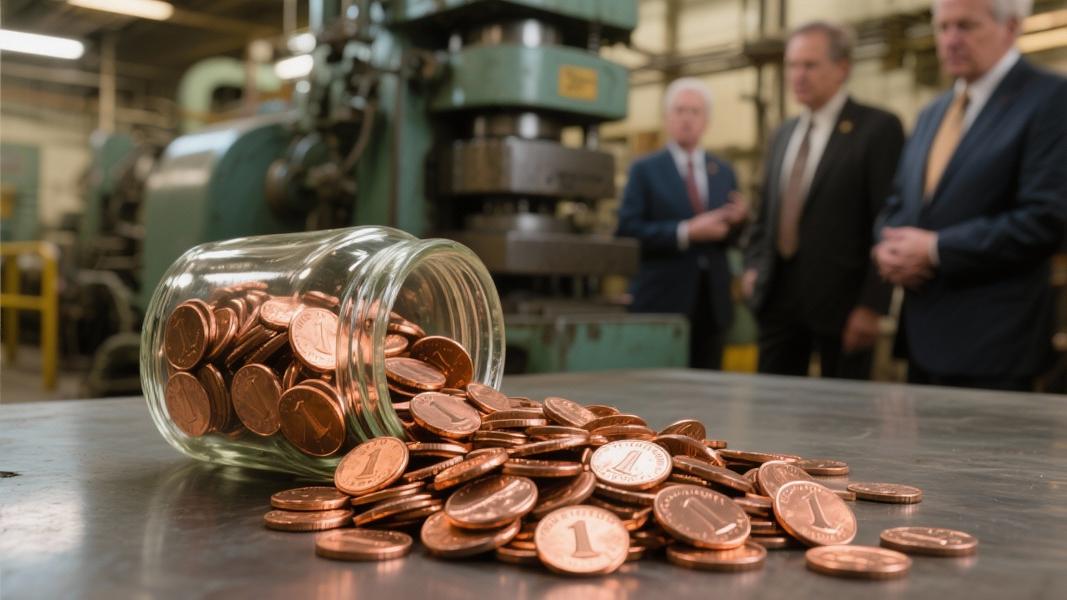
The U.S. Mint in Philadelphia struck its final circulating penny on Wednesday, ending a 230-year run for the copper coin that has long been more expensive to produce than it’s worth.
In a move that combines fiscal pragmatism with the end of an American tradition, the last official U.S. penny rolled off production lines on November 12, 2025, capping a monetary era that began in 1793. The cancellation comes by direct order from President Trump, who cited the penny’s excessive production costs as the primary reason for discontinuing America’s smallest denomination coin.
“For far too long the United States has minted pennies which literally cost us more than 2 cents. This is so wasteful!” Trump declared in a February statement that signaled the impending end of the humble one-cent piece.
A Penny Saved, Four Cents Spent
The economic math simply didn’t add up anymore. Each penny now costs the government nearly 4 cents to manufacture — a financial equation that Treasury officials could no longer justify as responsible stewardship of taxpayer dollars. With production costs climbing to almost quadruple the coin’s face value, the penny had become a literal money-losing proposition.
Treasury Department projections suggest the cancellation will save approximately $56 million annually in material costs alone. That figure doesn’t account for additional savings in labor, transportation, and distribution expenses that have made penny production increasingly impractical in the digital age.
What happens to the billions of pennies already in circulation? They’ll remain legal tender indefinitely, though their practical use is expected to gradually diminish as retailers adjust pricing strategies and payment systems evolve.
Retail Scramble
The abrupt nature of the cancellation has created significant challenges for America’s retail sector. With penny supplies dwindling in recent months and no comprehensive federal guidance on handling transactions, stores have been forced to improvise.
Jeff Lenard of the National Association of Convenience Stores expressed frustration with the implementation: “We have been advocating abolition of the penny for 30 years. But this is not the way we wanted it to go.”
Retailers across the country have developed creative workarounds. Some are rounding prices down to avoid shortchanging customers, while others have begun offering small incentives — like free drinks or small discounts — to customers willing to bring in their penny collections. Meanwhile, banks have started rationing penny supplies, creating an ironic shortage of a coin that many viewed as overabundant.
The Penny’s Legacy
Remember when a penny actually bought something? When the U.S. Mint began production in 1793, one cent could purchase a biscuit, a candle, or candy. That purchasing power has evaporated over two centuries, leaving the penny as more of a nostalgic token than a practical medium of exchange.
Still, the penny has maintained a special place in American culture. Phrases like “a penny for your thoughts” and “penny-pinching” remain embedded in our language. Lucky pennies are still collected, and children continue to be taught the value of saving through penny jars — though inflation has significantly diminished the lesson’s practical application.
The Philadelphia Mint, America’s oldest coin production facility, has produced approximately half of all pennies in circulation, with the Denver facility accounting for the remainder. Wednesday’s final production run was attended by Treasury Secretary Scott Bessent and Treasurer Brandon Beach, marking the ceremonial end to over 232 years of continuous penny manufacturing.
Comparative Costs
The penny isn’t the only coin that costs more to produce than its face value. The nickel actually has an even worse production-to-value ratio, costing nearly 14 cents to manufacture. By comparison, the dime costs less than 6 cents to produce, while quarters cost around 15 cents — still below their face value.
Why target pennies first? The sheer volume is a significant factor. Pennies have historically represented about half of all coins produced by U.S. mints, making their inefficiency particularly costly at scale.
As Americans empty their penny jars and retailers adjust their pricing strategies, the humble one-cent piece joins other discontinued denominations in U.S. monetary history — though none with such longevity or cultural significance. The penny may be going away, but like the expression says, it will likely be a long time before it’s forgotten.
