
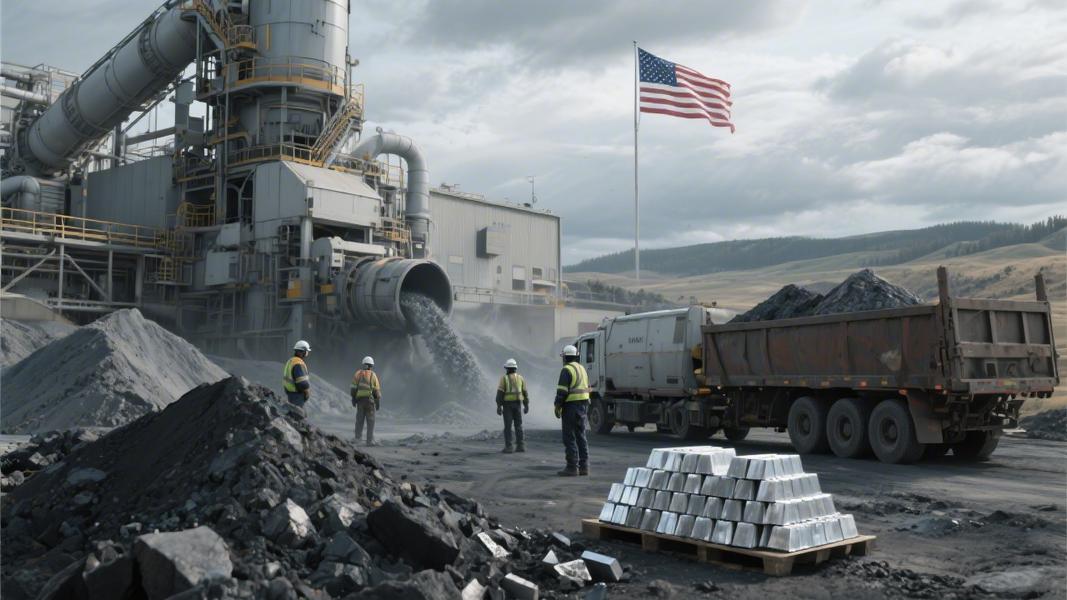
The United States is writing very large checks to make sure it never has to beg a foreign government for antimony again. And the numbers involved are starting to look less like a policy initiative and more like a full-scale industrial mobilization.
At the center of this push is a quiet but consequential bet on domestic critical minerals — specifically antimony, a silvery metalloid that most Americans couldn’t pick out of a lineup but that the Pentagon considers essential to everything from ammunition primers to night-vision equipment. The Department of War has committed $27 million in Defense Production Act Title III funds to U.S. Antimony Corporation (USAC), targeting domestic extraction, processing, and refinement operations across Montana and Alaska. It’s a signal, but also a down payment on something much larger.
A Supply Chain Problem Years in the Making
“For too long, DOW has depended on overseas sources for its critical mineral production,” said Assistant Secretary of War for Industrial Base Policy Mike Cadenazzi, in remarks released alongside the funding announcement. “This investment will address risk in one of our most critical munitions and materials supply chains.” That’s diplomatic language for: we’ve been dangerously exposed, and we know it.
China has long dominated global antimony production, and when Beijing moved last year to restrict exports of the mineral, it wasn’t exactly a surprise — but it was a wake-up call. The U.S. had let its domestic capacity atrophy for decades, and now it’s scrambling to rebuild it from the ground up. That’s the context. That’s why these investments matter.
USAC’s Windfall — and Its Obligations
Beyond the initial $27 million grant, USAC has secured something even more striking: a sole-sourced, long-term contract worth up to $245 million to supply approximately 6.68 million pounds — roughly 3,026 metric tonnes — of antimony metal ingots to the National Defense Stockpile over five years. Sole-sourced. Meaning no competitive bidding. Meaning, as the company itself put it, “United States Antimony Corporation is the only company qualified to bid on this contract.” That’s a remarkable thing to be able to say out loud.
Jonathan Miller, vice president of investor relations at US Antimony, framed the broader picture plainly. “The US is attempting to rebuild its reserves to reduce dependence on foreign sources and protect national security when supplies are cut off,” he told investors at the 17th Annual Southwest Ideas conference. It’s the kind of sentence that sounds almost obvious until you realize how recently the government was doing the opposite.
Operationally, USAC has already moved fast. The company has hauled over 250 tons of stibnite ore to a flotation mill, staked 102 federal claims, and is now projecting FY2026 revenues of $125 million — a preliminary upward revision of $25 million from earlier guidance, as noted by industry analysts tracking the sector. For comparison, the company expects to bring in just $40 to $43 million this year. That’s not incremental growth. That’s a company being turbocharged by federal demand.
Montana Is About to Get a Lot Busier
Part of how USAC plans to hit those numbers: a major expansion of its Montana refinery, scaling capacity from 100 to 500 tons per month. That’s a fivefold increase. If it executes, the facility becomes one of the most significant antimony processing operations in the Western world — which, given where things stood just a few years ago, is a genuinely strange sentence to write about a small-cap mining company operating out of Thompson Falls.
Still, USAC isn’t the only player the government is backing. Perpetua Resources, the company developing the Stibnite Gold Project in Idaho, has received $80 million in federal funding to advance domestic antimony supply — with the mine expected to eventually become a significant source of the mineral for defense applications, as outlined in recent briefings. The government, it seems, doesn’t want to bet everything on one company. Smart, given how thin the domestic supply base has become.
The Bigger Budget Picture
Where is all this money coming from? The FY2026 defense budget includes $384.3 billion in investment funding, with Major Defense Acquisition Programs alone accounting for $99.6 billion — a staggering figure that puts the antimony investments in perspective, even if they’re large by any other measure. Critical minerals are a rounding error in the overall ledger. But they’re the rounding error that, if it goes wrong, can stop a weapons production line cold.
That’s the catch that defense planners have internalized — finally. A $245 million antimony contract is nothing compared to a $13 billion aircraft carrier. But you can’t build the carrier’s systems, or the missiles it carries, or the flares it deploys, without a reliable supply of materials that until recently were almost entirely sourced from an adversarial nation. The leverage was sitting there in plain sight.
What Comes Next
The investments are real. The contracts are signed. The ore is moving. But execution risk in mining is notoriously brutal — permitting delays, geological surprises, workforce shortages, and cost overruns have derailed more than a few projects that looked bulletproof on paper. USAC’s ability to actually hit $125 million in revenue next year while simultaneously expanding its refinery will be the first real test of whether this domestic antimony renaissance is sustainable or simply well-funded optimism.
For now, the government seems willing to find out. After decades of offshoring its critical mineral supply chains and hoping nothing went wrong, Washington is finally acting like it understands the risk — and spending accordingly. Whether that’s wisdom or just very expensive catch-up is a question the next few years will answer.
As Miller put it, the goal is to be ready for when supplies are cut off. The unsettling implication, of course, is that planners believe that’s a matter of when — not if.
