
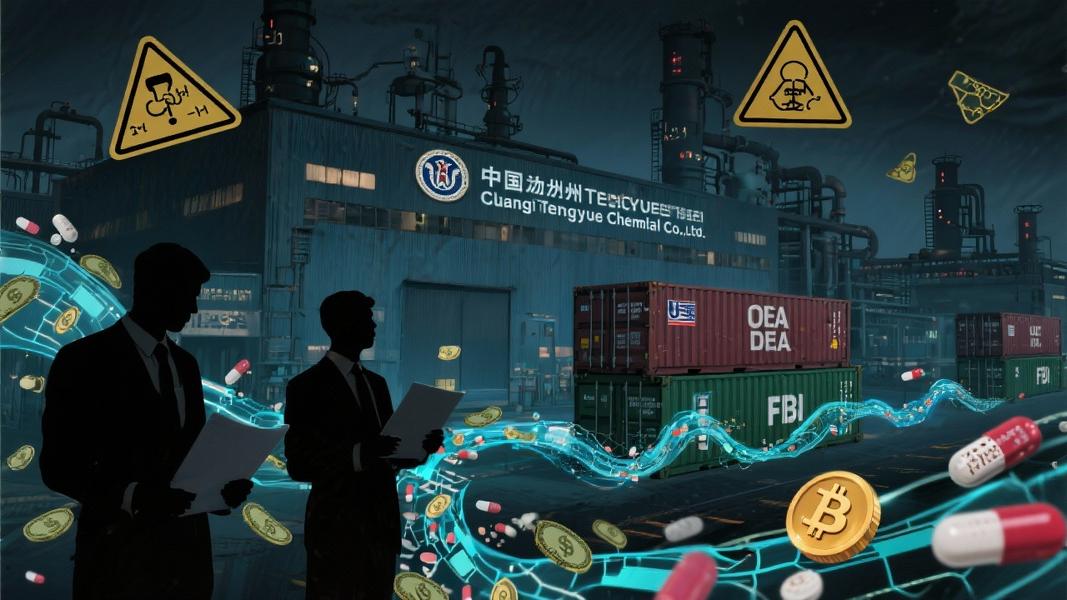
U.S. Treasury sanctions Chinese chemical company for flooding America with deadly synthetic opioids and cutting agents. The action targets Guangzhou Tengyue Chemical Co. and two representatives who continued operations despite previous indictments.
In a sweeping action against international drug trafficking networks, the U.S. Department of the Treasury’s Office of Foreign Assets Control (OFAC) has sanctioned a Chinese chemical manufacturer and two of its representatives for their role in supplying deadly synthetic opioids and dangerous cutting agents to the United States, officials announced today.
Guangzhou Tengyue Chemical Co., Ltd., along with company representatives Huang Xiaojun and Huang Zhanpeng, now face severe financial restrictions after being designated under Executive Order 14059. The sanctions freeze all their U.S.-based assets and broadly prohibit Americans from conducting business with them.
Persistent Operations Despite Prior Indictments
What makes the case particularly troubling? Despite a previous indictment unsealed in October 2024 in the Middle District of Florida, Guangzhou Tengyue continued its operations well into 2025, revealed Treasury officials. The company brazenly advertised nitazenes and xylazine on its website as recently as August 2024, and sales representatives coordinated shipments of medetomidine — another dangerous analgesic chemical — to U.S. customers in early 2025.
“Illicit opioids coming from China are destroying American lives, families, and communities,” said Under Secretary for Terrorism and Financial Intelligence John K. Hurley. “Under President Trump’s leadership, we will use all of the tools at our disposal—including sanctions and prosecutions by our law enforcement partners—to stop this epidemic.”
The Treasury’s action coincides with a federal criminal indictment announced by the FBI against the same company and individuals, plus approximately 22 additional China-based entities and three U.S.-based individuals. The charges stem from a joint FBI-DEA investigation that began in January 2024, focusing on a network trafficking multi-kilogram quantities of fentanyl, fentanyl adulterants, methamphetamine, and cocaine.
The Deadly Supply Chain
The investigation uncovered a sophisticated operation where U.S.-based co-conspirators ordered products from China specifically to extend and process their drug yield. These included nitazenes — a class of synthetic opioids with high addiction potential that can cause respiratory depression and death — as well as xylazine (commonly known as “tranq”) and medetomidine, along with presses for repackaging.
Xylazine presents a particularly insidious threat. This veterinary sedative doesn’t respond to Narcan, the emergency treatment that reverses opioid overdoses, substantially increasing the risk of fatal outcomes when mixed with other drugs. The National Institute on Drug Abuse highlighted the growing presence of xylazine in the illicit drug supply in September 2024.
The opioid crisis continues to devastate American communities. Since 2021, more than 70 percent of all reported drug overdose deaths have involved synthetic opioids, with fentanyl being the primary driver. Opioid overdose remains the leading cause of death for Americans aged 18 to 45.
Company Leadership in the Crosshairs
According to Treasury officials, Huang Zhanpeng serves as Guangzhou Tengyue’s executive director and legal representative, holding a 50 percent ownership stake. Meanwhile, Huang Xiaojun was identified as the holder of a bitcoin account used by the company to sell controlled substances to U.S. buyers in 2023.
The specific designations under Executive Order 14059 cite Guangzhou Tengyue and Huang Xiaojun for “having engaged in, or attempted to engage in, activities or transactions that have materially contributed to, or pose a significant risk of materially contributing to, the international proliferation of illicit drugs or their means of production.” Huang Zhanpeng received his designation for providing support to the company.
Why do these sanctions matter? They effectively cut off the designated parties from the U.S. financial system. All property and interests in property belonging to these entities that are in the United States or controlled by U.S. persons are now blocked and must be reported to OFAC. Any entities majority-owned by these blocked persons are similarly restricted.
The action represents the latest salvo in the U.S. government’s ongoing battle against China-based chemical manufacturing companies, which remain the primary source of fentanyl precursor chemicals and other illicit opioids entering American communities.
For those on the front lines of America’s opioid epidemic, the sanctions offer a glimmer of hope in disrupting the international supply chains feeding a crisis that continues to claim thousands of American lives each year — though the challenge of entirely stopping the flow of these deadly chemicals remains daunting.
