
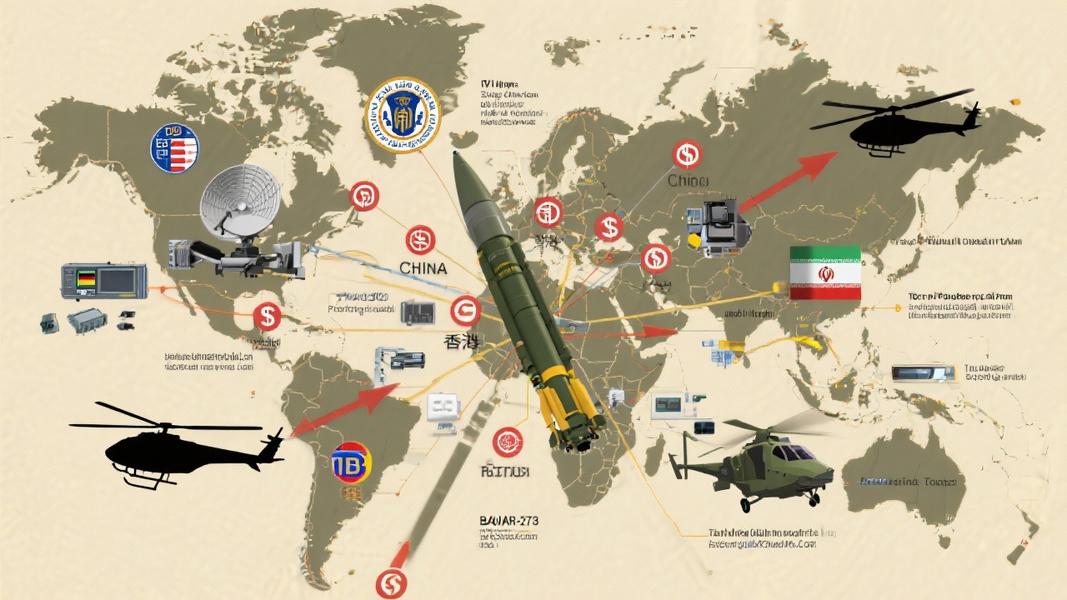
The U.S. Treasury Department has unleashed a sweeping round of sanctions targeting Iranian procurement networks spanning five continents, striking at the heart of Tehran’s efforts to acquire technology for ballistic missiles and military aircraft.
The Office of Foreign Assets Control (OFAC) on Wednesday designated 21 entities and 17 individuals involved in what officials describe as elaborate schemes to circumvent international restrictions and procure sensitive components for Iran’s defense sector. Among the most brazen operations was the illicit purchase of a U.S.-manufactured helicopter valued at nearly 4 million euros, according to Treasury officials.
Global Crackdown on Iran’s Military Supply Lines
“The Iranian regime’s support of terrorist proxies and its pursuit of nuclear weapons threatens the security of the Middle East, the United States and our allies around the world,” Treasury Secretary Scott Bessent said in a statement. “Under President Trump’s leadership, we will deny the regime weapons it would use to further its malign objectives.”
The action comes as UN Security Council sanctions on Iran’s nuclear, missile, and arms programs snapped back into force on September 27, 2025, following what international monitors determined was Tehran’s non-performance of commitments under the Joint Comprehensive Plan of Action. These sanctions require all member states to implement restrictions including arms embargoes, export controls, travel bans, and asset freezes on entities involved in proliferation activities.
The Treasury’s designations target Iranian procurement networks with tentacles reaching across Iran, Hong Kong, China, Germany, Türkiye, Portugal, and Uruguay. All were allegedly supporting key organizations within Iran’s military-industrial complex, including the Aerospace Industries Organization, Shahid Bakeri Industrial Group, Shiraz Electronics Industries, and the Iran Helicopter Support and Renewal Company (PANHA).
Sophisticated Technology Procurement Schemes
How sophisticated were these operations? According to investigators, they involved everything from front companies to falsified documentation, all designed to circumvent international restrictions on sensitive technology.
At the center of one network was Beh Joule Pars Commercial Engineering Company, which the Treasury identified as a critical procurer of accelerometers, gyroscopes, and MEMS components essential for Iran’s ballistic missile and unmanned aerial vehicle programs. The company and its subsidiaries were designated pursuant to Executive Order 13382, which targets proliferators of weapons of mass destruction.
Cofounders and managers Mehdi Farshchi and Mehdi Nili Ahmadabadi, along with board chair Alireza Shafiian Azarkhavarani and vice chair Fatemeh Shafiian Azarkhavarani, were also placed under sanctions for their leadership roles in the operation.
“Homeland Security Investigations Chicago is proud to have played a critical role in identifying key members of the Iran-based procurement network designated today,” said HSI Chicago Special Agent in Charge Matthew J. Scarpino, who emphasized that the network “has enabled Iran’s ballistic missile program and posed a significant threat to U.S. and global security.”
Chinese Connection: Electronic Components for Missile Systems
In a separate but equally concerning scheme, Khazra Communications Technology Solutions – a defense contractor for Shiraz Electronics Industries – allegedly sourced U.S.-origin printed circuit boards and advanced radar components for Iran’s air defense systems. These technologies included components for the Meraj-series radar systems used in advanced surface-to-air missile platforms such as the Bavar-373.
The Treasury revealed that Khazra relied heavily on Chinese accomplices led by procurement agent Liu Baoxia, also known as Emily Liu, who was previously designated by OFAC and is currently wanted by the FBI for smuggling U.S.-origin electronic components to Iran.
This network allegedly employed a complex web of front companies in China and Hong Kong, including entities with names like Westcom, Innovia, Longstone, Raybeam, and Raytronic. Many were linked through family connections and shared shareholders, facilitating shipments to Iranian military groups such as the Rayan Fan Group.
The FBI’s involvement underscores the national security implications. “The Federal Bureau of Investigation alongside our federal partners will remain relentless in preventing weapons and dangerous assets from falling into the hands of foreign and domestic adversaries,” stated Reuben Coleman, Acting Special Agent in Charge of the FBI Detroit Field Office.
Helicopter Procurement and Global Consequences
Perhaps most striking was a transnational network supporting PANHA, Iran’s helicopter maintenance company. This operation involved Iran-based Pasargad Helicopter Company working with partners in Germany, Türkiye, Portugal, and Uruguay to acquire helicopter parts and a complete U.S.-origin helicopter.
The sanctions block all property and interests in property of designated individuals and entities within U.S. jurisdiction and prohibit Americans from engaging in transactions with these blocked persons without authorization. Violations could lead to civil or criminal penalties.
Foreign financial institutions facilitating significant transactions with designated persons could face secondary sanctions, including restrictions on their correspondent accounts in the United States – a potentially devastating blow to international banking relationships.
That said, Treasury officials emphasized that their sanctions seek to incentivize behavioral change rather than merely punish violators. The department maintains a petition process for removal from the Specially Designated Nationals and Blocked Persons List for those who demonstrate changed behavior.
“This Security Council decision demonstrates the international community’s aim of safeguarding the global nonproliferation regime against Iranian efforts to undermine it through threats and nuclear escalation,” the Treasury concluded – a reminder that while today’s actions target specific networks, the broader goal remains preventing the spread of dangerous weapons technology in an increasingly unstable world.
