
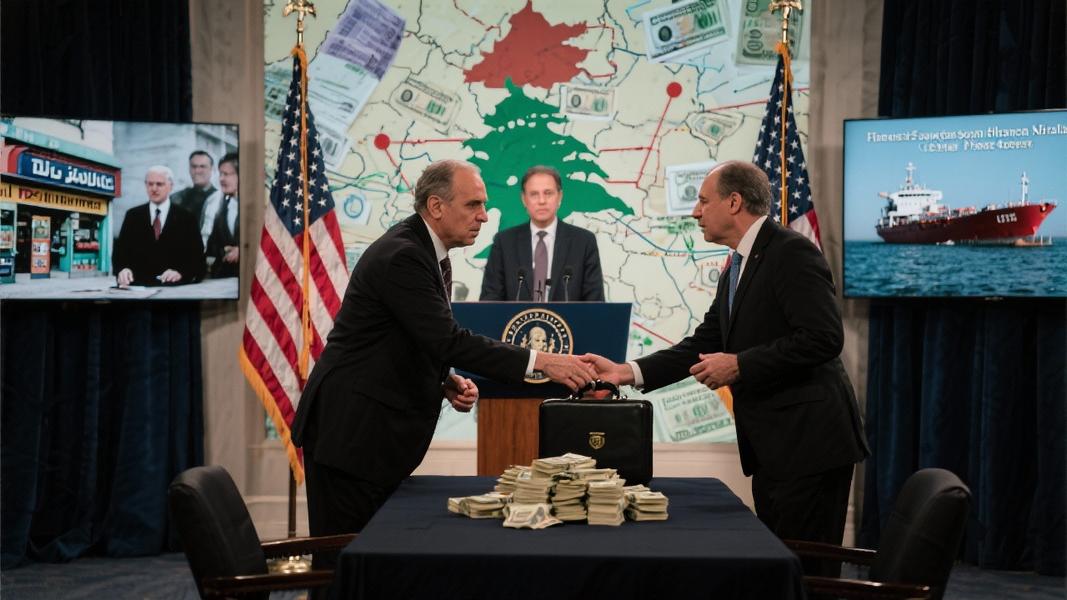
The U.S. Treasury Department has unveiled a new round of sanctions targeting individuals who funneled more than $1 billion from Iran to Hizballah since January 2025. The sanctions reveal a complex web of money exchange companies and financial operatives exploiting Lebanon’s largely cash-based economy to finance terrorist activities.
Following the Money: Hizballah’s Financial Pipeline
According to Treasury officials, the Iranian Islamic Revolutionary Guards Corps-Qods Force (IRGC-QF) has been systematically moving funds to Hizballah through shadow banking networks designed to evade international oversight. “Lebanon has an opportunity to be free, prosperous, and secure—but that can only happen if Hizballah is fully disarmed and cut off from Iran’s funding and control,” said Under Secretary of the Treasury for Terrorism and Financial Intelligence John K. Hurley.
Among those targeted is Ossama Jaber, identified as a Hizballah member who personally collected or converted tens of millions of dollars between September 2024 and February 2025. Treasury documents show Jaber worked directly with Lebanese money changers and exchange companies, many of which were owned by or associated with Hizballah members. The financial network expanded significantly following the death of Hizballah finance chief Muhammad Qasir in October 2024, when responsibilities were distributed among multiple individuals including his son Ja’far Muhammad Qasir.
The younger Qasir didn’t waste time stepping into his father’s shoes. He now manages Hizballah’s finance team and oversees its revenue-generating economic portfolio, working in close collaboration with Syrian businessman Yasar Husayn Ibrahim. Together, they’ve been selling Iranian oil, gas, and other energy products to fund Hizballah’s operations. In early 2025, Ibrahim offered to coordinate business deals with Ja’far and associates including Samer Kasbar, director of a U.S.-designated Hizballah front company, investigators found.
Cash Economy Creates Cover for Terror Financing
How does a terrorist organization move so much money in plain sight? The answer lies in Lebanon’s predominantly cash-based economy, which provides fertile ground for financial subterfuge.
“Unlicensed money exchanges and exchange companies that fail to conduct adequate screening on their customers allow Hizballah to take advantage of Lebanon’s largely cash-based economy to launder illicit money,” Treasury officials explained in their statement. This exploitation not only undermines Lebanon’s financial system but also creates a dangerous blend where terror financing mixes seamlessly with legitimate commerce.
The sanctions come at a particularly vulnerable time for Hizballah. The December 2024 collapse of Syria’s Assad regime, which had long served as both a support system and bridge to Iran, has “profoundly degraded” the organization’s ability to conduct financial transfers, according to Treasury documents. This disruption has forced Hizballah to seek alternative channels for funding, making the newly sanctioned networks all the more critical to their operations.
Under the sanctions, all property and interests belonging to the designated persons that are within U.S. jurisdiction are now blocked. U.S. persons are prohibited from engaging in transactions involving these individuals, with potential civil and criminal penalties for violations. Foreign financial institutions that facilitate significant transactions for the sanctioned entities also risk being cut off from the U.S. financial system through secondary sanctions.
Hunting for Financial Networks
The U.S. isn’t just playing defense. The State Department’s Rewards for Justice program is offering up to $10 million for information leading to the disruption of Hizballah’s financial mechanisms, underscoring the American commitment to exposing and dismantling the networks that fund the group’s activities.
“Iranian entities rely on shadow banking networks to evade sanctions and move millions through the international financial system,” Hurley noted in a related statement, pointing to the broader challenge of combating financial networks that fund malign activities and weapons development across the Middle East.
For Lebanese citizens caught in the middle, the sanctions represent yet another chapter in the ongoing struggle between Hizballah’s parallel state and international efforts to restore Lebanon’s sovereignty. With over $1 billion funneled to the organization in 2025 alone, the stakes couldn’t be higher for a country still reeling from years of economic crisis and political instability.
As Treasury officials put it, the funds obtained through these networks have been used not just to support Hizballah’s paramilitary forces, but to actively resist Lebanese government control—a sobering reminder of how financial warfare continues to shape the country’s uncertain future.
