
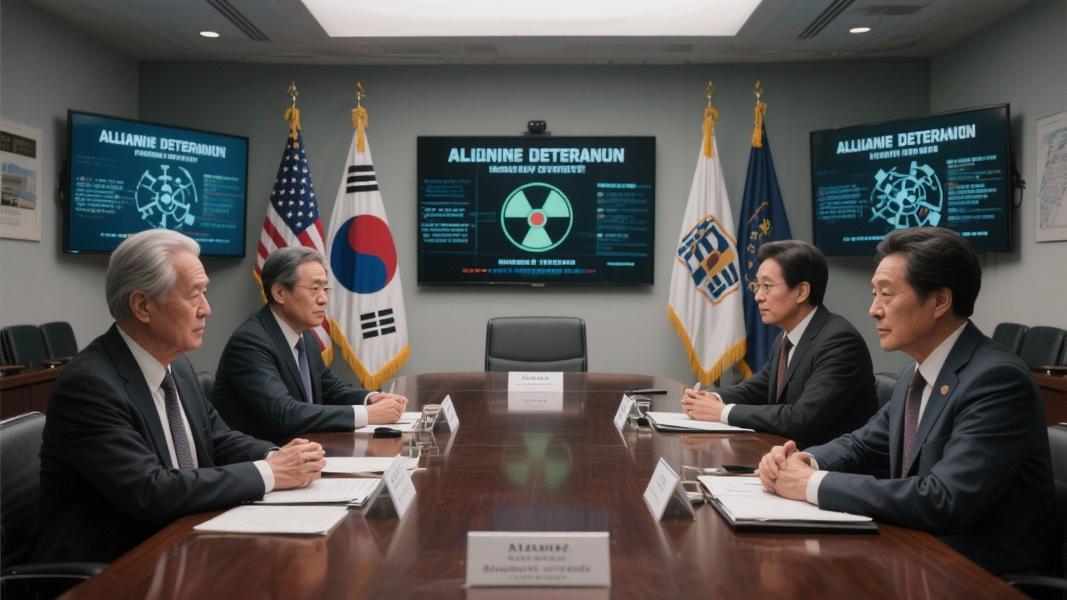
The United States and South Korea strengthened their nuclear alliance this week, as senior defense officials from both nations met in Washington for high-level consultations aimed at bolstering deterrence against North Korean threats.
The fifth U.S.-Republic of Korea Nuclear Consultative Group (NCG) meeting, held on December 11, 2025, brought together acting Principal Deputy Assistant Secretary Dr. Robert Soofer and South Korean Deputy Minister Hong-Cheol Kim to lead delegations packed with defense, foreign affairs, and intelligence officials from both countries. The discussions represent a significant evolution in the alliance’s nuclear posture, as tensions in the region continue to simmer amid North Korea’s expanding arsenal.
Equal Partners in Nuclear Deterrence
“The ROK will assume the leading role in the conventional defense of the Korean Peninsula,” Deputy Minister Kim emphasized during the talks, while Dr. Soofer “reiterated the U.S. commitment to provide extended deterrence to the ROK, utilizing the full range of U.S. defense capabilities, including nuclear,” according to a joint statement released following the meeting.
What’s notable about the NCG framework is how it positions the allies as equals in nuclear planning. Security experts have characterized the U.S.-ROK relationship as a “nuclear alliance” where both countries approach extended deterrence as equal partners — a significant shift from traditional arrangements where nuclear powers maintain exclusive control over strategic decision-making.
The alliance has been conducting an array of joint activities designed to enhance cooperative nuclear contingency planning, including a Nuclear Deterrence Immersion Course, simulation exercises, and Conventional-Nuclear Integration (CNI) table-top exercises. These activities were assessed during the meeting as significantly improving the alliance’s ability to make joint decisions during potential nuclear scenarios involving North Korea.
Origins in the Washington Declaration
The NCG was established in April 2023 as part of the Washington Declaration between President Biden and President Yoon Suk-Yeol, creating a formal structure for nuclear consultation that had previously been absent from the decades-old alliance. That declaration included five key provisions, including South Korea’s recommitment to the nuclear non-proliferation regime, U.S. commitments to consult before any nuclear use on the peninsula, and visible deployments of strategic assets, according to policy analysts who have documented the agreement’s evolution.
During this fifth meeting, the delegations approved a workplan for the first half of 2026, with a sixth principal-level NCG meeting already on the calendar. This institutionalization reflects the group’s status as “an enduring bilateral consultative body to strengthen the U.S.-ROK Alliance and enhance extended deterrence,” as noted in official statements.
Potential Nuclear Redeployment?
The elephant in the room, however, remains unaddressed in official communications. Some defense experts suggest the NCG represents a stepping stone toward potentially redeploying American tactical nuclear weapons to South Korea — weapons that were withdrawn in the early 1990s as part of denuclearization efforts.
Such a move would “do a much more effective job of enhancing deterrence, reassuring the South Korean public of American commitments, and limiting the consequences of a U.S. troop drawdown,” according to security analysts who have argued that the logical extension of the NCG would be exploring avenues for nuclear redeployment.
Neither the U.S. nor South Korea has publicly confirmed such discussions, though the increasing depth of nuclear cooperation suggests all options remain on the table.
Meanwhile, the NCG’s expanded role comes as South Korean public opinion has occasionally shown openness to developing an indigenous nuclear capability — a proposition that would dramatically alter Northeast Asian security dynamics and that U.S. officials have consistently discouraged.
For now, the alliance continues to strengthen its joint nuclear planning through the NCG framework, reflecting a delicate balance between reassuring South Korea of America’s nuclear umbrella while maintaining strategic ambiguity toward North Korea — a balancing act that grows more consequential with each passing year.
