
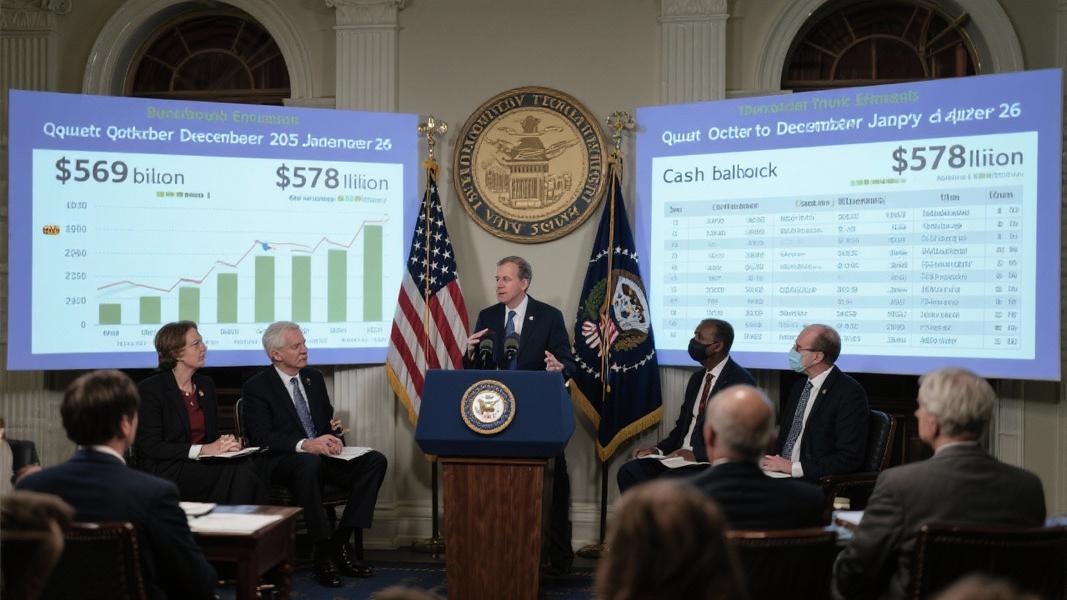
The U.S. Treasury plans to borrow $569 billion during the final quarter of 2025, slightly less than previously forecast, as government debt operations continue at historically elevated levels.
The Treasury Department announced Monday that its fourth-quarter borrowing estimate came in $21 billion lower than projections from July, primarily due to a higher cash balance at the beginning of the quarter. The adjustment offers a modest reprieve for debt markets that have absorbed massive government borrowing in recent years.
Looking ahead to early 2026, the Treasury expects to borrow $578 billion in the January-March quarter, maintaining a consistent pace of debt issuance and an $850 billion end-of-quarter cash balance.
Higher Than Expected Borrowing in Third Quarter
The latest projections follow a July-September 2025 quarter in which the Treasury borrowed $1.058 trillion in privately-held net marketable debt — $50 billion more than initially estimated. Officials ended that quarter with a cash balance of $891 billion, significantly above their projected $850 billion target.
“The $50 billion difference in privately-held net marketable borrowing resulted primarily from the higher end-of-quarter cash balance and lower net cash flows,” the Treasury explained in its statement.
What’s driving these massive borrowing needs? Persistent budget deficits remain the primary culprit, with government spending consistently outpacing revenue despite a relatively strong economy.
The Treasury’s borrowing figures specifically track “privately-held net marketable debt,” which excludes rollovers of Treasury securities held in the Federal Reserve’s System Open Market Account (SOMA). This technical distinction matters because it provides a clearer picture of new debt being absorbed by private markets.
Cash Balance Management
Treasury cash management has become increasingly complex in recent years. The department ended September with $891 billion in its coffers — $41 billion higher than previously assumed — which directly impacts borrowing requirements.
For the current quarter, the Treasury plans to maintain its $850 billion cash balance target, a level designed to provide sufficient cushion against unexpected financing needs while not unnecessarily increasing borrowing requirements.
Market watchers should mark their calendars for November 5, when the Treasury will release additional financing details related to its Quarterly Refunding at 8:30 a.m. Those specifics will outline exactly how the department plans to structure its debt issuance across different maturities.
Even with the slight downward revision for Q4, the Treasury’s borrowing needs remain near historic highs as the government continues navigating fiscal challenges that show little sign of abating as 2026 approaches.
