
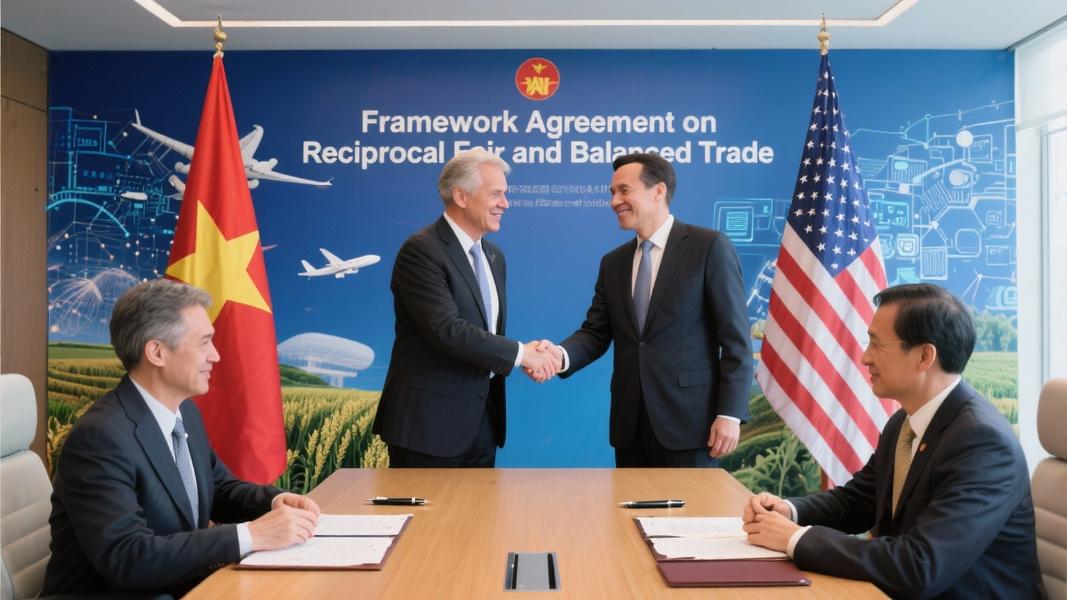
The United States and Vietnam have struck a landmark trade agreement that will reshape economic relations between the two countries, establishing a new framework that imposes a 20% tariff on most Vietnamese goods while granting U.S. exporters unprecedented access to Vietnam’s market.
The “Framework for an Agreement on Reciprocal, Fair, and Balanced Trade” aims to strengthen bilateral economic ties through a carefully calibrated system of tariffs and market access provisions. Under the deal, Vietnam pledged to provide preferential market access for “substantially all U.S. industrial and agricultural exports,” while the United States will maintain a 20% tariff on most Vietnamese goods, with select products receiving zero-tariff treatment.
Strategic Balancing Act
The timing couldn’t be more significant. Announced just days before a scheduled July 9 tariff hike, the agreement represents a strategic pivot in U.S.-Vietnam economic relations. The White House confirmed the framework will impose a standard 20% tariff on verified Vietnamese-origin exports, but will double that to 40% for goods merely transshipped through Vietnam from other countries — a move clearly aimed at preventing tariff circumvention.
“The United States and Viet Nam have agreed to a Framework for an Agreement on Reciprocal, Fair, and Balanced Trade to strengthen our bilateral economic relationship, which will provide both countries’ exporters unprecedented access to each other’s markets,” the joint statement reads.
What’s in it for Vietnam? Plenty, it seems. The Southeast Asian nation gains predictability in its largest export market while securing zero tariffs on selected goods. For the U.S., the agreement addresses long-standing concerns about market access, non-tariff barriers, and intellectual property protections.
Beyond Tariffs: Removing Trade Barriers
The deal goes far beyond simple tariff adjustments. Vietnam has committed to addressing numerous non-tariff barriers that have frustrated U.S. exporters for years. These include accepting vehicles built to U.S. motor vehicle safety and emissions standards, streamlining import licenses for medical devices, and implementing international intellectual property obligations.
Both nations have also agreed to collaborate on digital trade, services, investment, labor standards, environmental protections, and customs facilitation. Perhaps most notably, they’ve committed to addressing “any distortionary behaviors of state-owned enterprises” — a significant concession from Vietnam’s socialist government.
“The U.S.-Vietnam trade relationship exemplifies the dual forces of opportunity and risk in emerging market manufacturing,” notes an analysis from AI Invest, which suggests that “success will depend on Vietnam’s ability to strengthen digital traceability systems, enforce compliance standards, and diversify trade partnerships.”
Commercial Windfall
The agreement has already catalyzed significant commercial deals. Vietnam Airlines has agreed to purchase 50 Boeing aircraft worth over $8 billion — a much-needed boost for the American aerospace giant. Additionally, Vietnamese companies have signed twenty memorandums of understanding with U.S. agricultural producers, with purchases valued at over $2.9 billion.
Can Vietnamese manufacturers adapt quickly enough? That’s the pressing question facing the country’s export sector. The new tariff structure creates both “urgent challenges and opportunities,” according to Vietnam Briefing, which reports that companies are scrambling to deploy “immediate and short-term strategies to protect their margins and maintain US market access.”
Implementation Timeline
While the framework has been agreed upon in principle, specific implementation details remain to be finalized. The United States will determine which products qualify for zero-tariff treatment, with the selection process likely to favor strategic industries and friendly partners.
“The United States will determine products and potential tariff adjustment plans to provide friendly partners with zero-tariff reciprocal treatment,” Chain Catcher noted in its analysis of the deal.
Both countries have also expressed commitment to strengthening supply chain resilience, addressing duty evasion, and cooperating on export controls — issues that have taken on increased importance amid global trade tensions and pandemic-related disruptions.
The framework represents a significant evolution in U.S.-Vietnam relations, which have transformed dramatically since the normalization of diplomatic ties in 1995. From bitter wartime enemies to strategic economic partners, the trajectory underscores Vietnam’s growing importance in America’s Indo-Pacific strategy — and the complex dance of trade policy in an era of shifting global alliances.
