
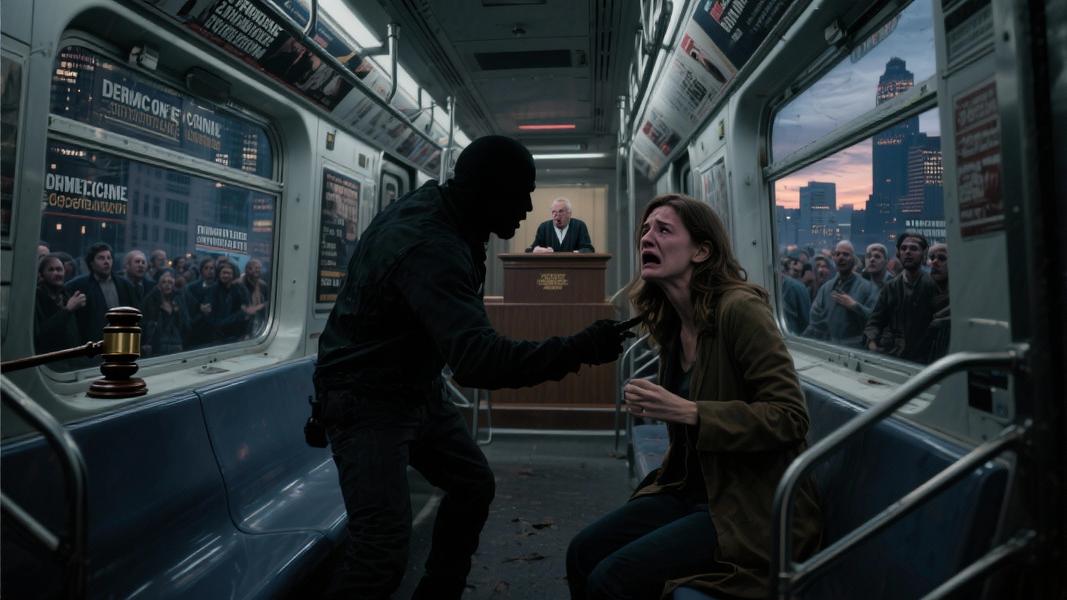
A Ukrainian refugee who fled war only to be murdered on a Charlotte light rail train might still be alive if the suspect — a man with a lengthy criminal record and documented mental health issues — hadn’t been released on a simple written promise to appear in court months earlier.
Court documents reviewed by multiple news outlets show Decarlos Brown, charged with the brutal stabbing death of Iryna Zaruska, was freed by North Carolina Magistrate Judge Teresa Stokes in January despite his history of violence and clear psychiatric problems. “North Carolina Magistrate Judge Teresa Stokes granted the release of Decarlos Brown, a homeless man charged with the brutal stabbing death of Ukrainian refugee Iryna Zaruska, following his arrest in January based upon a ‘written promise’ that Brown would return for his court hearing,” a court document revealed.
A Criminal History Ignored
Brown’s rap sheet should have raised serious red flags. He had been arrested at least 14 times over more than a decade, with charges including felony larceny, robbery with a dangerous weapon, assault, and shoplifting, according to documents obtained by the New York Post.
Perhaps more troubling? His January arrest came after he repeatedly called 911 about a bizarre delusion. “Brown wanted officers to investigate this ‘man-made’ material that was inside of his body… Officers advised Brown that the issue was medical issue and that there was nothing further they could do… The officers’ response angered Brown, leading him to call 911 with officers arresting him on the spot,” according to court documents reviewed by CBS Austin.
Mental health issues, including a schizophrenia diagnosis, were well-documented in Brown’s case. Yet despite these clear warning signs, Judge Stokes released him on nothing more than a written promise to return for court proceedings.
Part of a Larger Trend?
The decision to release Brown aligns with broader policy shifts in Charlotte and across North Carolina in recent years. In 2020, the Charlotte City Council launched an initiative to “reimagine policing,” which included diverting some 911 calls away from the police department and emphasizing alternatives to traditional law enforcement.
That same year, then-Governor Roy Cooper established a “Task Force for Racial Equity in Criminal Justice” that recommended “reimagining public safety” to “promote diversion and other alternatives to arrest,” “deemphasize” certain felony crimes, prioritize “restorative justice,” and “eliminate cash bail” for many crimes.
Charlotte-Mecklenburg Police Chief Johnny Jennings himself stated in 2020 that “law enforcement, in general, is based on racism” and suggested the department could “probably slow down” on “discretionary arrests.”
Has this progressive approach to criminal justice gone too far? Some critics think so, pointing to Brown’s release as a tragic example of what happens when public safety takes a backseat to reform ideologies.
Democrat State Senator Mujtaba Mohammed, representing Charlotte, went so far as to declare in 2020 an “independence from rogue police,” reflecting the progressive stance that has shaped local policies on policing and criminal justice.
A Presidential Response
The case has drawn national attention, including comments from President Trump, who on September 8 addressed the broader issue of public safety. “There are evil people. We have to be able to handle that. If we don’t handle that, we don’t have a country,” Trump remarked.
For the family of Iryna Zaruska, who survived the horrors of war in Ukraine only to be killed on American public transit, these policy debates offer little comfort. Their tragedy stands as a stark reminder that decisions made in courtrooms and city councils can have devastating real-world consequences.
The system, designed to balance public safety with individual rights, failed spectacularly in this case. And a refugee seeking safety in America paid the ultimate price.
