
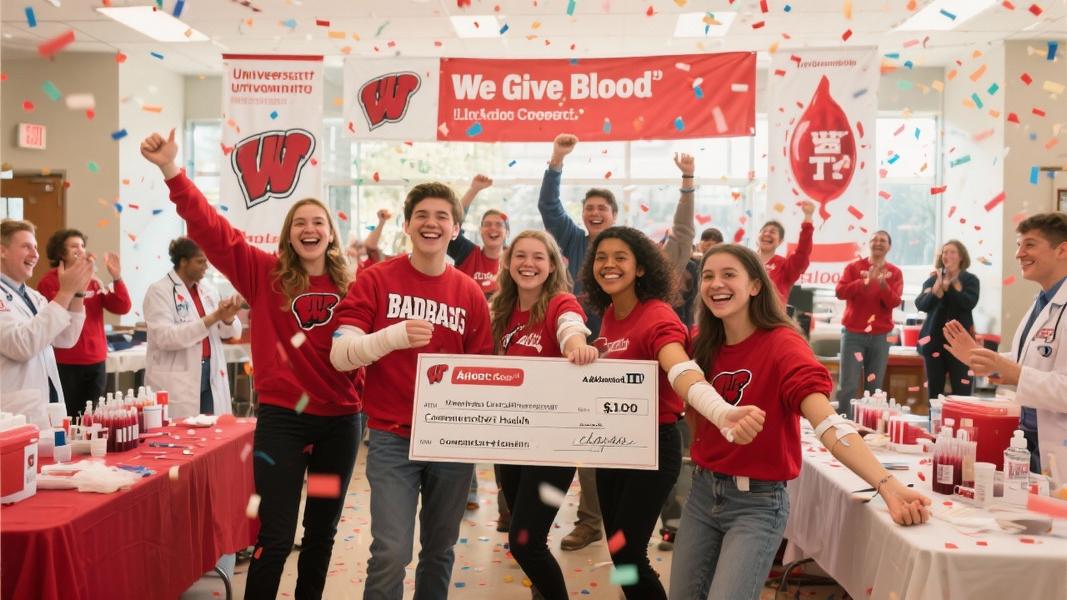
In a stunning display of collegiate solidarity, the University of Wisconsin clinched the 2025 Abbott and Big Ten “We Give Blood” competition, rallying an astonishing 15,476 blood donations that could potentially save up to 46,428 lives.
The Badgers edged out defending champion University of Nebraska in a nail-biting finish, earning a $1 million prize from Abbott to advance student or community health initiatives. The victory comes amid what health officials have described as “the largest blood shortage in a generation.”
Record-Breaking Participation
How dramatic was the increase? This year’s competition saw donations surge by a staggering 319% compared to 2024, with 83,043 total donations across all Big Ten schools. Each donation has the potential to save up to three lives, meaning nearly 250,000 lives could be impacted by the campaign’s success, according to competition organizers.
“This life-saving partnership demonstrates the tremendous passion of the Big Ten community,” said Tony Petitti, commissioner of the Big Ten Conference. “We’re proud to help activate our fans from coast-to-coast in support of such a valuable mission and excited for the opportunity to honor the University of Wisconsin during the 2025 Discover Big Ten Football Championship Game.”
The competition, which ran from August 27 through December 5, allowed participants to donate at any blood center nationwide and credit their school via text message or online submission. Wisconsin will receive formal recognition at the 2025 Discover Big Ten Football Championship Game.
Addressing a Critical Need
In the United States, someone needs blood every two seconds. The donations are critical for trauma patients, accident victims, cancer patients, mothers with childbirth complications, and premature babies. Yet the national blood donor pool continues to shrink and age at an alarming rate.
That demographic challenge is what makes this competition so significant. Blood donations among 19- to 24-year-olds have fallen by nearly one-third in recent years, making college students a vital audience. The initiative appears to be working: nearly 37% of student donors reported that the campaign inspired them to donate for the first time, and over 90% indicated they’re likely to donate again.
University of Wisconsin-Madison Chancellor Jennifer Mnookin expressed pride in her campus community’s response. “I am incredibly proud of our Badger community for showing up with generosity, compassion, and fantastic teamwork,” she said. “Together, we’re saving lives. A huge thank you to our students, faculty, and staff and broader Badger community for demonstrating once again the power of our Wisconsin Idea commitment to public service.”
Harnessing Rivalry for Good
The competition cleverly leveraged the intense rivalries of Big Ten athletics to fuel participation. Weekly “One-Up Challenges” pitted schools against each other in mini-competitions, with donors from winning schools eligible for special campus experiences offered by their universities.
Robert B. Ford, chairman and chief executive officer of Abbott, noted the broader impact of the campaign. “This year’s competition not only helped to save a record-breaking number of lives, but it also showed the power of using sports for good with all schools increasing their participation from year one,” he said. “We are proud of the students, alumni, and fans who united to make a lasting impact on the blood supply, and we hope this spirit continues well beyond the season.”
Last year’s inaugural competition winner, the University of Nebraska-Lincoln, collected nearly 4,000 donations — saving as many as 12,000 lives. The university has used its prize money to support health-focused research, student organization grants, and its Well-Being Collective, which promotes students’ physical, social, and emotional health.
Wisconsin’s winning total of 15,476 donations represents a remarkable fourfold increase over last year’s champion, suggesting the competition has found its footing and established itself as what may become a permanent and increasingly impactful tradition in Big Ten athletics.
For a conference known for its passionate fan bases and storied rivalries, this competition may ultimately prove to be its most meaningful legacy — turning the energy of college sports toward saving lives, one donation at a time.
