
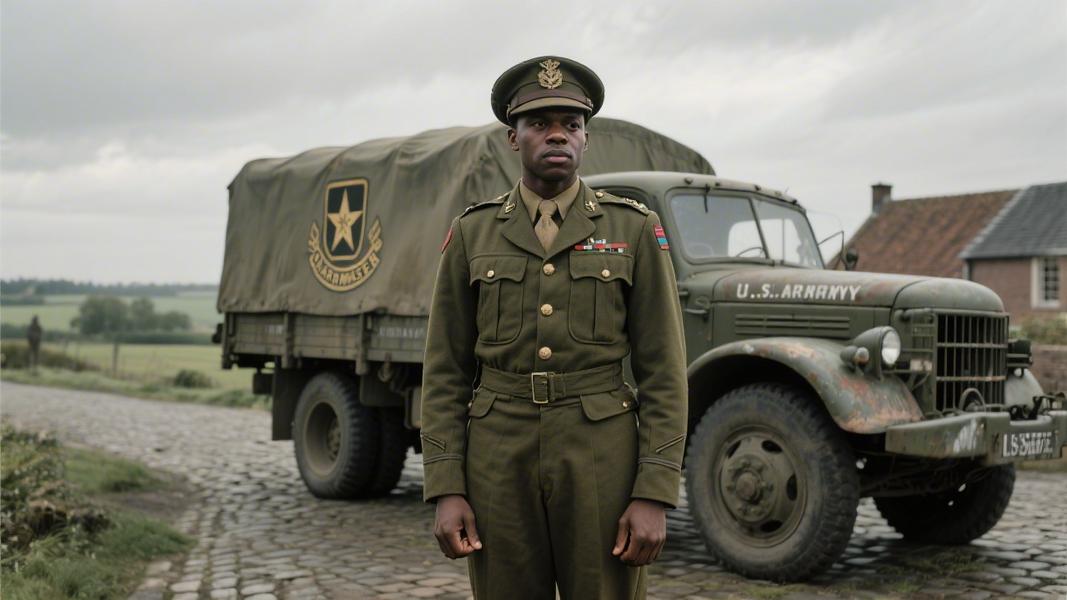
He was a sergeant, not a general — and that distinction matters more than most history books let on.
The Texas General Land Office has spotlighted the wartime service of Sergeant M.C. Clark, a U.S. Army veteran whose story is preserved through the agency’s Voices of Veterans oral history program — an initiative dedicated to capturing the firsthand accounts of Texas servicemembers before those voices are lost entirely. Clark’s interview, archived in full through the program, documents a life shaped by service in the U.S. Army Quartermaster Corps, with deployments spanning Scotland, Ireland, England, and Belgium during World War II.
A Different Kind of Service
Not every WWII story involves a beachhead or a firefight. Clark’s doesn’t, at least not in the conventional sense. His role as a POW guard placed him at one of the war’s more morally complicated intersections — responsible for the custody of enemy prisoners at a time when the rules of engagement were written in real time, under real pressure. It’s the kind of assignment that rarely makes it into the highlight reel of wartime mythology, but it’s exactly the sort of detail that oral history programs exist to preserve.
The Voices of Veterans archive, maintained by the Texas GLO, has quietly become one of the more important repositories of enlisted-level testimony in the American Southwest. While generals write memoirs and commanders get biographies, it’s the sergeants — the ones hauling supplies across the Scottish Highlands or watching over prisoners somewhere outside Brussels — who tend to get forgotten. That’s the gap this program is trying to close.
Why Enlisted Voices Get Lost
Here’s the uncomfortable truth about how military history gets recorded: rank has always had its privileges, and documentation is one of them. High-ranking officers like General Mark Wayne Clark — commander of the Fifth Army and a towering figure in the European theater — left behind voluminous records, press coverage, and published accounts of their decisions. Sergeant Clark, by contrast, left behind an oral history interview. That’s it. And it’s arguably more valuable.
Still, the logistics of preservation are complicated. Oral histories age. Tapes degrade. Memories fade, and the veterans themselves — the last living links to that era — are almost entirely gone now. The Greatest Generation, as they’ve been called with only mild irony by every pundit since Tom Brokaw coined the phrase, is down to its final members. Which is precisely why the Texas GLO’s documented effort to capture these interviews carries an urgency that wasn’t there even a decade ago.
The Quartermaster Corps and the Invisible War
What did the Quartermaster Corps actually do? More than most people realize. They were the logistical backbone of the Allied effort — responsible for food, fuel, clothing, equipment, graves registration, and yes, the movement and housing of prisoners of war. Without them, Patton’s tanks don’t move. Without them, troops in Belgium go hungry in the winter of 1944. The corps operated largely in the background, and its members paid a psychological price for work that was essential but unglamorous.
Clark’s postings — Scotland, Ireland, England, Belgium — trace a geographic arc that mirrors the Allied buildup and eventual push into Western Europe. It’s a trajectory that tells its own story, even without the specific details of his individual assignments. Someone moving through those theaters in that sequence was present for the slow, grinding preparation that preceded D-Day and the chaotic aftermath that followed it.
Accessing the Full Record
The complete interview with Sergeant Clark is available through the Voices of Veterans program on the Texas General Land Office website. The archive includes dozens of similar interviews — men and women whose service was real, whose sacrifices were documented, and whose stories deserve the same careful attention that history has traditionally reserved for those with stars on their shoulders.
That said, accessing these materials requires some effort on the reader’s part. The GLO has built a searchable interface, but the depth of any individual record varies. Some interviews run to dozens of pages of transcript. Others are shorter. Clark’s, given the specificity of the press release highlighting it, appears to be among the more substantive entries in the collection.
The Bigger Picture
Oral history programs like this one exist at a peculiar cultural moment. On one hand, there’s more interest than ever in primary-source documentation — journalists, historians, and documentary filmmakers have never had more tools for capturing and distributing personal testimony. On the other, the actual subjects of WWII-era oral histories are almost entirely gone, which means programs like Voices of Veterans are now working almost entirely with recordings rather than living interviews.
The Texas GLO has been running this initiative for years, and the breadth of its collection reflects a genuine institutional commitment — not just a press-release-friendly gesture. That matters. Because the alternative, the slow disappearance of enlisted-level testimony into institutional silence, is exactly what happened to generations of veterans before the oral history movement took hold.
Sergeant M.C. Clark served his country in theaters that stretched across the North Atlantic and into the heart of occupied Europe. He did it without a general’s stars, without a biographer, and without the kind of institutional memory that comes with commanding armies. What he left behind is a recording. It’s worth listening to.
