
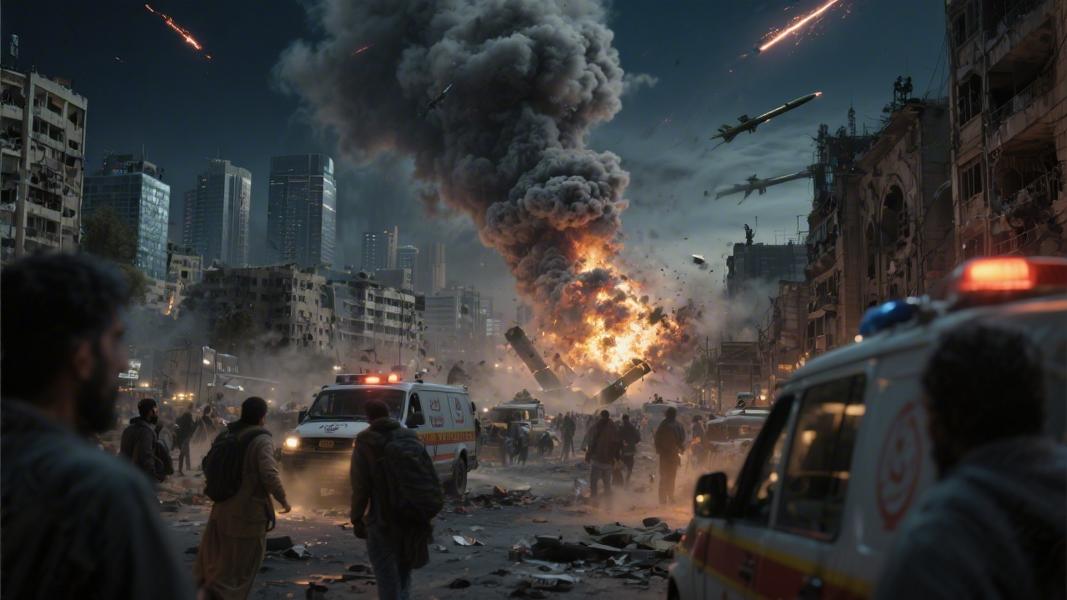
The bombs are still falling — and so is any pretense of diplomacy. As of March 5, 2026, the United States and Israel are prosecuting an active military campaign against Iran, and the human cost is climbing by the hour.
This isn’t a standoff or a series of warning shots anymore. It’s a war — one that has already killed more than a thousand civilians inside Iran in its first five days alone, spilled into Lebanon, and drawn in U.S. naval assets halfway across the globe. The question now isn’t whether this conflict has escalated. It’s how far it goes, and who pays the price.
Trump’s Warning — and Iran’s Answer
President Donald Trump set the tone for the day early Wednesday, posting on Truth Social with characteristic bluntness: “Today Iran will be hit very hard!” He also warned that more Iranian officials would become targets — a signal that the campaign isn’t simply about military infrastructure anymore.
Tehran didn’t flinch. Iranian President Masoud Pezeshkian publicly dismissed Trump’s earlier calls for Iran to surrender unconditionally, saying that’s “a dream that they should take to their grave.” It’s the kind of line that plays well at home — and probably signals that no off-ramp is coming anytime soon.
Still, bravado has its limits when warships are sinking. U.S. Defense Secretary Pete Hegseth claimed on Wednesday that an American submarine had sunk an Iranian warship in the Indian Ocean the previous day — a significant escalation that extends the conflict well beyond the Gulf region and into open-ocean warfare.
The Civilian Toll Nobody Wants to Talk About
How bad is it? Bad. The U.S.-based Human Rights Activists News Agency has documented more than 1,000 civilians killed inside Iran in just the first five days of fighting — among them, 181 children under the age of ten. Those aren’t combatant casualties. Those are families.
One strike in particular has drawn international condemnation. Shiva Amelirad, a Canada-based representative of Iranian teachers’ unions, confirmed that at least 108 children were killed in a strike on Minab. The Iranian Red Crescent Society put the toll from that single incident even higher — tallying 175 schoolgirls and staff killed there, part of a nationwide death count the organization places at least 1,230.
That’s not a rounding error. That’s a school.
The Regional Spillover
Lebanon is bleeding too. The country’s health ministry reported at least 102 people killed and more than 638 wounded — a reminder that Israel’s parallel campaign is reshaping multiple fronts simultaneously. A separate human rights group noted over 70 killed in Lebanon, figures that may still be incomplete as reporting catches up with the pace of strikes.
Taken together, Wikipedia’s aggregated casualty estimates — drawing from multiple sources — place the total regional death toll at somewhere between 1,482 and 4,301 killed, with Iran alone accounting for 1,216 to 4,145 of those figures. The range is wide, which is itself telling. In active conflict zones, the truth tends to lag behind the bombs.
Energy, Stakes, and the Bigger Picture
But it’s not just about the military math. Omar Qudrat, a former U.S. Department of Defense official, offered a sobering reminder of why this conflict carries global weight: “as to global effects, Iran’s energy has always made its regime globally significant.” Oil markets, shipping lanes, regional alliances — all of it is now in play in ways that will ripple far beyond the Middle East. Analysts have begun warning of sustained disruption to energy supplies if the campaign continues at this pace.
That said, none of that geopolitical calculus brings back 175 girls who went to school on a Wednesday and didn’t come home.
