
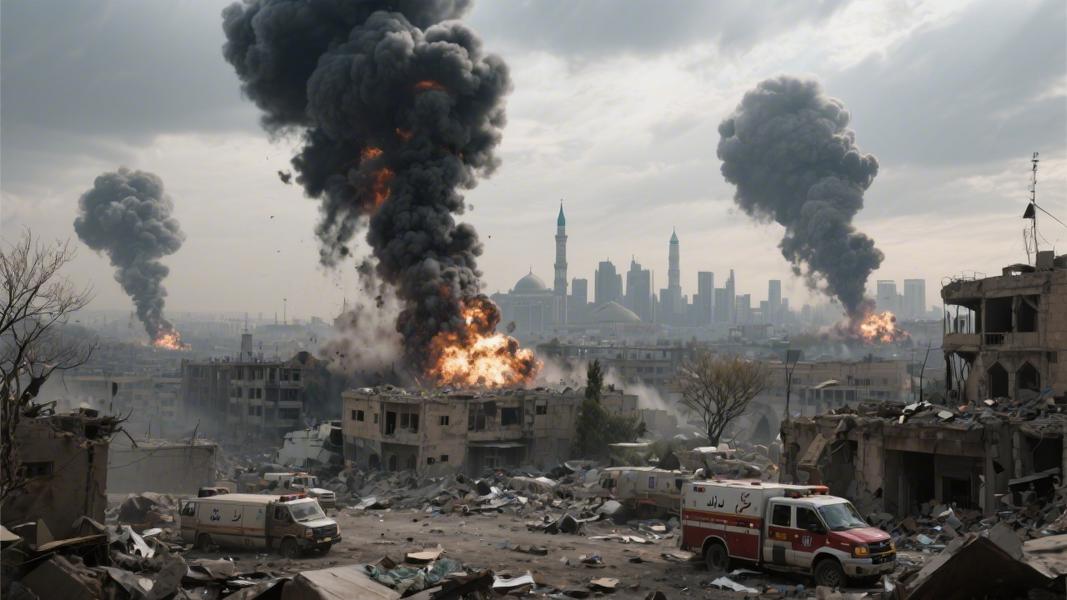
Three American service members are dead. Five more are seriously wounded. And the United States — alongside Israel — is now at war with Iran.
In the early hours of February 28, 2026, the U.S. and Israel launched a sweeping, coordinated military campaign against the Islamic Republic, striking at the very heart of its government and armed forces. The operation, codenamed Operation Epic Fury by the U.S. and Roaring Lion by Israel, represents the most significant direct military action against Iran in modern history — and it’s still ongoing. The strikes targeted senior officials including Supreme Leader Ayatollah Ali Khamenei, and by most accounts, the goal isn’t just to degrade Iran’s capabilities. It’s regime change, full stop.
What We Know About the Strikes
The scope of the operation is staggering. U.S. and Israeli forces hit Iranian military installations, governmental sites, ballistic missile stockpiles, drone production facilities, naval infrastructure, and the command structure of the Islamic Revolutionary Guard Corps, according to analysts tracking the campaign. The campaign was specifically calibrated, officials say, to degrade Iran’s ability to strike back — taking out missiles, drones, leadership, and naval assets before any retaliation could be mounted.
President Donald Trump addressed the Iranian people directly in a televised statement that was, to put it mildly, unlike anything a sitting American president has ever said publicly. “Finally, to the great, proud people of Iran, I say tonight that the hour of your freedom is at hand,” Trump declared. “Stay sheltered. Don’t leave your home. It’s very dangerous outside. Bombs will be dropping everywhere. When we are finished, take over your government. It will be yours to take. This will be probably your only chance for generations.”
That’s not a warning. That’s an invitation to revolution — delivered mid-airstrike.
Trump’s Four Objectives — and a Fifth That Goes Unsaid
The White House has framed the operation around four stated military objectives: preventing Iran from acquiring a nuclear weapon, destroying its missile arsenal and production capacity, dismantling its network of regional proxies, and annihilating the Iranian navy. The Center for Strategic and International Studies has noted each of these goals explicitly. But the fifth objective — regime change — is increasingly hard to separate from the rest. Trump’s address to the Iranian people made that subtext into plain text.
Still, the operation hasn’t come without cost. As strikes entered their second day on March 1, 2026, the U.S. Navy Institute confirmed that at least three American service members were killed and five were seriously wounded. Several others sustained concussions or shrapnel injuries. The human toll, in other words, is already real — and the operation is far from over.
Iran Threatens to Hit Back. Trump Responds on Social Media.
Iran didn’t stay quiet. After Tehran signaled it intended to retaliate, Trump took to Truth Social with a message that left little room for diplomatic interpretation. “Iran just stated that they are going to hit very hard today, harder than they have ever been hit before,” he wrote. “THEY BETTER NOT DO THAT, HOWEVER, BECAUSE IF THEY DO, WE WILL HIT THEM WITH A FORCE THAT HAS NEVER BEEN SEEN BEFORE!”
How does one parse that? With difficulty. The Atlantic Council’s experts, reacting in real time, warned that even a degraded Iran retains the capacity — and, crucially, the motivation — to strike back through proxy forces, cyberattacks, and direct missile salvos. Degrading retaliatory capacity is one thing. Eliminating it entirely is another, and probably not achievable in a matter of days.
What Comes Next
The broader strategic picture is still taking shape. What’s clear, as reported by public radio outlets tracking the operation’s second day, is that this isn’t a one-night strike meant to send a message. This is a sustained campaign with an end state that goes well beyond any previous American military action in the region. The killing of Khamenei — if confirmed — would mark the first time the U.S. has directly eliminated the supreme leader of a sovereign nation since the modern era of international law took shape.
Wikipedia’s documentation of the strikes is already being updated by the hour, a strange artifact of how fast history is moving right now. And video footage emerging online shows strikes lighting up the Tehran skyline — images that, just a year ago, would have seemed unthinkable.
Three Americans are dead. A supreme leader may be gone. And a president is telling the Iranian people, via social media, to seize their moment. Whatever happens next, the Middle East — and the world — will not look the same on the other side of it.
