
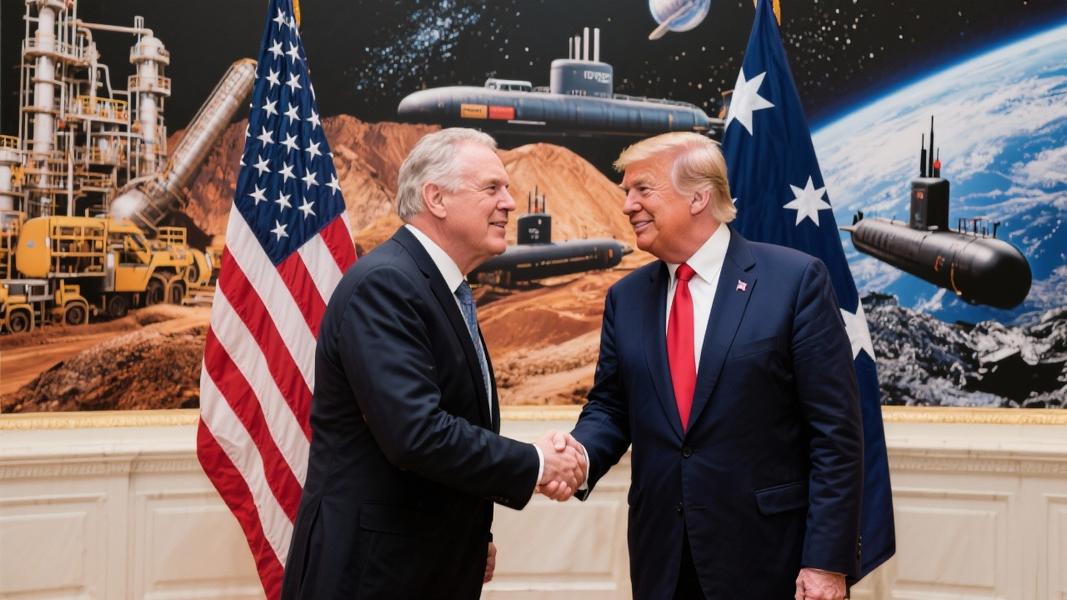
In a sweeping diplomatic maneuver that could reshape global mineral supply chains, President Donald J. Trump and Australian Prime Minister Anthony Albanese have signed a landmark framework agreement committing more than $3 billion toward critical mineral projects over the next six months.
The deal, announced during high-level bilateral talks in Washington, represents one of the most significant economic partnerships between the two nations in recent years, with potential recoverable resources estimated at a staggering $53 billion in value. Officials from both countries confirmed the Export-Import Bank of the United States has already issued Letters of Interest exceeding $2.2 billion to jumpstart financing for these initiatives.
Strategic Minerals: The New Battlefield
Why does this matter now? As global competition for rare earth elements and processing capabilities intensifies, particularly with China’s dominance in the sector, the U.S.-Australia partnership signals a determined Western push for supply chain security. The Department of War’s decision to invest in a 100-metric-ton-per-year advanced gallium refinery in Western Australia underscores the urgent national security dimensions at play, experts note.
“This isn’t just about economic cooperation — it’s about ensuring technological independence in an increasingly fractured global marketplace,” said one senior administration official who requested anonymity to discuss sensitive matters.
The gallium facility, critical for semiconductor manufacturing and defense applications, represents a direct attempt to reduce dependence on Chinese processing capabilities that have dominated global markets for decades.
Defense Ties Deepen
But minerals are just one piece of the expanding alliance. Australia has simultaneously committed to purchasing $1.2 billion in Anduril unmanned underwater vehicles — autonomous systems that will significantly enhance the Royal Australian Navy’s surveillance capabilities in the Indo-Pacific region, defense analysts suggest.
The underwater systems deal comes alongside a separate $2.6 billion agreement for Apache helicopters, substantially upgrading Australia’s attack helicopter capabilities at a time of growing regional tensions.
Perhaps most significantly for American interests, Australia has already contributed $1 billion toward expanding and modernizing the U.S. submarine industrial base — a direct investment in American manufacturing capacity — with another billion planned by year’s end. This contribution directly supports the trilateral AUKUS security partnership that includes the United Kingdom.
Economic Integration Accelerates
Beyond defense and minerals, the economic integration between the two nations appears set to accelerate dramatically. Australian superannuation funds — the country’s massive pension system — are projected to increase their investments in the United States to a remarkable $1.44 trillion by 2035, potentially creating tens of thousands of American jobs, according to government projections.
The sheer scale of this capital flow represents one of the largest foreign investment commitments into American infrastructure and industry in recent memory.
Technology cooperation is expanding too. Negotiators are finalizing what they’re calling a “Technology Prosperity Deal” focused on artificial intelligence, quantum computing, and other emerging fields where Western allies are racing to maintain advantages.
Space: The Next Frontier
Looking skyward, NASA and the Australian Space Agency have formalized their own framework agreement strengthening civil space cooperation. The deal includes Australia’s participation in the Artemis lunar program, where Australian engineers will develop a specialized lunar rover.
Interestingly enough, even American cattle ranchers stand to benefit. The agreements include expanded market access for U.S. beef exports to Australia — a surprising development given Australia’s own massive beef industry.
Critics might question whether these ambitious commitments will materialize as planned. Previous critical minerals initiatives have sometimes struggled to move from memorandums to mines, with financing and environmental permitting creating bottlenecks that slowed actual production.
Still, the comprehensive nature of these agreements — spanning defense, space, agriculture, and finance — suggests a relationship that’s evolving beyond traditional alliance parameters into something resembling economic integration.
As competition with China intensifies across multiple domains, this U.S.-Australia partnership may represent something more profound than typical diplomatic declarations: the beginnings of a Western economic bloc built around secure supply chains for the technologies that will define the coming decades.
