
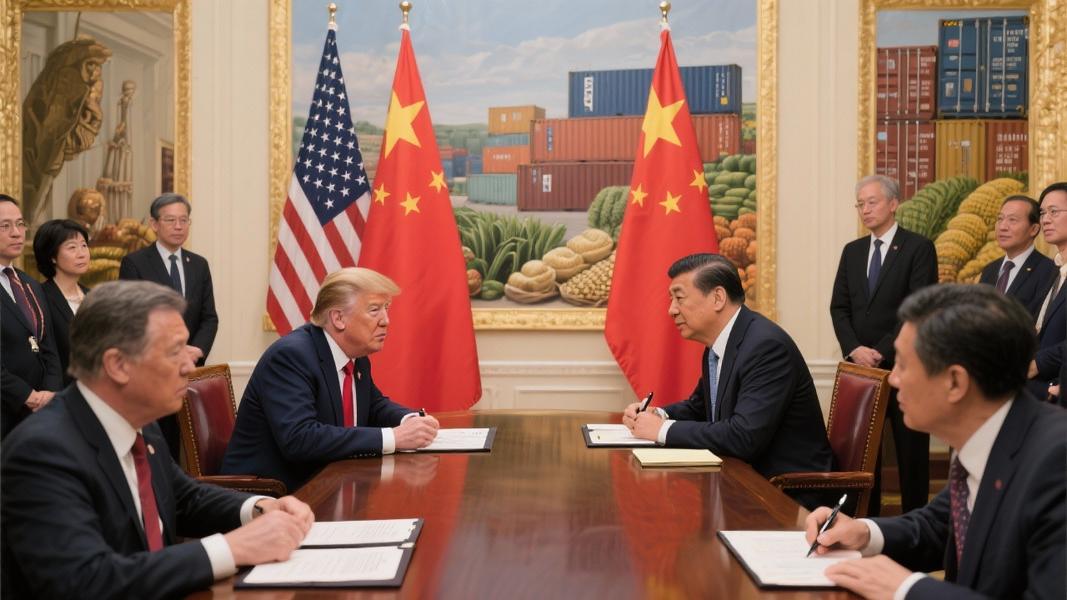
The United States and China have struck a significant trade deal that suspends escalated tariffs between the world’s two largest economies until late 2026, marking a temporary easing of tensions in the long-running trade war.
Under the agreement, the U.S. has committed to “maintain the suspension of heightened reciprocal tariffs on imports” from China until November 10, 2026, according to details outlined in official statements. However, the deal maintains a 10% additional ad valorem duty on Chinese imports during this period.
Agricultural Relief
For American farmers, the agreement brings welcome news. China has agreed to suspend retaliatory tariffs on a wide range of U.S. agricultural products, including soybeans, chicken, pork, beef, dairy, wheat, corn, cotton, and sorghum, as revealed in the deal’s details.
“China will suspend retaliatory tariffs on soybeans, chicken, pork, beef, dairy products, wheat, corn, cotton, sorghum and more,” the agreement states, potentially opening up significant export opportunities for American producers who have weathered years of market uncertainty.
Beijing has also “committed to purchase United States agricultural exports integral to the economy and general welfare of the United States, including soybeans, sorghum, and logs,” according to documents published by the Cato Institute.
Tariff Extensions
What does this mean for businesses importing Chinese goods? The U.S. Treasury has extended the expiration of certain Section 301 tariff exclusions on Chinese goods, pushing the deadline from November 29, 2025, to November 10, 2026, as reported by EY Tax News.
President Trump justified the continuation of a 10% additional duty during this period, stating, “I determined that it was necessary and appropriate to address the emergency declared in Executive Order 14257 by suspending application of the heightened ad valorem duties imposed on the PRC under Executive Order 14257, as amended, and to instead impose on articles of the PRC an additional ad valorem rate of duty of 10 percent.”
Critical Minerals and Semiconductors
Perhaps most significantly for technology and manufacturing sectors, China has pledged to address several contentious issues in the high-tech supply chain. The agreement indicates that “The PRC has committed to, among other things, postpone and effectively eliminate the PRC’s current and proposed coercive global export controls on rare earth elements and other critical minerals.”
These rare earth elements are crucial components in everything from smartphones to electric vehicles to military equipment. The deal also requires China to “address Chinese retaliation against United States semiconductor manufacturers and other major companies in the semiconductor supply chain.”
But will China follow through? The U.S. administration has built in monitoring mechanisms and reserved the right to respond if commitments aren’t met.
“Should the PRC fail to implement its commitments under the Arrangement, I may modify this order as necessary to deal with the emergency declared in Executive Order 14257,” President Trump stated in the executive order implementing the deal.
The agreement provides businesses on both sides with a measure of certainty through late 2026, though the 10% additional tariff remains a significant trade barrier. For U.S. farmers and manufacturers who have navigated years of trade turbulence, the deal represents a partial return to more predictable market conditions — at least until the next presidential election cycle brings potential new approaches to U.S.-China relations.
