
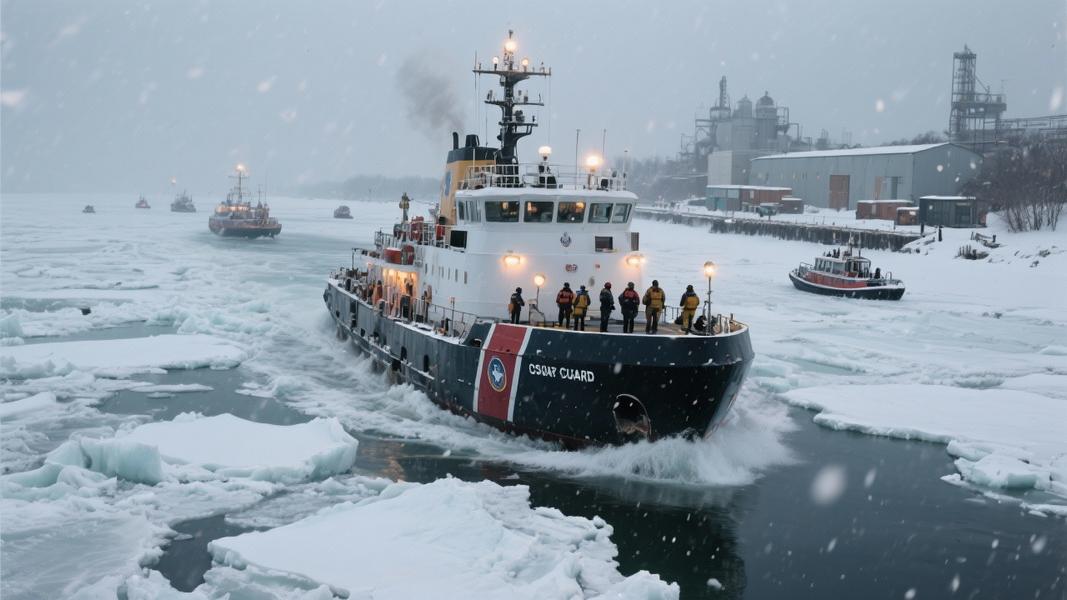
U.S. Coast Guard’s icebreaking fleet springs into action across both poles this winter, with three concurrent operations highlighting America’s renewed focus on polar capabilities. The aging but resilient USCGC Polar Star, now celebrating its 50th year of service, has once again proven its worth with a dramatic rescue in Antarctica’s treacherous waters.
On January 2, the Coast Guard launched Operation Coal Shovel, deploying icebreakers across the Great Lakes region from southern Lake Huron through the St. Clair-Detroit River system and into Lakes Erie and Ontario. The mission’s primary objective? Breaking through frozen channels to reach isolated communities and deliver essential supplies during the harsh winter months.
Meanwhile, thousands of miles south, the service’s sole heavy icebreaker is marking a milestone anniversary while conducting its 29th deployment to Antarctica. “Polar Star is the nation’s only active heavy icebreaker and has served as a cornerstone of U.S. presence in the polar regions,” the Coast Guard stated as the vessel departed Seattle in November for Operation Deep Freeze 2026.
Dramatic Rescue Highlights Icebreaker’s Critical Role
That presence proved vital when the cruise ship MV Scenic Eclipse II found itself trapped in pack ice near McMurdo Sound in the Southern Ocean. The Polar Star quickly responded, breaking through the dense ice to free the stranded vessel and its passengers — a dramatic demonstration of why icebreaking capabilities remain essential even as climate change alters polar environments.
The rescue comes at a pivotal moment for the Coast Guard’s icebreaking fleet. For the first time in nearly two decades, three active icebreakers were simultaneously docked in Seattle last November, a visual testament to the service’s expanding polar operations. This renaissance is backed by substantial investment — almost $9 billion has been allocated for new ships as the U.S. positions itself for increased activity in warming Arctic regions.
Why the sudden focus on icebreaking capabilities? As polar ice recedes, new shipping routes and resource extraction opportunities are emerging, particularly in the Arctic. Nations including Russia and China have aggressively expanded their icebreaker fleets in recent years, prompting American officials to address a capability gap that has persisted for decades.
The 50-year-old Polar Star’s continued operation underscores both the durability of these specialized vessels and the challenges faced by the Coast Guard in maintaining polar capabilities with aging equipment. Each deployment represents a technical achievement for the service’s engineers and crew, who must keep the vintage icebreaker operational in some of Earth’s most hostile environments.
As climate change transforms the polar regions, the Coast Guard’s icebreakers find themselves at the intersection of traditional missions and emerging challenges — from search and rescue operations to maintaining America’s strategic presence in increasingly contested waters at the top and bottom of the world.
