
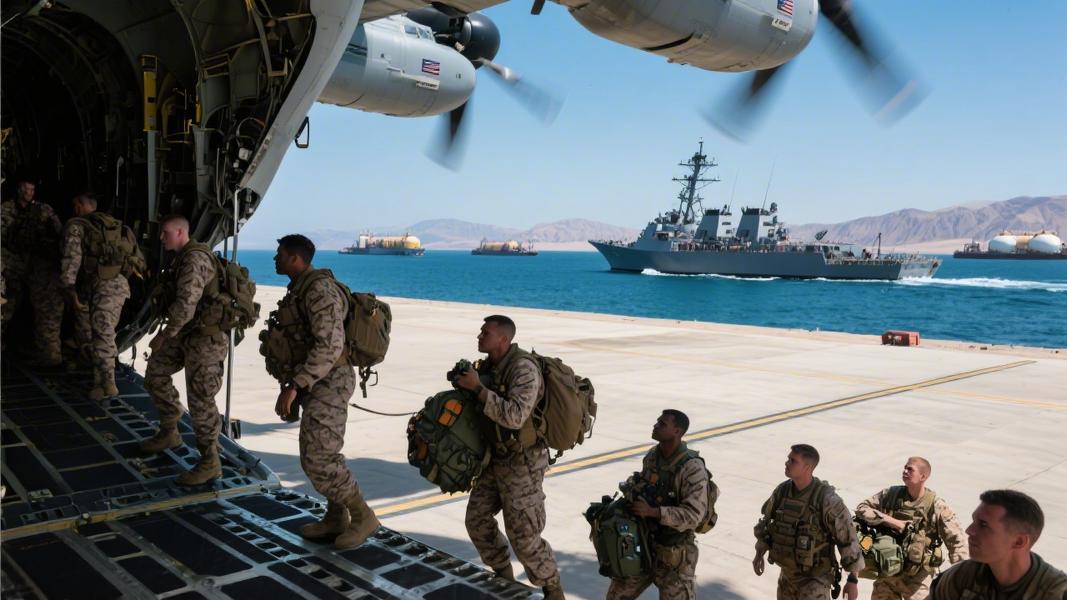
The United States is doubling down in the Middle East, and fast. As the war with Iran stretches into its third week, the Pentagon is pouring more firepower into the region — warships, Marines, and a grim warning that the casualties aren’t over yet.
Defence Secretary Pete Hegseth has approved a U.S. Central Command request to deploy a Marine Expeditionary Unit — up to 2,500 Marines — along with elements of an amphibious ready group totalling around 5,000 personnel, according to officials. The move comes as Iran’s blockade of the Strait of Hormuz continues to choke one of the world’s most critical shipping lanes — and as the broader conflict, dubbed Operation Epic Fury, shows no signs of winding down.
Marines, Warships, and a Blockade That’s Rattling Markets
Leading the new naval deployment is the USS Tripoli, an amphibious assault ship, accompanied by its 31st Marine Expeditionary Unit. The Pentagon has been deploying the force in direct response to escalating tensions, with Hegseth making clear — in his characteristically blunt fashion — that the campaign isn’t finished. “Very soon,” he said, “all of Iran’s defense companies will be destroyed.”
That’s a bold claim. But the numbers backing it up are, if accurate, striking. Iran’s missile stockpile has reportedly decreased by 90 percent, and its suicide drone count has dropped by 95 percent, with more than 15,000 Iranian targets struck by U.S. and Israeli forces combined, as noted by defense analysts tracking the operation. Whether those figures hold up to independent scrutiny remains an open question — but Washington is clearly projecting confidence.
“We Expect to Take Additional Losses”
Not everyone in uniform is talking victory laps. Gen. Dan Caine, Chairman of the Joint Chiefs of Staff, addressed reporters with a soberness that cut through the triumphalist noise. Four U.S. service members have already been killed in the operation. More deaths, he warned, are coming. “This is not a single, overnight operation,” Caine said. “We expect to take additional losses.”
That’s the kind of line that tends to get buried beneath the satellite imagery and strike counts — but it matters. It tells you something about the military’s honest internal assessment, even as the public messaging leans hard into the operational wins.
Two Carrier Groups, No Boots on the Ground — For Now
Operation Epic Fury is currently anchored by two carrier strike groups: the USS Gerald R. Ford and the USS Abraham Lincoln. Their focus, the Pentagon says, has been Iran’s missile systems, production infrastructure, and naval capabilities. Critically — and this point has been stressed repeatedly — there are no U.S. ground forces inside Iran.
Still, how long that holds is anyone’s guess. When pressed on whether ground troops might eventually be deployed, Hegseth deflected with a line that’s become something of a Washington classic: “Why in the world would we tell the enemy what we will or will not do?” It’s a non-answer, of course — but it’s also not a denial, and reporters in the room noticed.
The Bigger Picture
What’s unfolding in the Persian Gulf right now is the largest U.S. military engagement in the Middle East in years — possibly decades, depending on how the next few weeks unfold. The Strait of Hormuz blockade alone carries enormous economic stakes; roughly 20 percent of the world’s oil supply passes through that narrow chokepoint. Every day it stays closed, pressure builds — on markets, on allies, on the administration to show results.
But it’s not that simple. Military campaigns that begin with declarations of swift destruction have a long and humbling history in this region. The hardware is impressive, the strike numbers are staggering, and the political will in Washington appears — for now — unwavering. Whether that’s enough to end this cleanly is a different question entirely.
As Gen. Caine might put it: this is not a single, overnight operation. The country would do well to remember that.
