
America’s education system is in crisis. The latest national test scores aren’t just bad — they’re historically bad.
New data from the 2024 National Assessment of Educational Progress (NAEP), commonly known as “the nation’s report card,” reveals American students have reached alarming new lows in core academic subjects, with proficiency rates that would earn failing grades in most classrooms across the country.
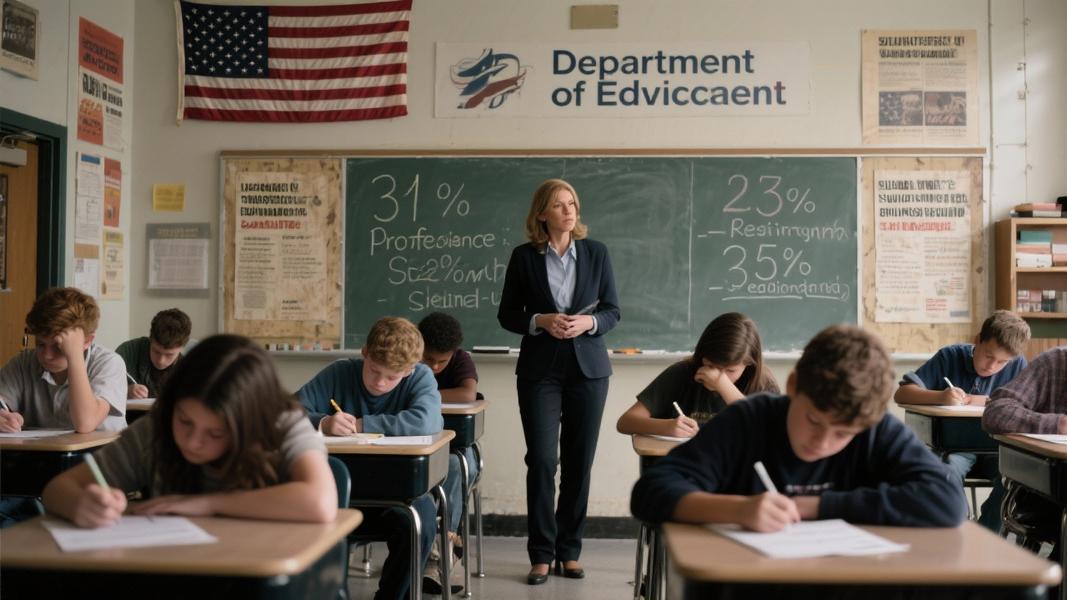
Just 31% of eighth graders demonstrated proficiency in science, while a mere 22% of high school seniors showed competency in mathematics — the lowest score since the current assessment format began, according to federal data. Perhaps most troubling, only 35% of graduating seniors are proficient in reading, marking the lowest score on record.
Decades of Spending, Little Progress
How did we get here? The troubling results come despite massive increases in education spending over decades. Since 1979, the U.S. Department of Education has poured over $3 trillion into American schools, with per-pupil spending jumping by more than 245%. Yet standardized test scores have remained stubbornly flat, with American students ranking near the bottom compared to other developed nations in critical subjects like mathematics, according to budget history from the Department of Education.
“These 2024 results clearly show that students are not where they need to be or where we want them to be,” said Peggy Carr, commissioner of the National Center for Education Statistics, in a briefing with journalists. Education experts have widely characterized the results as “dismal,” noting that reading and math skills among fourth and eighth graders remain significantly below pre-pandemic levels, as reported by The Hechinger Report.
The pandemic’s impact can’t be overlooked, but the assessment shows problems run deeper. Fourth grade reading scores dropped 2 points since 2022 and a more concerning 5 points compared to 2019 pre-pandemic levels. The decline appears across nearly all performance levels except for students in the 90th percentile, suggesting that struggling readers are falling even further behind, according to NAEP findings.
Widening Achievement Gaps
Perhaps most concerning is the growing chasm between high and low performers. On the NAEP’s 500-point scale, the lowest-performing students score approximately 100 points below their highest-performing peers. While higher-performing students drove most of the modest progress seen in 2024, lower-performing students continue to show troubling declines, widening achievement gaps that were already substantial, according to analysis from the National Assessment Governing Board.
But it’s not that simple. State-by-state comparisons reveal significant variations that can’t be explained by educational policy alone. When accounting for demographic differences like poverty rates, ethnicity, and other socioeconomic factors, some states perform better or worse than raw scores suggest.
“For nearly 10 years, the Urban Institute has published adjusted scores that capture how well students in each state score on the NAEP compared with demographically similar students around the country,” researchers explain. “These adjustments have important limitations, but come closer than the unadjusted scores to capturing the relative effectiveness of state policies.”
What remains clear across all metrics, however, is that despite trillions in spending and decades of reform efforts, American students are struggling more than ever to master basic academic skills. The question now facing educators, policymakers, and parents is not just how to recover from pandemic learning loss, but how to address the systemic issues that have left American education stagnant despite unprecedented financial investment.
