
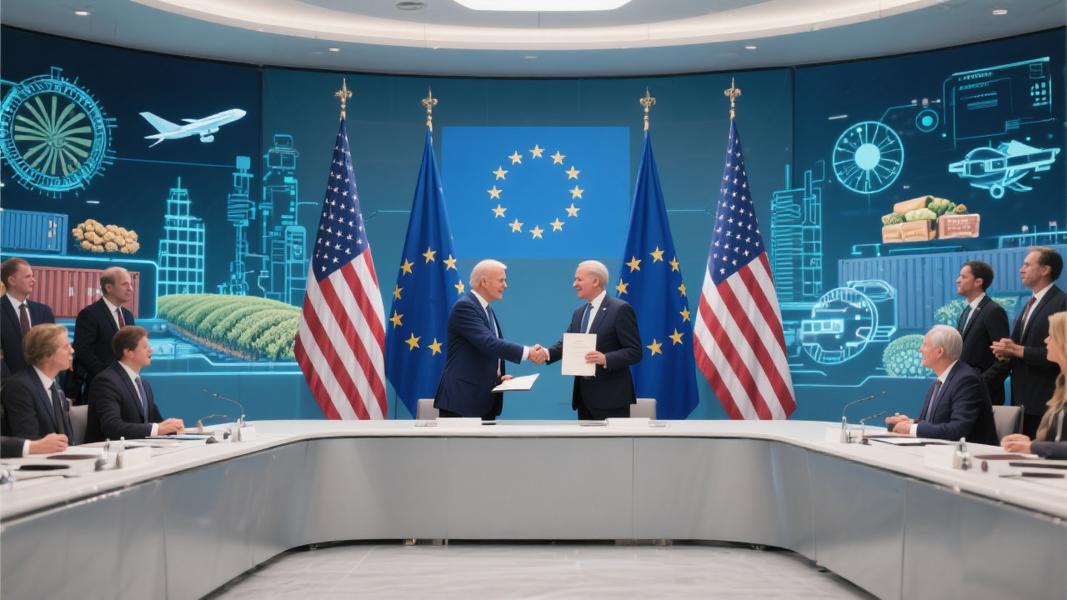
The United States and European Union have struck a landmark trade deal that dramatically reshapes the transatlantic economic relationship, setting new rules for everything from tariffs to technology while narrowly avoiding what could have been a punishing trade war between the world’s largest economic powers.
The Framework Agreement on Reciprocal, Fair and Balanced Trade, announced by the White House, establishes a standard 15% tariff on most EU exports to the U.S. — significantly lower than the threatened 30% tariff that was set to take effect on August 1. In exchange, the EU has committed to eliminate tariffs on all U.S. industrial goods while opening markets for American agricultural products, from dairy to tree nuts.
A High-Stakes Deal for a $1.7 Trillion Relationship
The agreement covers the world’s largest bilateral trade relationship, affecting more than $1.7 trillion in annual trade flows and trillions more in cross-border investment. “This Framework Agreement represents a concrete demonstration of our commitment to fair, balanced, and mutually beneficial trade and investment,” stated the joint announcement.
Just how big is this deal? Beyond tariff adjustments, the agreement encompasses massive EU commitments to purchase American energy and technology products, including $750 billion in U.S. liquified natural gas, oil, and nuclear energy through 2028, plus at least $40 billion in American AI chips for European computing centers.
European companies are expected to invest an additional $600 billion across strategic sectors in the United States through 2028, building on mutual investment stocks that already exceed $5 trillion.
Tariff Structure: The 15% Solution
The core of the agreement establishes that the U.S. will apply either the higher of its Most Favored Nation (MFN) tariff rate or a 15% tariff on most EU goods. That’s a significant increase from the average 4.8% that European goods faced previously, but far less than the 30% blanket tariff that had been threatened.
Some sectors received special treatment. Starting September 1, 2025, the U.S. will apply only MFN tariffs (not the 15% minimum) to several critical categories: “unavailable natural resources (including cork), all aircraft and aircraft parts, generic pharmaceuticals and their ingredients and chemical precursors,” according to the White House document.
For goods already subject to Section 232 national security tariffs, the U.S. has committed to cap rates on EU pharmaceuticals, semiconductors, and lumber at 15%. Additionally, automobile tariffs will be reduced once the EU enacts its proposed tariff reductions.
European Concessions: Agriculture, Energy and Defense
What did Europe give up to avoid the 30% tariffs? Quite a lot, according to trade experts.
The European Union has committed to eliminate tariffs on all U.S. industrial goods and provide preferential market access for a wide range of American agricultural products — a sector where European protectionism has historically been fierce. The agreement specifically mentions improved access for “tree nuts, dairy products, fresh and processed fruits and vegetables, processed foods, planting seeds, soybean oil, and pork and bison meat,” along with extending tariff agreements on lobster, including processed lobster.
Perhaps most striking is the EU’s commitment to purchase massive amounts of American energy and technology products. The $750 billion pledge for U.S. energy products through 2028 represents a significant deepening of transatlantic energy dependence at a time when Europe has been working to diversify its supplies.
Is there a defense component? Absolutely. “The European Union plans to substantially increase procurement of military and defense equipment from the United States, with the support and facilitation of the U.S. government,” the agreement states, underscoring a shared goal of strengthening NATO interoperability.
Beyond Tariffs: Addressing Non-Tariff Barriers
The agreement goes well beyond traditional tariff reductions to address some of the most persistent irritants in transatlantic trade.
Both sides have committed to reducing non-tariff barriers, including mutual recognition of automobile standards and enhanced technical cooperation. “The United States and the European Union intend to accept and provide mutual recognition to each other’s standards,” the agreement notes.
For food and agricultural trade, the EU has committed to streamlining sanitary certificate requirements for U.S. pork and dairy products — longstanding barriers to American agricultural exports.
The EU has also pledged to address U.S. concerns about several contentious regulatory initiatives, including the EU Deforestation Regulation, to avoid “undue impact on U.S.-EU trade.” Similar commitments apply to the Carbon Border Adjustment Mechanism (CBAM), the Corporate Sustainability Due Diligence Directive (CSDDD), and the Corporate Sustainability Reporting Directive (CSRD) — all EU environmental and sustainability regulations that American businesses have criticized as trade barriers.
Digital Trade and Technology Cooperation
The agreement contains several significant provisions on digital trade. The EU has confirmed it will not adopt or maintain network usage fees, and both sides will maintain zero customs duties on electronic transmissions, supporting the WTO multilateral moratorium.
U.S. conformity assessment bodies can be designated as Notified Bodies under EU telecommunications standards, and the parties have committed to negotiate a mutual recognition agreement on cybersecurity.
Both sides also agreed to strengthen economic security alignment by enhancing supply chain resilience and innovation, addressing non-market policies from third countries, and cooperating on investment reviews, export controls, and duty evasion.
Critics and Unanswered Questions
Despite the comprehensive nature of the agreement, significant details remain to be worked out.
The U.S. and EU still need to negotiate rules of origin “that ensure that the benefits of the Agreement on Reciprocal Trade accrue predominately to the United States and the European Union,” according to the joint statement. This is designed to prevent “third-country free-riding” — particularly from China.
Some trade analysts have questioned whether the deal disproportionately benefits the United States. The 15% tariff on most EU goods represents a significant increase from previous levels, while the EU’s elimination of industrial tariffs largely maintains the
