
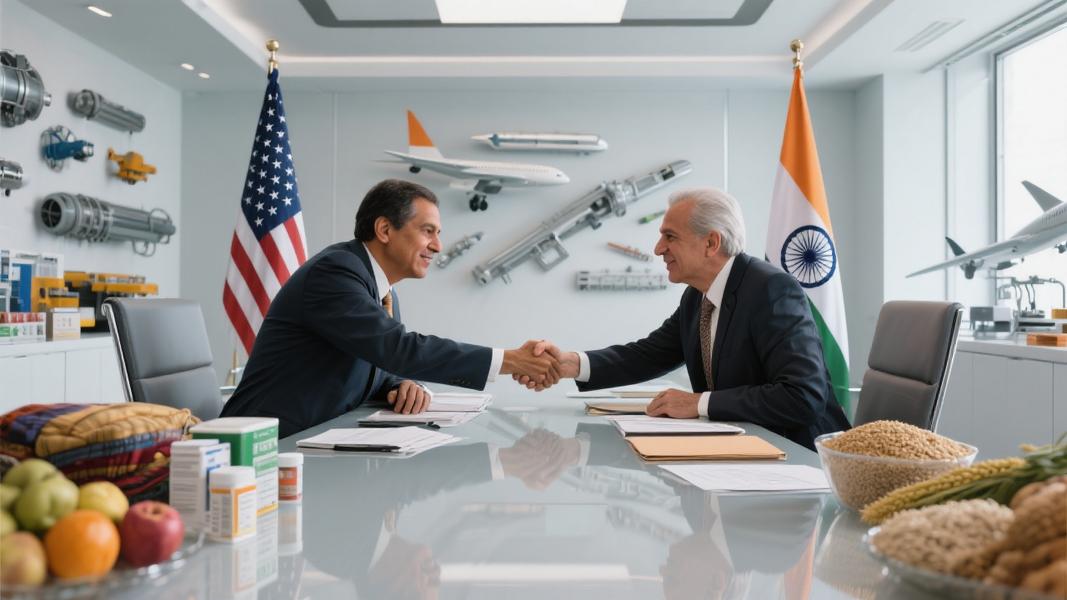
The United States and India have struck a historic trade agreement that slashes tariffs and aims to boost bilateral commerce by hundreds of billions of dollars, marking a significant shift in economic relations between the world’s two largest democracies.
The framework, announced Wednesday, reduces U.S. tariffs on Indian goods to 18% from a previous high of 50%, while India commits to eliminating or reducing tariffs on American industrial products and numerous agricultural exports. Most notably, India pledged to purchase $500 billion in U.S. products over the next five years — a massive procurement commitment that spans energy, aircraft, technology, and raw materials.
Breaking the Tariff Standoff
“Today’s framework reaffirms the countries’ commitment to broader U.S.-India Bilateral Trade Agreement negotiations,” the joint statement declared, referring to talks launched by President Trump and Prime Minister Modi in February. The interim deal represents what both sides characterize as “a historic milestone” in the partnership between Washington and New Delhi.
For American exporters, the agreement offers significant relief. India will cut tariffs on industrial goods to zero from the previous 13.5%, while also reducing barriers on several agricultural products including dried distillers’ grains, tree nuts, fresh fruit, soybean oil, and wine and spirits. Notably, India has maintained protections for sensitive sectors like dairy, reflecting the political realities Modi faces at home.
The U.S. side, meanwhile, will apply an 18% reciprocal tariff on Indian goods — down from 25% — affecting categories like textiles, leather goods, organic chemicals, and certain machinery. Washington will also remove tariffs on certain Indian aircraft and aircraft parts, while providing preferential treatment for automotive components.
Beyond the Border: Tackling Non-Tariff Barriers
But tariffs are only part of the story. What’s the real game-changer? The agreement tackles long-standing non-tariff barriers that American companies have complained about for years.
India has committed to addressing obstacles that have frustrated U.S. medical device manufacturers and eliminating restrictive import licensing procedures that have effectively limited access for American technology products. Within six months, India will determine whether U.S.-developed or international standards are acceptable for products entering the Indian market — a potential breakthrough for American exporters who have long struggled with India’s unique regulatory requirements.
“This agreement represents a significant step toward more balanced trade between our nations,” said U.S. Trade Representative Katherine Tai in a statement. “We’re not just reducing tariffs — we’re systematically addressing the structural barriers that have limited American exports to India for decades.”
The $500 Billion Promise
Perhaps most eye-catching is India’s commitment to purchase $500 billion worth of American goods over five years, including energy products, aircraft, precious metals, and technology. This procurement target — averaging $100 billion annually — would represent a dramatic increase from current trade levels.
Technology cooperation receives special emphasis, with both countries agreeing to “significantly increase trade in technology products, including Graphics Processing Units (GPUs) and other goods used in data centers,” according to the joint statement.
Trade experts view this procurement commitment as ambitious but achievable. “It’s a stretch goal, but not impossible,” said Mukesh Aghi, president of the U.S.-India Strategic Partnership Forum, in an interview. “India’s growing economy and infrastructure needs align perfectly with American export strengths in energy, aviation, and technology.”
Digital Trade and Economic Security
The agreement also sets “a clear pathway” for digital trade rules, an area where the two countries have historically diverged. Both nations commit to addressing “discriminatory or burdensome practices” affecting digital commerce, though specific details remain to be worked out in future negotiations.
Economic security features prominently, with commitments to enhance supply chain resilience and align approaches to “address non-market policies of third parties” — diplomatic language that likely refers to China without naming it directly. The countries also plan to coordinate on investment reviews and export controls, suggesting deeper strategic alignment beyond mere commercial interests.
That said, challenges remain. The agreement is still a framework, with many details to be finalized in coming months. Implementation timelines remain vague, and the ambitious procurement targets will require sustained political will on both sides.
Balancing Act
For India, the agreement represents a careful balancing act. While making significant concessions on tariffs and regulatory barriers, Modi’s government has preserved protection for politically sensitive sectors like dairy and agriculture. The procurement commitment, meanwhile, gives India leverage to demand continued tariff reductions in future negotiations.
The deal includes a safeguard clause allowing either country to modify its commitments if the other changes agreed-upon tariffs — a provision that could prove important if domestic political pressures mount on either side.
“This is a win-win that addresses core concerns on both sides,” said Nisha Biswal, president of the U.S.-India Business Council at the U.S. Chamber of Commerce. “It creates immediate commercial opportunities while establishing a framework for tackling more complex issues in the broader bilateral trade agreement.”
As negotiators work to finalize the interim agreement and move toward a comprehensive bilateral trade pact, one thing is clear: the economic relationship between these democratic giants is entering a new phase — one that could reshape not just bilateral commerce, but global supply chains and strategic alignments for decades to come.
