
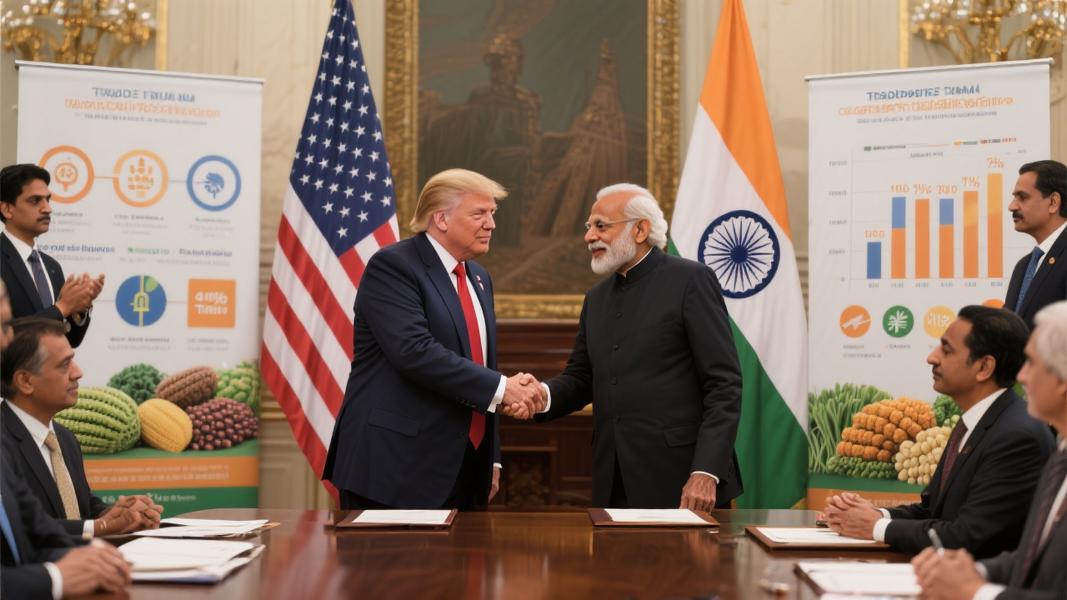
The United States and India have reached a landmark trade agreement that slashes tariffs and promises a massive $500 billion in Indian purchases of American goods, the White House announced yesterday, marking a significant shift in economic relations between the world’s largest democracies.
A Deal Years in the Making
President Trump and Prime Minister Narendra Modi jointly unveiled the framework for an Interim Agreement on February 2, setting the stage for a broader U.S.-India Bilateral Trade Agreement that was formally launched earlier this month. Under the deal, the United States will lower its reciprocal tariff rate on Indian goods from 25% to 18%, while India has committed to eliminating or reducing tariffs on a wide range of American products.
“This framework reflects the growing depth, trust and dynamism of our partnership,” Modi said on social media, adding it will “further deepen investment and technology partnerships between us.”
Perhaps most notably, the agreement includes India’s intention to purchase $500 billion of U.S. goods over the next five years — spanning energy products, aircraft and aircraft parts, technology products, precious metals, and coking coal, according to a White House statement.
The Russian Oil Question
A key sticking point in the negotiations? Russian oil. President Trump has agreed to remove an additional 25% tariff on Indian imports after India reportedly committed to stop purchasing oil from the Russian Federation. Trump signed an Executive Order to that effect, though the exact terms of this commitment remain somewhat murky.
Independent analysts have noted that while President Trump’s announcement emphasized India’s commitment to cease Russian oil purchases, Prime Minister Modi’s statements have been notably silent on this point. Sources familiar with the discussions suggest the agreement may include monitoring mechanisms rather than an immediate complete cessation, with potential flexibility for India to resume purchases after the current conflict ends.
Agricultural Wins for American Farmers
American agricultural producers stand to benefit significantly from the deal. India has agreed to eliminate or reduce tariffs on a broad spectrum of U.S. food and agricultural products, including dried distillers’ grains, red sorghum, tree nuts, fresh and processed fruit, certain pulses, soybean oil, and wine and spirits, according to White House documents.
What’s driving this sudden breakthrough in trade relations? Analysts point to a combination of factors, including growing concerns about China’s economic influence in the region and India’s desire to strengthen ties with Western economies as it continues its rapid development.
The agreement represents a significant shift from the more confrontational trade stance the U.S. had previously taken with India. Just last year, the U.S. had imposed a 25% tariff on Indian goods under Executive Order 14257, citing trade imbalances and national security concerns.
Questions Remain
Despite the fanfare, some details of the agreement remain vague or contested. While President Trump has claimed India is committing to invest $500 billion in the U.S., zeroing out trade barriers, and stopping Russian oil purchases, Prime Minister Modi has been more circumspect in his public statements, focusing instead on the broader framework and future cooperation.
Indian officials have primarily confirmed only the reduction in the U.S. reciprocal tariff rate from 25% to 18%, suggesting that some aspects of the deal may still be under negotiation or subject to different interpretations by the two sides.
The agreement comes at a critical time for both nations. For India, it represents an opportunity to further integrate with global supply chains and secure access to American technology and investment. For the United States, the deal offers expanded market access in one of the world’s fastest-growing major economies while potentially reducing India’s economic ties with Russia.
Whether this interim framework truly delivers on its lofty promises remains to be seen, but it undoubtedly marks a significant milestone in the evolving economic relationship between Washington and New Delhi.
