
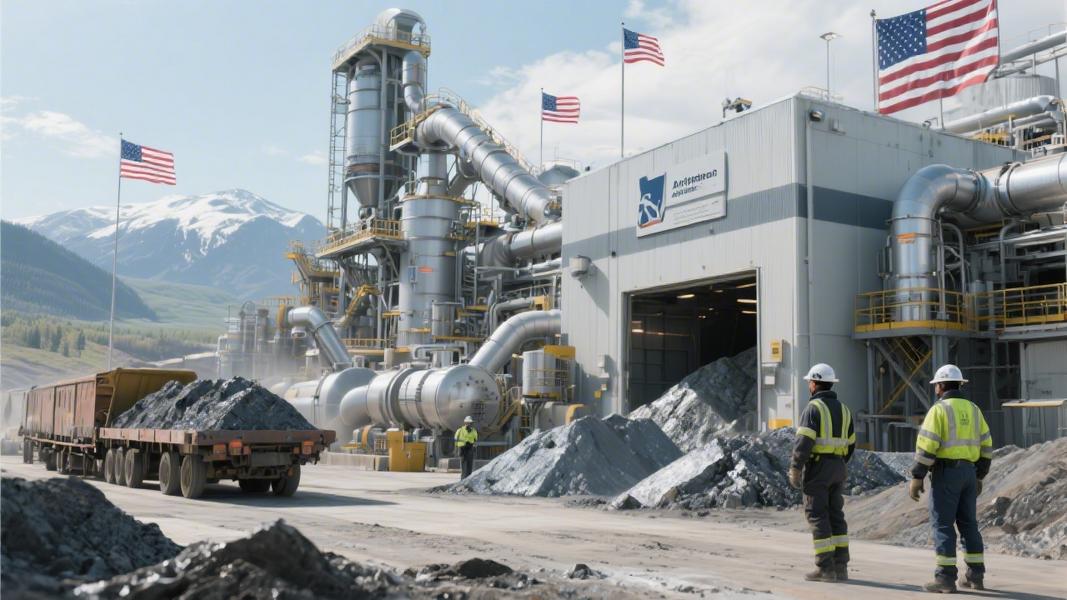
The United States is writing big checks to make sure it never has to ask China for antimony again. And given what’s at stake — munitions, flame retardants, military-grade batteries — that urgency isn’t hard to understand.
The Department of War announced a $27 million investment through Defense Production Act Title III funds directed at U.S. Antimony Corporation, backing domestic extraction, processing, and refinement of one of the Pentagon’s most strategically sensitive minerals. The funds, drawn from the Additional Ukraine Supplemental Appropriations Act of 2022 and delayed briefly by a government shutdown, represent a pointed effort to pull critical mineral supply chains back onto American soil.
A Supply Chain Problem Years in the Making
“For too long, DOW has depended on overseas sources for its critical mineral production,” said Assistant Secretary of War for Industrial Base Policy Mike Cadenazzi. “This investment will address risk in one of our most critical munitions and materials supply chains.” It’s the kind of statement that sounds like boilerplate — until you look at the numbers behind it.
China’s decision to cut off antimony exports didn’t just rattle commodity traders. It exposed a genuine vulnerability in the defense industrial base, one that U.S. Antimony Corporation — traded on markets as UAMY — has been quietly positioning itself to fill. The company secured a staggering $245 million contract with the Defense Logistics Agency after Beijing’s export restrictions took effect, and officials have noted plainly that UAMY was, at that point, described as “the only company qualified to bid on this contract.”
That’s not a competitive marketplace. That’s a single point of failure — dressed up as a solution.
Montana, Alaska, and the Push for Vertical Integration
The new DOW investment targets two geographic fronts. In Thompson Falls, Montana, the funding will modernize USAC’s existing refinery capacity — new furnaces came online there in January 2026 — scaling production from roughly 100 tons per month toward 500 tons per month. Meanwhile, excavation operations are being established in Alaska to give the company a vertically integrated supply chain, from raw ore in the ground to refined material ready for defense applications.
Over 250 tons of stibnite ore have already been hauled to a flotation mill, and the company has staked 102 federal claims as it races to expand its footprint. UAMY raised its FY2026 revenue guidance by $25 million, bringing the full-year target to $125 million. Its Mexican facility is also being pushed to 200 tons per month. The company is moving fast — because it has to.
“Strong domestic mineral supply chains are essential to support our warfighting capability,” said Jeffrey Frankston, Acting Deputy Assistant Secretary of War for Industrial Base Resilience. It’s a sentiment echoed across the department, but what makes this moment different is the money actually following the words.
Part of a Broader, Accelerating Push
The USAC award isn’t a one-off. It’s one of three investments made by the DPA Purchases Office since fiscal year 2026 began, collectively totaling $58.5 million — all overseen by the MCEIP Directorate. A separate $11.8 million investment went to Umicore Optical Materials USA for critical materials processing in Oklahoma, also delayed by the shutdown and aligned with Executive Order 14241, which the department outlined in a parallel release.
And USAC isn’t the only antimony play in town — at least not for long. The U.S. government also awarded Perpetua Resources $80 million in federal funding to develop the Stibnite mine in Idaho, a project that could eventually provide a second domestic source of the mineral. Officials have pointed to the Stibnite project as a cornerstone of long-term critical minerals self-sufficiency.
Why Antimony, and Why Now
Still, it’s worth asking: why does antimony matter so much? The element turns up in an almost unsettling range of defense-critical applications — armor-piercing ammunition, night-vision equipment, flame retardants in military vehicles, and advanced battery systems. It’s not glamorous. It doesn’t generate headlines the way rare earth elements do. But its absence from a supply chain can quietly hollow out a military’s readiness in ways that only become obvious in a crisis.
China understood that. The export cutoff was a message, and Washington appears to have received it.
Whether these investments — spread across Montana, Alaska, Idaho, and Oklahoma — add up to genuine strategic independence or simply a more expensive version of dependency is a question that won’t be answered in a press release. But for now, at least, the checks are being written. And in Washington, that’s usually where the story starts.
