
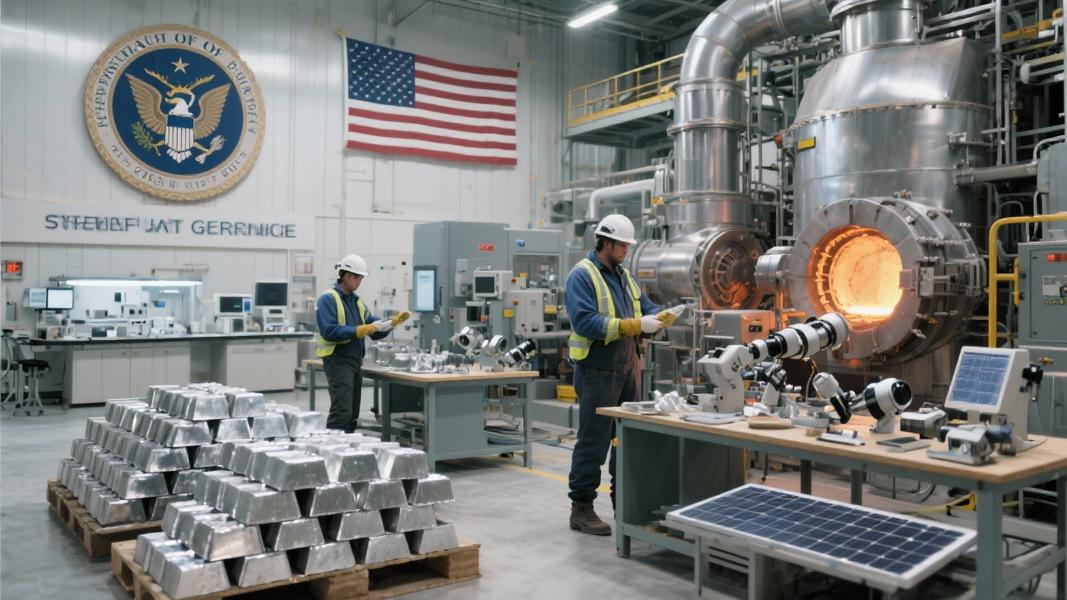
The U.S. Department of War is making a significant push to secure the nation’s supply of germanium, a critical mineral essential for military optics and surveillance systems, with a fresh $18.1 million investment in 5N Plus Inc.’s Utah facility announced on December 15, 2025.
The investment, made through Defense Production Act Title III funds, aims to dramatically expand the company’s germanium metal refining capacity at their St. George location — boosting production sevenfold to more than 20 metric tons annually. It’s part of a broader strategy to reduce U.S. dependence on foreign adversaries for materials deemed critical to national security.
“Our warfighters depend on next generation optics for surveillance, reconnaissance, and targeting, and germanium is a key element in their manufacture,” said Assistant Secretary of War for Industrial Base Policy Mike Cadenazzi in a statement.
Strategic Mineral Push
The 5N Plus expansion represents just one piece of a larger military effort to secure domestic supplies of germanium. In September 2025, the Department also invested $18.5 million in Lattice Materials to increase capacity for optical-grade germanium and silicon crystals while developing capabilities to produce germanium metal from recycled materials.
“Optics are a pacing item for major weapons platforms across all the military Services,” noted Jeffrey Frankston, Acting Deputy Assistant Secretary of War for Industrial Base Resilience, who explained that the investment addresses “a capability bottleneck that affects some of our most critical weapons platforms across all the military Services.”
Why such urgency around a relatively obscure element? Germanium plays a crucial role in infrared optics, night vision systems, targeting equipment, and satellite technology — all considered vital to modern military operations. The semiconductor material is also used in high-efficiency solar cells for spacecraft and military applications.
Breaking Dependency
Perhaps the most ambitious project in the works is a $6.6 billion partnership with Korea Zinc to build a massive critical minerals smelter in Tennessee. The facility, scheduled to begin operations in 2029, is expected to produce approximately 44 tons of germanium annually — more than doubling current U.S. production capacity.
“President Trump has directed his Administration to prioritize critical minerals as essential to America’s defense and economic security,” said Deputy Secretary of War Steve Feinberg regarding the Korea Zinc partnership.
The push for domestic germanium production comes amid heightened concerns about China’s dominance in critical mineral supply chains. The FY26 National Defense Authorization Act explicitly prohibits acquisition of critical minerals — including germanium — from China and other adversary nations.
That legislative move aligns with a January 2026 directive from the White House adjusting imports of processed critical minerals, which identified germanium as essential to equipment including fighter aircraft, munitions, and satellite systems.
Industrial Strategy
The flurry of investments reflects a strategic shift in how the U.S. approaches critical mineral supply chains. After decades of offshoring production of many specialized materials, the Department of War now appears committed to rebuilding domestic capacity for minerals deemed essential to national security.
According to industry analysts, the Korea Zinc smelter’s germanium production will be phased in gradually after the primary zinc circuit reaches full capacity around 2029 — indicating that full independence from foreign suppliers remains years away.
Still, the combined impact of these investments could fundamentally alter the global germanium market. With both the 5N Plus expansion and the Lattice Materials contract focused on refining and processing capabilities, the U.S. is systematically addressing weak points in its supply chain.
For military planners, the stakes couldn’t be higher. As advanced surveillance and targeting systems become increasingly central to modern warfare, secure access to the materials that make those systems possible has become a national security imperative — one the Department of War is addressing with unprecedented financial commitments to domestic production.
