
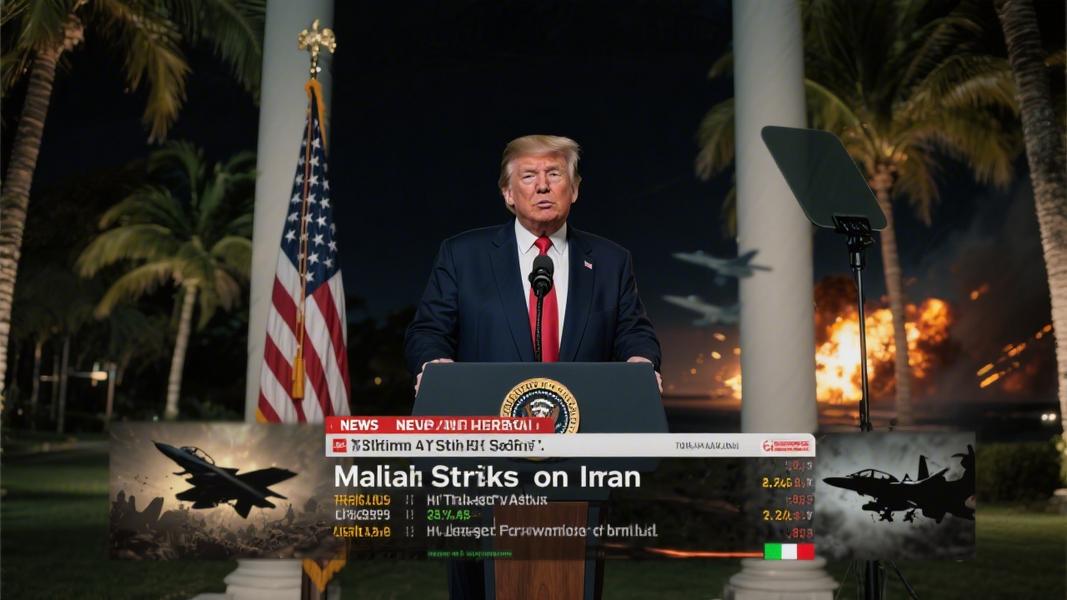
The United States and Israel struck Iran on Saturday, February 28, 2026 — and the Middle East may never look the same again. In a sweeping, coordinated assault spanning multiple Iranian cities, the two allies launched what could be one of the most consequential military operations in decades.
Codenamed “Operation Epic Fury” by Washington and “Operation Roaring Lion” by Jerusalem, the joint strikes hit targets across Tehran, Isfahan, Qom, Karaj, and Kermanshah, according to reports. The campaign was built around three stated goals: dismantling Iran’s missile and military infrastructure, cutting off any path to a nuclear weapon, and — perhaps most audaciously — toppling the Islamic Republic’s ruling regime itself.
Trump Makes It Personal
President Donald Trump didn’t mince words. He announced the strikes alongside Israeli leadership, framing the operation in sweeping terms — describing it as “undertaking a massive and ongoing operation to prevent this very wicked, radical dictatorship from threatening America and our core national security interests.” He also called on members of the Islamic Revolutionary Guard Corps to lay down their arms, promising immunity to those who complied. Whether that offer lands with any traction inside Iran remains, at best, an open question.
This didn’t come out of nowhere. For months, the Trump administration had been ratcheting up pressure on Tehran — demanding an end to uranium enrichment, sharp limits on ballistic missile programs, and a full halt to Iran’s support of regional proxy forces. Diplomacy, it turns out, wasn’t going anywhere fast. Talks over a new nuclear deal collapsed, and Washington apparently decided it had run out of patience.
The Military Buildup Nobody Could Miss
The buildup was anything but subtle. The U.S. had deployed a formidable naval armada to the region ahead of the strikes — including the USS Abraham Lincoln and the USS Gerald R. Ford, flanked by guided-missile destroyers. That’s two carrier strike groups, positioned squarely within reach of Iranian territory. Military analysts watching the region said it was one of the largest U.S. naval concentrations in the Persian Gulf in years.
Still, February 28th wasn’t the first time American firepower had touched Iranian soil in this conflict. Earlier, in June, the U.S. had already conducted airstrikes on Iran’s nuclear facilities at Fordo, Natanz, and Isfahan — deploying B-2 stealth bombers and submarine-launched missiles in what was, at the time, an extraordinary escalation. The February operation was broader, deeper, and unmistakably coordinated with Israeli forces in a way the earlier strikes were described as not being.
What Comes Next?
That’s the question hanging over everything right now. Iran’s government has long promised devastating retaliation for any attack on its soil — and it’s worth remembering that Tehran has spent years cultivating a network of armed proxies across Lebanon, Iraq, Syria, and Yemen precisely for moments like this. Whether those forces respond, and how quickly, will shape the next chapter of this crisis in ways no one can fully predict.
The regime-change language from Trump is particularly loaded. Calling for IRGC fighters to defect is one thing. Actually engineering a collapse of a government that has survived four decades of sanctions, internal unrest, and regional war is something else entirely. That’s the catch — and history has a way of humbling those who underestimate it.
For now, the bombs have fallen. The alliance between Washington and Jerusalem has been tested and, at least operationally, held. But the real measure of Operation Epic Fury won’t be counted in sorties or bomb craters — it’ll be counted in what rises, or doesn’t, from the smoke.
