
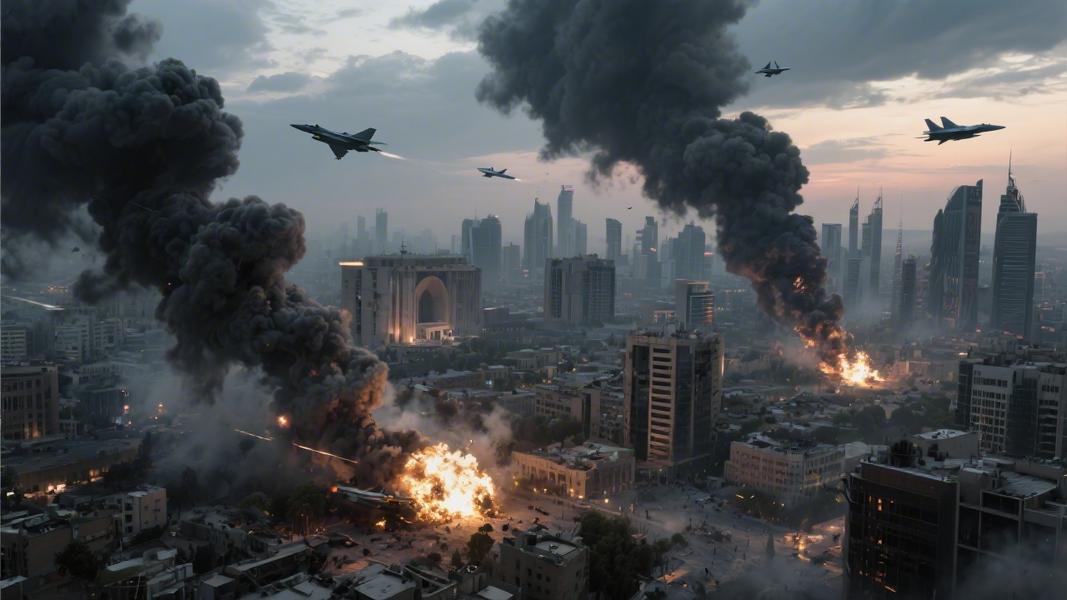
The United States and Israel launched a sweeping joint military operation against Iran on Saturday, striking nuclear facilities, killing top government officials — including Supreme Leader Ali Khamenei — and igniting what could become the most consequential military confrontation in the Middle East in decades.
Dubbed Operation Epic Fury by the United States and Operation Roaring Lion by Israel, the strikes began in the early hours of February 28, 2026, hitting a broad range of targets: Iranian nuclear facilities, ballistic missile stockpiles, naval assets, governmental buildings, and the leadership infrastructure of the regime itself. President Donald Trump authorized the operation, the White House confirmed, following what officials described as a prolonged failure of diplomatic options to halt Iran’s nuclear ambitions.
Trump Addresses the Nation
Speaking in the early morning hours, Trump did not mince words. “A short time ago, the United States military began major combat operations in Iran,” he stated. “Our objective is to defend the American people by eliminating eminent threats.” He indicated the strikes could continue through the week — a signal that this was no one-night show of force.
The scope of the operation is staggering. According to a CSIS analysis, the campaign targeted not just Iran’s nuclear program but the full architecture of its regional power: military commanders, proxy terror networks stretching across the Middle East, and the country’s navy. The stated goals include preventing Tehran from ever acquiring a nuclear weapon — and, more bluntly, achieving regime change.
American Blood on the Ground
It hasn’t come without cost. Three U.S. service members are dead. Five others were seriously wounded, with several more sustaining minor injuries, the U.S. Naval Institute noted. The fallen soldiers were Army personnel stationed in Kuwait, deployed there in a logistics capacity — a grim reminder that “support roles” can still put Americans in the line of fire.
KOMO News identified the casualties as part of the broader Army presence in the region that had been quietly reinforced in the weeks leading up to Saturday’s strikes. Their names have not yet been publicly released pending notification of next of kin.
Khamenei Dead, Iran Retaliates
The killing of Supreme Leader Ali Khamenei — confirmed as part of the operation’s opening wave — represents an extraordinary escalation. It’s not hyperbole to say this is the most dramatic targeted killing of a sitting head of state in modern American military history. Iran’s government has not yet confirmed the death publicly, but multiple sources cited by Wikipedia’s live conflict entry corroborate it.
Tehran didn’t wait long to respond. Iran launched retaliatory strikes on U.S. allies in the region, with Israel absorbing a wave of incoming fire, as documented in early footage from the region. The scale of those counterstrikes is still being assessed. That said, Israeli defense systems were on high alert, and the country’s military had clearly anticipated a response.
How bad could the blowback get? That’s the question every analyst in Washington is wrestling with tonight. Iran’s proxy networks — Hezbollah, the Houthis, various Iraqi militias — remain largely intact, or at least functional enough to complicate whatever comes next. The operation targeted those networks, but degrading them and dismantling them are two very different things, as the last two decades of Middle East policy have made painfully clear.
The Wider Stakes
Trump’s team has framed all of this under the banner of “peace through strength” — the White House’s language, not a paraphrase. The argument is that years of sanctions, negotiations, and half-measures failed to stop Iran’s nuclear march, and that only direct military action could close that window permanently. Critics, predictably, are arguing the opposite — that this risks opening a far larger and less controllable conflict across an already volatile region.
Still, the administration’s resolve appears firm, at least for now. Calls for the Iranian government to be overthrown — which emerged in early statements from both U.S. and Israeli officials — suggest this operation was never purely surgical. It was, from the start, an attempt to fundamentally reshape the Iranian state, as one early broadcast from the region made clear.
Three soldiers came home in flag-draped coffins before most of America had finished its morning coffee. Whatever history ultimately makes of Operation Epic Fury — liberation, overreach, or something in between — that part is already written.
